Description
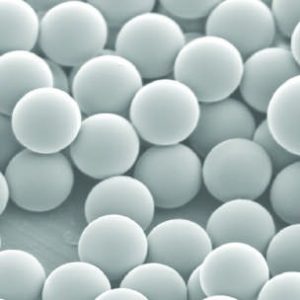
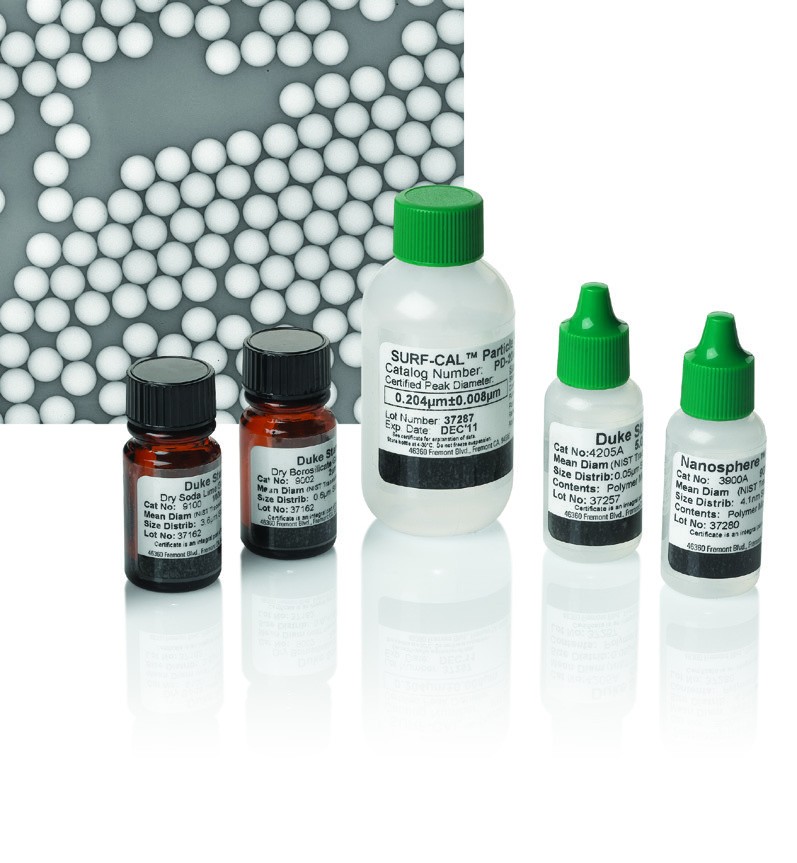
The Glass Size Standards are highly uniform borosilicate or soda lime glass spheres calibrated with NIST-traceable methodology. Standards are ideal for the calibration of microscopes, light scattering instruments and other particle-measuring equipment. They are also used in laser light scattering studies and colloidal systems research.
- Mean diameters have been calibrated with Applied Physics’s NIST™-traceable microscopy methods
- Size distribution and uniformity are measured by optical microscopy
- Spheres are used instead of irregularly shaped particles to minimize the response of analytical systems to shape effects
- Products are packaged as dry spheres
- Packages are lot-numbered for convenient technical service and support after the sale
- 9000 Series products from 2μm to 20μm are made from borosilicate glass, have a particle density of 2.5 to 2.55g/cm3 and an index of refraction of 1.56 at 589nm (25°C)
- Products from 30μm to 2000μm are made from soda lime glass, have a particle density of 2.4 to 2.5g/cm3 and an index of refraction of 1.51 at 589nm (25°C)
Includes: Certificate of Calibration and Traceability to NIST™, including description of the calibration method and its uncertainty, table of chemical and physical properties, and Material Safety Data Sheet with handling and disposal instructions. Recommended for: Spacer applications where uniform bond thickness is a necessity. Note: Applied Physics has its own engineering, production and metrology facilities for better quality control and response to customer needs. In addition to this line of polymer size standards, we also offer calibration standards in silica and glass materials. Ask our technical service department for information about specific applications or other product needs not listed here.
| Part# | Nom Size | Size Peak | Uniformity, Subject to Change Each New Batch | Solids | Dry Sphere Volume | $ Retail |
| AP-9002 | 5μm | 5μm | <20% | 10% | 1 Gram | |
| AP-9005 | 8μm | 8μm | <20% | 10% | 1 Gram | |
| AP-9008 | 15μm | 15μm | <20% | 10% | 1 Gram | |
| AP-9010 | 20μm | 20μm | <20% | 10% | 1 Gram | |
| AP-9015 | 30μm | 30μm | <20% | 10% | 1 Gram | |
| AP-9020 | 40μm | 40μm | <20% | 10% | 1 Gram | |
| AP-9030 | 50μm | 50μm | <20% | 10% | 1 Gram | |
| AP-9040 | 60μm | 60μm | <20% | 10% | 1 Gram | |
| AP-9050 | 70μm | 70μm | <20% | 10% | 1 Gram | |
| AP-9060 | 80μm | 80μm | <20% | 10% | 1 Gram | |
| AP-9070 | 90μm | 90μm | <20% | 10% | 1 Gram | |
| AP-9080 | 100μm | 100μm | <20% | 10% | 1 Gram | |
| AP-9090 | 110μm | 110μm | <20% | 10% | 1 Gram | |
| AP-9100 | 120μm | 120μm | <20% | 10% | 1 Gram | |
| AP-9110 | 130μm | 130μm | <20% | 10% | 1 Gram | |
| AP-9120 | 140μm | 140μm | <20% | 10% | 1 Gram | |
| AP-9140 | 170μm | 170μm | <20% | 10% | 1 Gram | |
| AP-9170 | 200μm | 200μm | <20% | 10% | 1 Gram | |
| AP-9200 | 230μm | 230μm | <20% | 10% | 1 Gram | |
| AP-9230 | 280μm | 280μm | <20% | 10% | 1 Gram | |
| AP-9280 | 330μm | 330μm | <20% | 10% | 1 Gram | |
| AP-9330 | 400μm | 400μm | <20% | 10% | 1 Gram | |
| AP-9400 | 480μm | 480μm | <20% | 10% | 1 Gram | |
| AP-9480 | 550μm | 550μm | <20% | 10% | 1 Gram | |
| AP-9550 | 650μm | 650μm | <20% | 10% | 1 Gram | |
| AP-9650 | 750μm | 750μm | <20% | 10% | 1 Gram | |
| AP-9950 | 950μm | 950μm | <20% | 10% | 1 Gram | |
| AP-91000 | 1000μm | 1000μm | <20% | 10% | 1 Gram | |
| AP-92000 | 2000μm | 2000μm | <20% | 10% | 1 Gram |
Glass particle standards should be matched to the measurement method
Specify the instrument/method, nominal size or range, sample preparation, quantity and certificate/documentation need.
Choose particle material from the method—not from the product name
| Material / family | Start here when the requirement is… | Quote variables |
|---|---|---|
| PSL / polystyrene latex | Monodisperse particle-size references, particle-counter/optical calibration, aerosol work, or deposited wafer references. | Instrument/application, nominal size(s), form/concentration, quantity, certificate/traceability. |
| Silica / SiO₂ | Silica reference behavior, contamination-wafer work, optical/material research, or functionalized silica formulations. | Size, surface treatment/functionalization, powder vs suspension, solvent/concentration, quantity. |
| Borosilicate / glass | Powder/particle-size measurement and methods where glass material properties and available size ranges are appropriate. | Method/instrument, nominal size/range, quantity, sample preparation and documentation. |
| Fluorescent / dyed polymer | Imaging, tracking, optical method development, method visibility or research requiring a colored/fluorescent signal. | Size, color/excitation-emission, surface chemistry, dry/suspension form, concentration/quantity. |
| Functionalized / assay particles | Conjugation, binding, lateral-flow, diagnostic or assay-development workflows. | Core material, size, functional group/coating, concentration, conjugation target and assay conditions. |
| Magnetic / metallic nanoparticles | Research workflows where magnetic response, plasmonic/optical properties or specialized surface chemistry are part of the method. | Composition, size, morphology, coating/functionalization, concentration and application. |
Make the glass-particle inquiry quote-ready
- Instrument, method or end application
- Particle material / composition
- Nominal size or multi-size set
- Dry powder, suspension, concentration or deposited format
- Measurement method and sample-preparation constraints
- Package size / quantity and needed date
- Certificate, traceability or other documentation requirement
Do not let the catalog make the engineering decision
Applied Physics has overlapping particle families and many individual size SKUs. The correct quote should be driven by the customer's method and required reference properties—not by whichever product title happens to rank first.
For an accurate quote: use the product quote control so the selected product, variation and quantity remain attached to your request.