
Description
Gold Nanospheres, PVP-Coated, Dried, 10 nm
Dried PVP-coated gold nanospheres combine the controlled morphology and optical response of colloidal gold with the handling and storage advantages of a lyophilized dry formulation.
The nanoparticles are stabilized with a neutral, hydrophilic polyvinylpyrrolidone (PVP) coating. The polymer shell helps prevent particle-to-particle fusion during dehydration, allowing the dried material to redisperse as individual nanoparticles after solvent addition.
The dry format supports flexible reconstitution into selected concentrations and solvents, including water, PBS, biological media, ethanol, methanol, and DMSO. After reconstitution, the 10 nm gold cores display an LSPR extinction peak near 518–522 nm, producing a ruby-red suspension with minimal optical scattering.
Key features
- Complete reconstitution: The PVP coating helps prevent irreversible fusion during drying and supports redispersion without extensive sonication.
- Flexible concentration control: Reconstitute into a selected volume to prepare dilute working solutions or concentrated suspensions.
- Solvent compatibility: Suitable for water, physiological buffers, biological media, ethanol, methanol, and DMSO.
- Improved transport stability: The dry format reduces freeze-thaw concerns during shipping and storage.
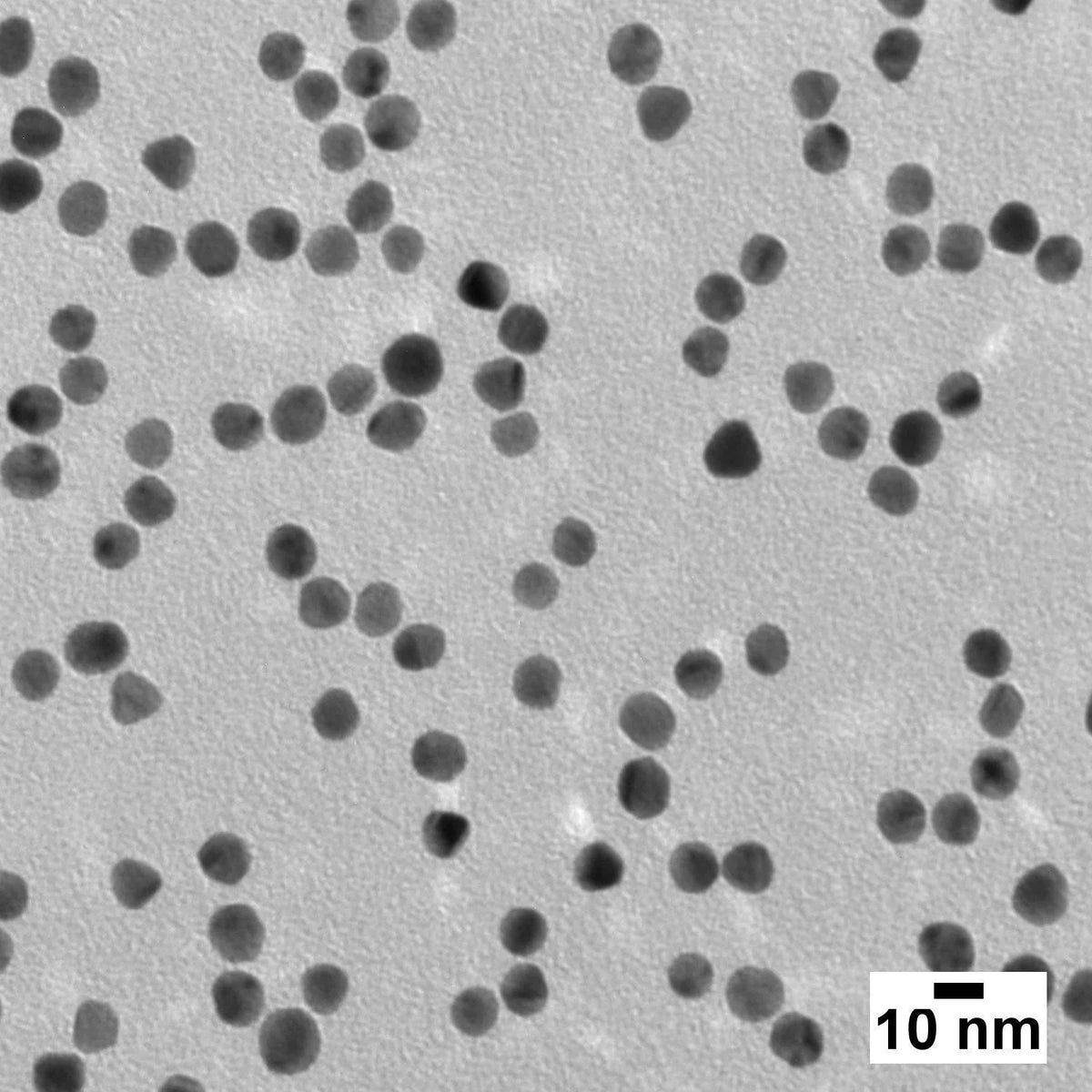
- Monodisperse core geometry: Uniform 10 nm spherical gold cores provide predictable surface area and diffusion behavior.
- Defined plasmonic response: The reconstituted material exhibits an LSPR maximum near 518–522 nm.
Specifications
| Parameter | Specification |
|---|---|
| Core material | Pure metallic gold, Au0 |
| Surface coating | Polyvinylpyrrolidone, PVP, approximately 40 kDa |
| Physical form | Lyophilized dry powder or dried cake |
| Nominal core diameter | 10 nm |
| Size distribution | CV≤15% |
| Reconstituted LSPR peak | Approximately 518–522 nm |
| Surface charge | Neutral to slightly negative |
| Particle morphology | Uniform, nonporous spheres |
| Compatible solvents | Water, PBS, biological media, ethanol, methanol, and DMSO |
| Available gold mass | 1, 5, 10, and 30 mg |
| Dry storage temperature | 2∘C to 25∘C |
| Dry storage condition | Sealed and desiccated |
| Shelf life | 24 months from receipt when unopened and stored dry |
Mass and packaging selection
| Part number | Nominal diameter | Gold mass | Form | Container |
|---|---|---|---|---|
| AP-AU-PVPD-10-1MG | 10 nm | 1 mg | Dry powder/cake | Low-binding glass vial |
| AP-AU-PVPD-10-5MG | 10 nm | 5 mg | Dry powder/cake | Low-binding glass vial |
| AP-AU-PVPD-10-10MG | 10 nm | 10 mg | Dry powder/cake | Low-binding glass vial |
| AP-AU-PVPD-10-30MG | 10 nm | 30 mg | Dry powder/cake | Low-binding glass vial |
Reconstitution guidelines
1. Calculate the diluent volume
Use the following relationship:
C=mV
where:
- C is the target concentration,
- m is the gold mass,
- V is the final reconstitution volume.
Examples for a 1 mg vial:
- For 1.0 mg/mL, add 1.0 mL of diluent.
- For 5.0 mg/mL, add 0.2 mL, or 200 µL, of diluent.
2. Select the solvent
Compatible reconstitution liquids include:
- Ultrapure deionized water, 18.2 MΩ⋅cm
- 1×PBS
- Cell-culture media
- Ethanol
- Methanol
- DMSO
Compatibility should be confirmed for the intended assay, especially when using high-salt buffers or organic solvents.
3. Add the diluent
Add the selected liquid directly to the dried cake inside the vial. Allow the vial to stand for 1 to 2 minutes to hydrate the PVP coating.
4. Mix gently
Swirl or gently vortex for 15 to 30 seconds until the dried material has dissolved and the suspension appears clear and uniformly ruby red.
If the suspension is prepared in a dense or viscous matrix, a brief, mild ultrasonic treatment of approximately 10 seconds may be used.
5. Store after reconstitution
Store reconstituted aqueous suspensions upright at 2∘C to 8∘C. Do not freeze reconstituted suspensions.
Applications
- High-concentration in vitro formulations: Prepare concentrated gold nanoparticle suspensions for cellular uptake studies and other laboratory assays without centrifuge concentration steps.
- In vivo formulation research: Prepare selected concentrations for microinjection or animal-dosing studies, subject to appropriate formulation and safety validation.
- Nonaqueous and sol-gel nanotechnology: Disperse the particles in ethanol, methanol, and polar polymer matrices for optical coatings, thin films, and nanocomposites.
- Nanotoxicology and environmental modeling: Study nanoparticle biodistribution and biological responses using a sterically stabilized material.
- Transmission electron microscopy: Use as uniform, electron-dense reference particles for biological specimen localization.
- Photothermal and laser-ablation research: Evaluate plasmonic absorbers in concentrated or high-salinity media.
Handling and storage
Before reconstitution
- Store in the original sealed container at 2∘C to 25∘C.
- Keep the material dry and protect it from light.
- Maintain the container with desiccant to reduce moisture uptake.
- Avoid opening the vial unnecessarily.
After reconstitution
- Store aqueous suspensions upright at 2∘C to 8∘C.
- Do not freeze. Freezing can disrupt the hydrated PVP layer and cause precipitation or aggregation.
- Gently swirl before sampling.
- Use sterile, disposable pipette tips when adding diluent or removing aliquots.
Product relationship
Available Through Applied Physics
Applied Physics supplies and supports quotation of this product. Product branding and manufacturer information, where stated on the product page or supporting documentation, remain authoritative.
Applied Physics portfolio: General
Catalog relationship: Available Through Applied Physics
Related Applied Physics resources
Continue through the General portfolio
Use these technical and portfolio pages to compare applications and related equipment. To keep this exact product attached to an RFQ, use the product’s existing Request a Quote or Add To Order control.

Reviews
There are no reviews yet.