
Unchecked SSIS tool drift compromises semiconductor yield by distorting defect binning and breaking calibration consistency across inspection fleets.
Surf-Cal™ Particle Size Standards resolve this variance by delivering NIST-traceable Polystyrene Latex (PSL) microspheres calibrated to rigorous physical reference baselines.
Supplied ready-to-use in ultrafiltered DI water at certified $3 \times 10^8$ and $1 \times 10^{10}$ concentrations, they eliminate manual dilution errors, prevent agglomeration, and leave zero optical background haze on bare silicon.
This turnkey reliability guarantees seamless scanner matching across multi-fab networks, full SEMI M52 compliance, and dependable defect sizing on every production line.
Sources of SSIS Fleet Variance and Calibration Drift
Surface scanning tools from manufacturers such as KLA-Tencor, Hitachi, ADE, and Topcon rely on laser scattering to detect and size particles on bare silicon and patterned substrates.
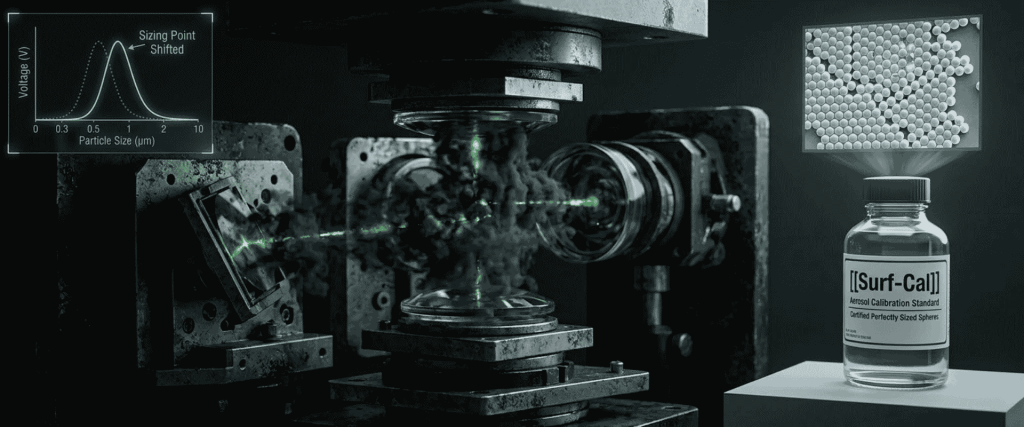
The tool directs a focused laser beam across the rotating wafer surface; when the beam encounters a particle, light scatters across wide-angle or narrow-angle collectors and strikes photomultiplier tubes (PMTs) or solid-state detectors.
Over weeks and months of production runs, several physical factors introduce calibration drift:
- Laser Power and Beam Profile Degradation: Laser diodes and solid-state lasers experience gradual flux decay and slight beam-geometry shifts, altering the incident photon density at the wafer plane.
- Optical Path Contamination: Trace organic outgassing and airborne molecular contamination (AMC) gradually coat collection mirrors and lens surfaces, reducing light-collection efficiency.
- Detector Sensitivity Shift: PMTs and avalanche photodiodes suffer gain variations driven by operating hours, thermal cycling, and supply voltage fluctuations.
- Chuck Flatness and Stage Height Offsets: Micro-deviations in vertical stage positioning alter the focal plane, directly impacting scatter collection angles.
Without regular recalibration, these factors alter the tool’s voltage-to-particle-size transfer function. A 64 nm particle may be registered as 58 nm on Tool A and 71 nm on Tool B. In high-volume manufacturing, this variance distorts statistical process control (SPC) limits, triggers false alarms, or allows killer defects to pass undetected.
How Surf-Cal Standards Stabilize SSIS Response Curves
Calibrating an optical surface scanner requires establishing a predictable relationship between the scattered light intensity ($I_{\text{scat}}$) and physical particle diameter ($d_p$).
According to Mie scattering theory, for particles with dimensions comparable to the illumination wavelength, the scattering cross-section varies sharply with size, shape, and refractive index.

Surf-Cal standards provide spherical, monodisperse PSL particles suspended in deionized, ultrafiltered water with a known refractive index ($n = 1.59$ at 589 nm).
Eliminating Operator Dilution Error
Standard laboratory dilutions introduce manual pipette errors, inconsistent surfactant concentrations, and potential fluid contamination. Surf-Cal eliminates serial dilution uncertainty by shipping pre-mixed at stable target concentrations:
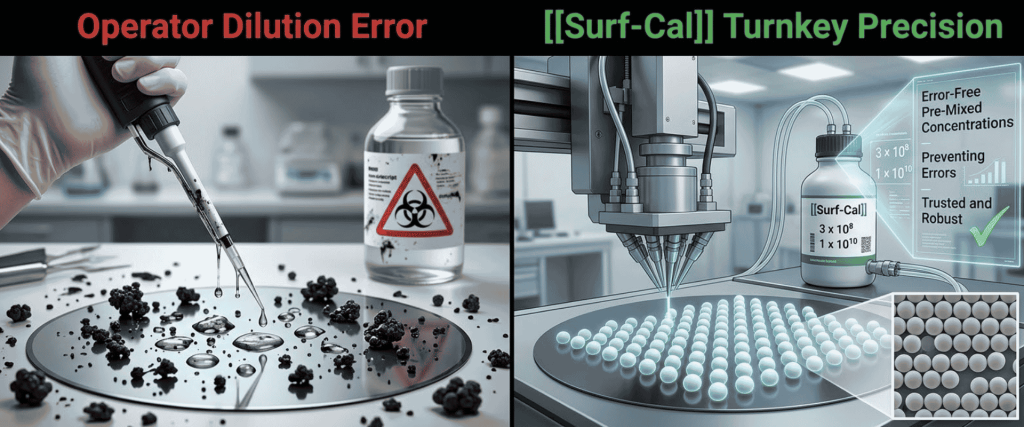
- $3 \times 10^8 \text{ particles/mL}$: Optimized for standard aerosol generation and controlled-density wafer deposition.
- $1 \times 10^{10} \text{ particles/mL}$ (Suffix “B”): Engineered for high-throughput deposition systems requiring dense aerosol feeds to minimize cycle time on smaller particle diameters.
High-Precision NIST Traceability
Each batch is sized using Differential Mobility Analyzers (DMA), transmission electron microscopy (TEM), or optical microscopy calibrated against National Institute of Standards and Technology (NIST) Standard Reference Materials (SRMs).
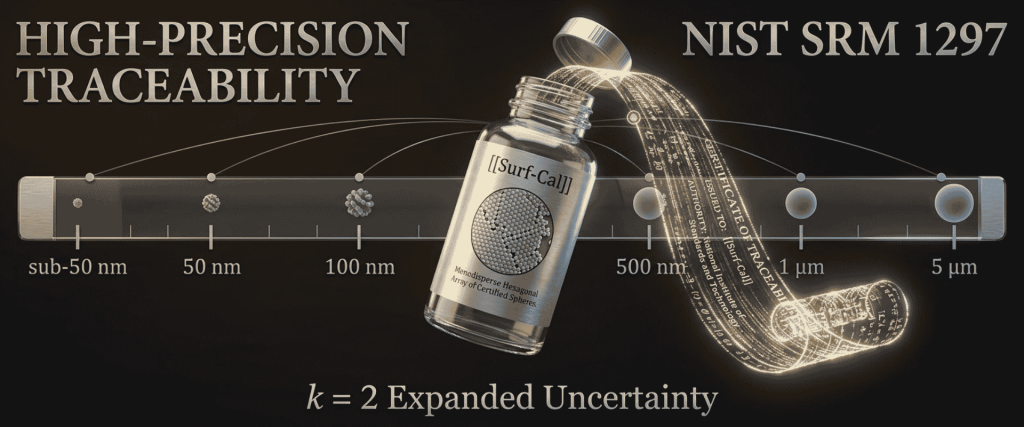
Expanded uncertainty is calculated per NIST Technical Note 1297 with a coverage factor of $k = 2$, ensuring measurement confidence down to sub-50 nm nodes.
Surf-Cal Sizing and Concentration Selection Matrix
Selecting the proper reference diameter depends on your fab’s inspection recipes, target substrate types, and critical defect thresholds. Below is an overview of representative sizes and their primary operational focus areas:
| Part Number | Certified Diameter | Size Distribution (SD) | Target Concentration | Primary Tool Verification Focus |
| APPD-047 / APPD-047B | 0.047 µm (47 nm) | 0.004 µm | $3 \times 10^8$ / $1 \times 10^{10}$ | Sub-50 nm threshold tuning; advanced node DUV sensitivity |
| APPD-064 / APPD-064B | 0.064 µm (64 nm) | 0.003 µm | $3 \times 10^8$ / $1 \times 10^{10}$ | Critical gate-level sensitivity checks; SPx threshold calibration |
| APPD-100 / APPD-100B | 0.100 µm (100 nm) | 0.003 µm | $3 \times 10^8$ / $1 \times 10^{10}$ | Industry-standard 100 nm cross-matching; daily SPC monitoring |
| APPD-200 / APPD-200B | 0.202 µm (202 nm) | 0.004 µm | $3 \times 10^8$ / $1 \times 10^{10}$ | Mid-range optical collection balance; PMT linearity verification |
| APPD-500 / APPD-500B | 0.498 µm (498 nm) | 0.006 µm | $3 \times 10^8$ / $1 \times 10^{10}$ | Upper dynamic range calibration; wide-angle channel alignment |
| AP PD1100 / AP PD1100B | 1.112 µm | 0.011 µm | $3 \times 10^8$ / $1 \times 10^{10}$ | Macro-defect inspection channels; film-delamination simulation |
| AP PD3000 | 3.040 µm | 0.026 µm | $3 \times 10^8$ | Edge-bead removal (EBR) and wafer backside inspection tools |
Deposition Best Practices: Preventing Agglomeration and Haze
Generating a clean calibration wafer requires disciplined preparation. Poor deposition techniques can create measurement artifacts that defeat the purpose of using a certified standard:
Prevent Doublets and Agglomerates
PSL microspheres naturally form dimers and trimers if the suspension settles. If an agglomerated doublet enters the aerosol stream, the inspection tool registers it as a single, larger particle, producing artificial secondary peaks on the sizing histogram.
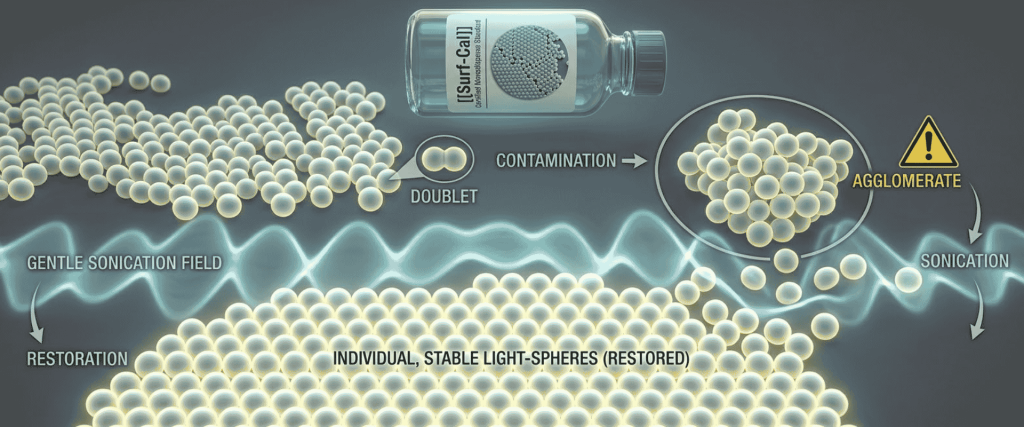
- Handling Protocol: Invert the bottle gently 10 to 15 times before sampling.
- Sonication: Place the sample in a mild ultrasonic bath for 30 to 60 seconds prior to nebulization. Avoid extended sonication cycles that heat the solution and degrade the polymer surface.
Control Background Optical Haze
Residues from ionic stabilizers or non-volatile organics present in low-grade solutions leave microscopic rings upon droplet evaporation. On high-sensitivity darkfield tools, this residue raises the baseline background scatter (haze), obscuring low-signal particles below 60 nm.
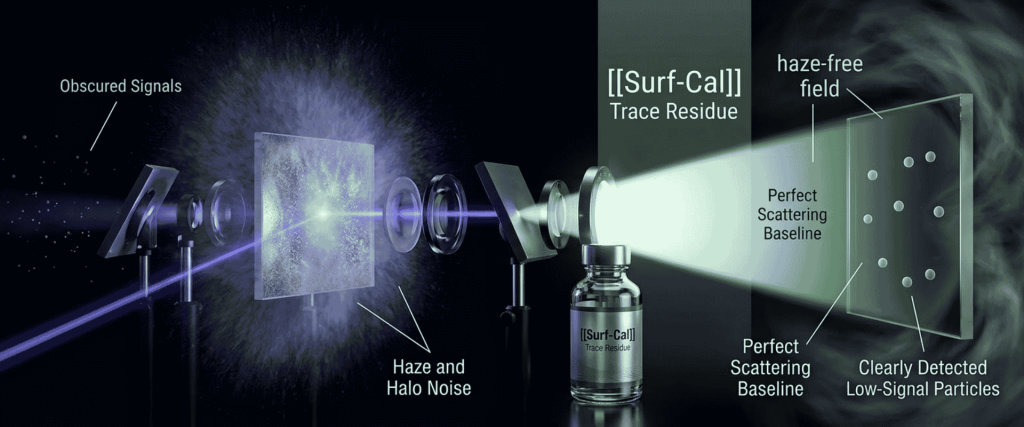
Surf-Cal suspensions are produced in deionized, particle-filtered water to ensure clean dry-down behavior during aerosol deposition.
Meeting SEMI M52 Standards Across Multi-Fab Networks
Cross-site matching requires compliance with SEMI M52 (Guide for Specifying Surface Inspection Systems for Silicon Wafers). SEMI M52 establishes standards for sizing accuracy, count repeatability, and false-positive limits across surface scanners.
To achieve compliance across a global fleet:
- Standardize Deposition Density: Target a controlled deposition range (typically 1,000 to 3,000 particles per wafer) to eliminate coincident particle strikes while generating statistically significant sizing populations.
- Execute Full-Spectrum Calibration: Run calibration sweeps across lower, mid, and high channels (e.g., 47 nm, 100 nm, 500 nm) to confirm detector-response linearity rather than relying on a single mid-range reference point.
- Establish Scheduled Verification Intervals:
- Weekly: Single-size verification check (typically 100 nm) to monitor drift against historical control charts.
- Monthly/Quarterly: Multi-point calibration sweep to realign channel gain and collect optic coefficients.
- Post-Maintenance: Mandatory baseline reset following laser replacement, optic cleaning, or PMT service.
Conclusion
Unchecked tool drift directly compromises wafer yield by distorting defect sizing and breaking cross-fleet correlation.
By delivering rigorous NIST traceability, Surf-Cal™ standards anchor every scanner in your facility to verified, uncompromised physical baselines.
Their pre-mixed $3 \times 10^8$ and $1 \times 10^{10}$ concentrations eliminate manual dilution errors and background haze, guaranteeing clean, repeatable aerosol depositions every time.
Standardizing on Surf-Cal ensures full SEMI M52 compliance, streamlines multi-fab matching, and keeps your defect metrology entirely defensible.
Frequently Asked Questions (FAQs)
1. How often should an SSIS tool be checked with Surf-Cal standards?
Metrology facilities typically run a single-size standard wafer (such as 100 nm) weekly to monitor tool drift and verify particle count repeatability. A complete, multi-point calibration sweep across low, medium, and high diameters should be executed quarterly or immediately following optical servicing and laser adjustments.
2. Why use pre-mixed concentrations instead of performing in-house serial dilutions?
Manual dilution introduces human error, pipetting variance, and contamination risks from container surfaces or non-filtered water. Surf-Cal’s factory-certified concentrations ($3 \times 10^8$ and $1 \times 10^{10}\text{ particles/mL}$) guarantee consistent particle-to-droplet ratios during aerosol nebulization, ensuring uniform wafer coverage and repeatable calibration runs.
3. Can Surf-Cal be deposited on patterned wafers?
While Surf-Cal PSL spheres can physically adhere to patterned wafers, they are primarily engineered for deposition onto clean, bare silicon or blanket-film substrates (such as thermal oxide, silicon nitride, or bare metal). Patterned substrates introduce background optical noise from underlying circuitry, complicating primary sizing curve calibration.