
Pharmaceutical manufacturing environments operating under revised aseptic regulations face stringent microbiological control mandates.
The updated EU GMP Annex 1 framework requires continuous viable air monitoring across critical Grade A zones throughout the entire duration of processing, including equipment setup and active filling.
Traditional portable sampling units contain internal vacuum motors, cooling fans, and exhaust pathways that introduce heat dissipation and airborne turbulence into unidirectional laminar streamlines.
Deploying externalized sampling architecture resolves this risk by isolating mechanical motor exhaust outside the classified core.
Achieving compliant monitoring requires balancing impaction physics, vacuum line fluid dynamics, and agar plate viability over extended operational shifts.
Regulatory Imperatives: Navigating Annex 1 Continuous Viable Monitoring
Sterility assurance teams must comply with explicit expectations outlined in Annex 1 sterile manufacturing regulations, where passive monitoring alone no longer satisfies regulatory scrutiny.
Settle plates provide continuous passive sedimentation records, but they fail to capture active microbial aerosols generated by mechanical transfers or glove interventions. Active air sampling is essential for quantifying viable bioburden per cubic meter of sampled air.
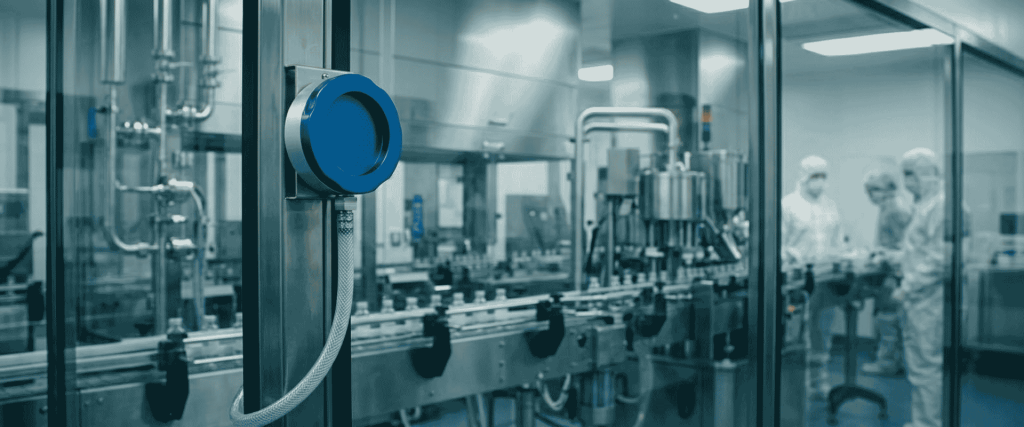
Technical documentation detailed across cleanroom monitoring publications emphasizes that viable monitoring must reflect conditions during operational states rather than quiescent conditions.
Meeting this standard means sampling heads must operate without shedding particulates, disturbing laminar flow protection, or requiring intrusive personnel interventions to swap agar media during active batch runs.
Operational State Verification
Continuous viable monitoring must cover the entire duration of the aseptic process. Sampling protocols must verify:
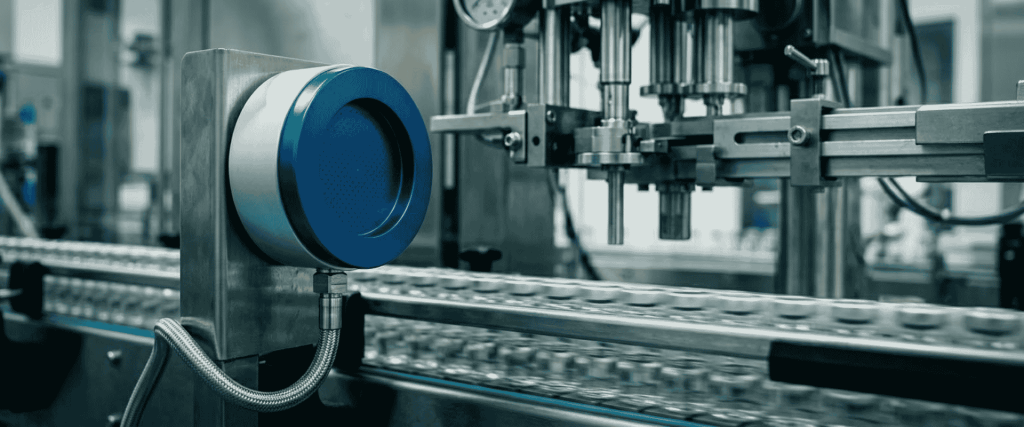
- Baseline bioburden levels during automated line setup and sterile component loading.
- Ongoing viable air counts during high-speed container closure and vial stoppering.
- Immediate sampling coverage during planned or unplanned glove-port interventions.
Flow Rate Dynamics: Balancing 100 LPM vs. 28.3 LPM to Prevent Media Desiccation
Physical impaction onto nutrient agar depends on the aerodynamic cutoff diameter ($d_{50}$). The sampler accelerates airborne particles through calibrated sieve orifices, forcing viable cells to impact the agar surface while diverted air exhausts through vacuum ports.
Traditional monitoring protocols rely heavily on a 100 Liters Per Minute (LPM) volumetric flow rate, completing a standard 1,000-liter sample in 10 minutes.
Running 100 LPM continuously across long filling shifts rapidly desiccates nutrient agar media.
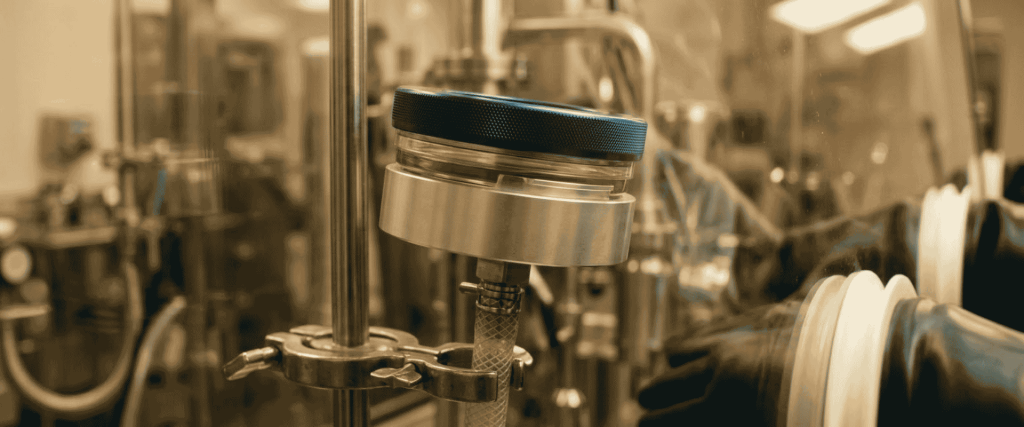
High-velocity air currents strip moisture from the gel matrix within 15 to 20 minutes, causing surface shrinkage, cracks, and osmotic stress that kills collected microorganisms before incubation.
Switching to a 28.3 LPM (1 CFM) flow rate resolves this operational failure.
A 28.3 LPM inlet allows gentle, extended impaction over 35.3 minutes per cubic meter, preserving moisture equilibrium, maintaining physical contact between microbes and nutrients, and reducing plate exchange frequency under critical barrier systems.
| Operational Parameter | 100 LPM High-Velocity Impaction | 28.3 LPM (1 CFM) Extended Impaction |
| Duration per $1\text{ m}^3$ Sample | 10 minutes | 35.3 minutes |
| Media Desiccation Risk | Severe (cracking within 15–20 min) | Low (maintains hydration past 35 min) |
| CFU Recovery Efficiency | High initial capture, rapid cell death | Sustained cell viability and recovery |
| Sampling Interruption Rate | High (frequent plate transfers) | Low (prolonged continuous monitoring) |
| Airflow Wake Turbulence | Moderate to high localized disruption | Minimal streamlined air wake |
| Primary Cleanroom Fit | Short qualification and spot checks | Continuous Grade A operational monitoring |
Engineering the Remote Architecture: Tubing Runs, Vacuum Loss, and Aerodynamics
Maintaining physical compliance with ISO 14644-1 airborne particulate standards requires removing particle-generating vacuum motors from critical environments. Remote Air Samplers (RAS) decouple the collection head from the prime mover, routing exhaust lines outside barrier walls or sub-floor service chases.
Physical fluid dynamics dictate that vacuum line diameter and length directly affect face velocity at the sampling sieve. Drawing air through standard 0.375-inch (3/8″ ID) vacuum lines introduces wall friction and localized pressure drops over extended lengths.

Facilities must calibrate remote sampling stations at the actual sampling sieve head rather than relying on vacuum pump readouts located meters away. Verified configurations described in viable impaction protocols use heavy-wall, non-collapsing vacuum tubing secured with 316 stainless steel barb fittings to ensure volumetric flow stability without internal flow starvation.
Proper physical placement inside Grade A enclosures prevents turbulent wake generation. Bulky instruments create stagnant eddies where contaminants settle; a streamlined cylindrical sampler with a 1/4-20 mounting thread secures directly to low-profile stainless steel brackets. Aligning the intake sieve parallel to incoming laminar streamlines minimizes wake drag, as documented in cleanroom airflow visualization studies.
Material Compatibility: Anodized Aluminum Performance Against Sporicidal Decontamination
Aseptic processing enclosures undergo rigorous surface disinfection protocols and frequent bio-decontamination cycles using Vaporized Hydrogen Peroxide (VHP), peracetic acid, and sterile 70% isopropanol. Equipment inside these barriers must endure continuous oxidative exposure without surface oxidation, flaking, or particle shedding.
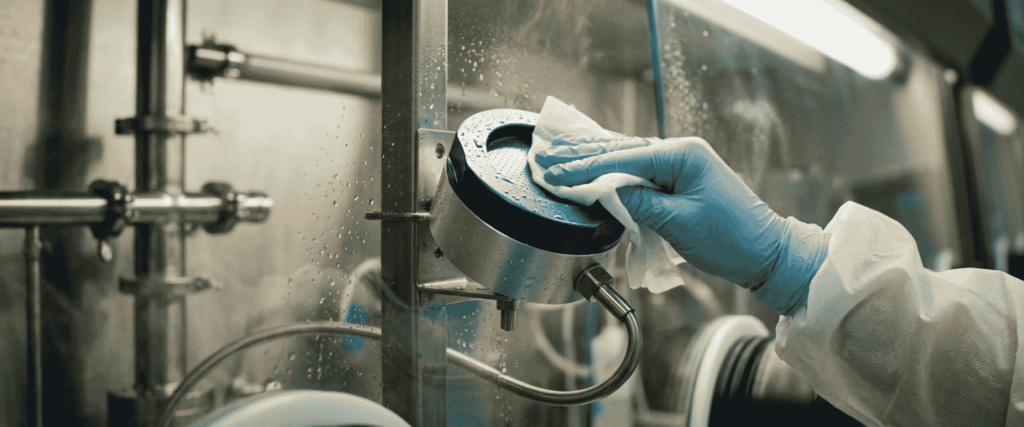
Standards governed by PDA Technical Report guidelines and EN 17141 biocontamination control standards emphasize non-shedding contact materials. The Remote Air Sampler utilizes a base constructed from high-grade 6061-T6 aluminum protected by hard-coat blue anodization, paired with an adjustable clear-anodized media stage and a corrosion-resistant 316 stainless steel vacuum barb.
Anodizing seals the aluminum substrate under a durable oxide layer, preventing oxidation from daily chemical wipe-downs. This offers a robust, lightweight alternative to solid stainless steel fixtures without adding excessive mechanical load to isolator mounting brackets.
Operational Protocols: Mitigating False Positives During Agar Plate Exchange
Contamination control strategies must address human error during agar plate exchange. Swapping Petri dishes through heavy isolator glove ports represents a primary risk point for accidental touch contamination, which can trigger costly out-of-specification investigations.
Engineered systems detailed across isolator monitoring strategies emphasize simplified mechanical ergonomics. A clear-anodized adjustable media stage ensures standard 90 mm nutrient plates snap securely into place without lateral slippage. Quick-securing inlet covers with precision-aligned indexing pins let technicians seat and lock the sampling sieve using one gloved hand, preventing accidental contact with the sterile agar surface.
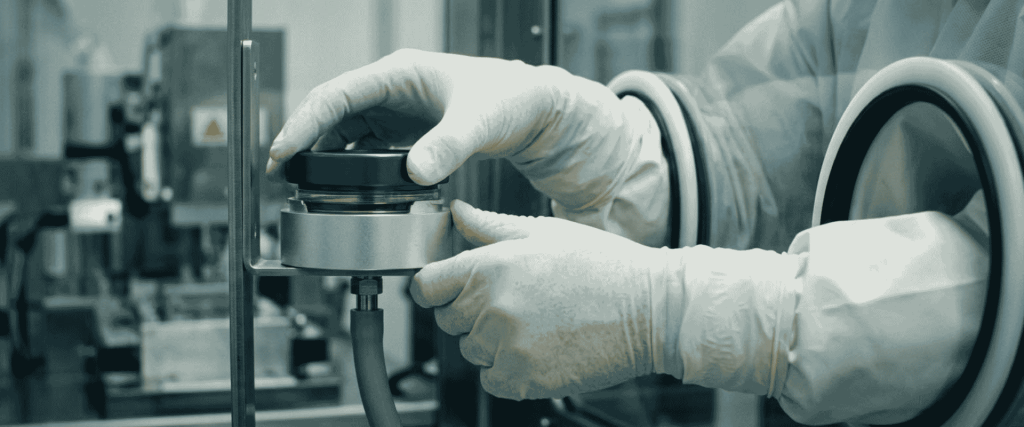
Routine calibration protocols outlined in microbial air sampling methods demand regular verification of intake volume using calibrated flow hoods. Establishing leak-tight connections across vacuum barbs, Teflon port plugs, and tubing lines ensures that air pulled across the media comes entirely from the critical zone, preventing unmonitored ingress from compromised barrier seals.
Integrating these practices into a facility’s contamination control strategy establishes consistent compliance with global pharmacopeias and cleanroom validation literature.
Conclusion
Meeting revised EU GMP Annex 1 mandates requires aligning regulatory expectations with sound contamination control physics.
Isolating vacuum pump hardware outside critical Grade A zones eliminates thermal plumes and parasitic particulate shedding, while implementing a validated 28.3 LPM (1 CFM) sampling rate prevents agar media desiccation across extended batch shifts.
Precision-machined 6061-T6 anodized aluminum construction provides the chemical durability needed to survive aggressive sporicidal regimens and routine VHP cycles without adding excessive mechanical load to isolator barriers.
Frequently Asked Questions (FAQs)
1. How does a remote air sampler support EU GMP Annex 1 compliance?
Placing only the sampling head inside Grade A zones keeps vacuum motor exhaust and heat plumes outside critical barrier areas, preserving unidirectional laminar airflow during continuous monitoring.
2. Why is a 28.3 LPM flow rate preferred for long production cycles?
Operating at 28.3 LPM reduces face velocity across the Petri dish, preventing nutrient agar desiccation and surface cracking during extended continuous runs.
3. Can anodized aluminum withstand repeated cleanroom decontamination?
Hard-coat anodized 6061-T6 aluminum provides dependable resistance against vaporized hydrogen peroxide (VHP), peracetic acid, and sterile alcohol wipe-downs without flaking or generating particles.
4. What vacuum tubing size connects to the remote sampling head?
The unit features a 316 stainless steel barb designed for standard 0.375-inch (3/8-inch ID) non-collapsing vacuum tubing to maintain airtight suction over remote distances.
