
Sample preparation errors in histopathology can compromise an entire diagnostic workflow, and in clinical settings, that cost is too high to ignore.
Automated tissue processors have changed how laboratories approach fixation, dehydration, clearing, and paraffin infiltration by removing the variability that comes with manual handling.
Instead of depending on technician availability and attention at every step, these machines execute each stage with programmed precision and consistency.
This article breaks down exactly how automated tissue processors eliminate preparation errors and why they have become a standard requirement in modern pathology labs.
An automated tissue processor is a laboratory instrument that replaces manual, step-by-step sample preparation with a fully controlled, programmable chemical workflow.
Instead of relying on a technician to move tissue cassettes between reagent baths at the right time and temperature, the machine handles every transfer automatically, from fixation through to paraffin infiltration.
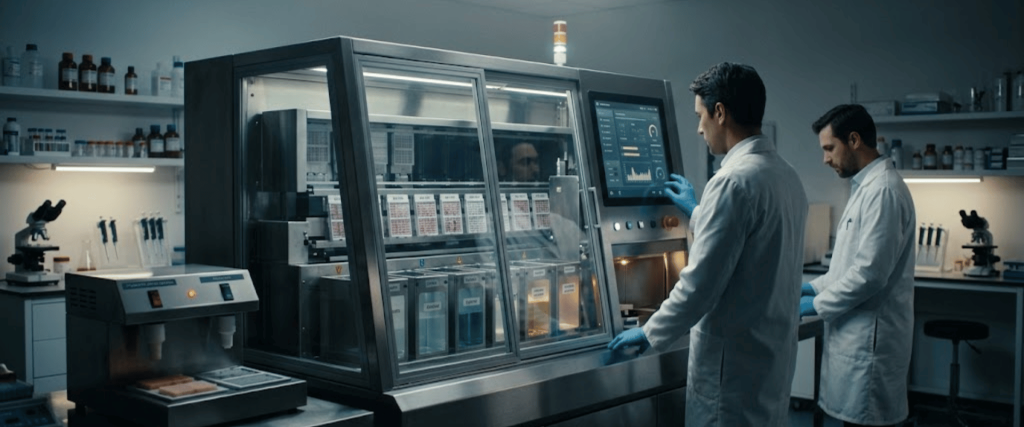
These instruments are central to histopathology and surgical pathology workflows, where tissue quality directly impacts diagnostic accuracy.
A poorly processed tissue block can obscure cellular detail, compromise staining, or produce misleading results, making consistent processing a non-negotiable requirement for any serious diagnostic laboratory.
Automated tissue processors address each manual failure point through engineering controls rather than relying on operator discipline.
The processor follows a programmed schedule, transferring cassettes between reagent stations at exact, repeatable intervals.
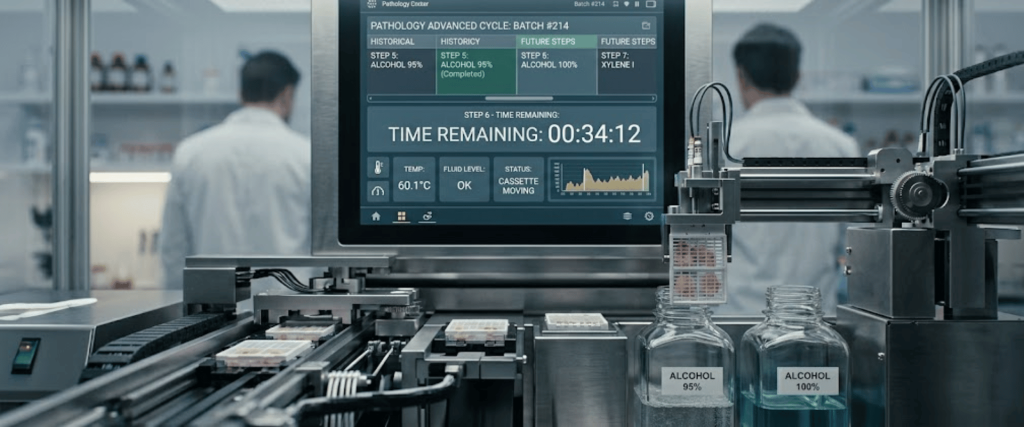
There is no possibility of a transfer being delayed because a technician is occupied elsewhere. Laboratories can run overnight programs that are completed by morning without any staff involvement.
Modern processors maintain paraffin bath temperatures within tight tolerances throughout the infiltration stage.
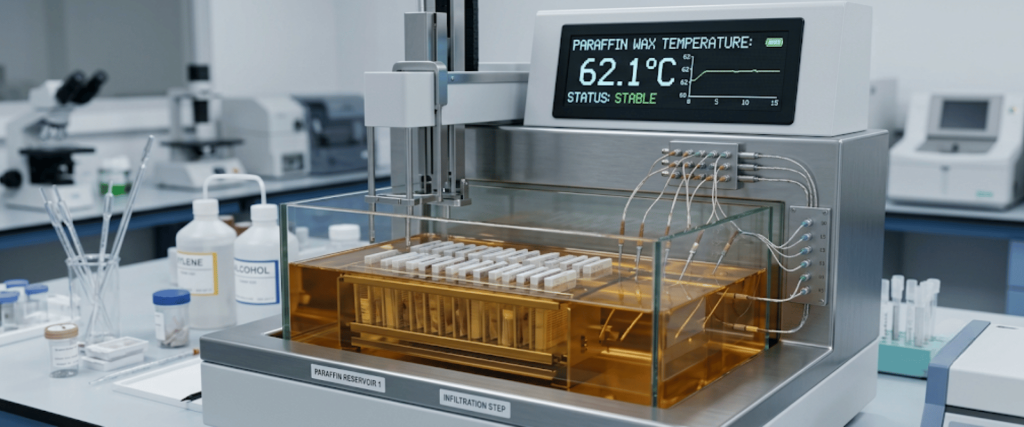
Consistent temperature ensures that wax penetrates tissue evenly, preventing hard or soft zones in the final block.
Automated systems agitate cassettes through consistent mechanical motion, typically oscillation, during every reagent immersion step.
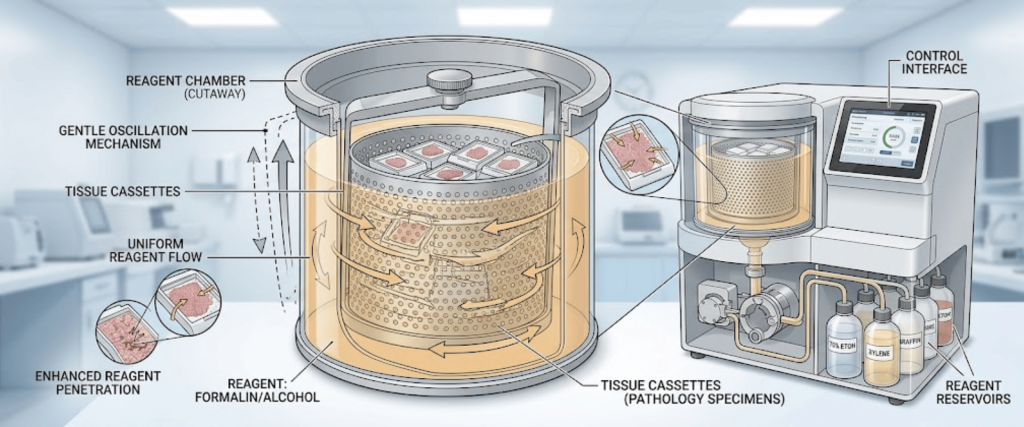
This controlled movement increases reagent penetration speed and ensures every cassette in the batch receives identical treatment.
Many current processors include intelligent reagent monitoring that tracks usage cycles and flags when a reagent needs replacement.
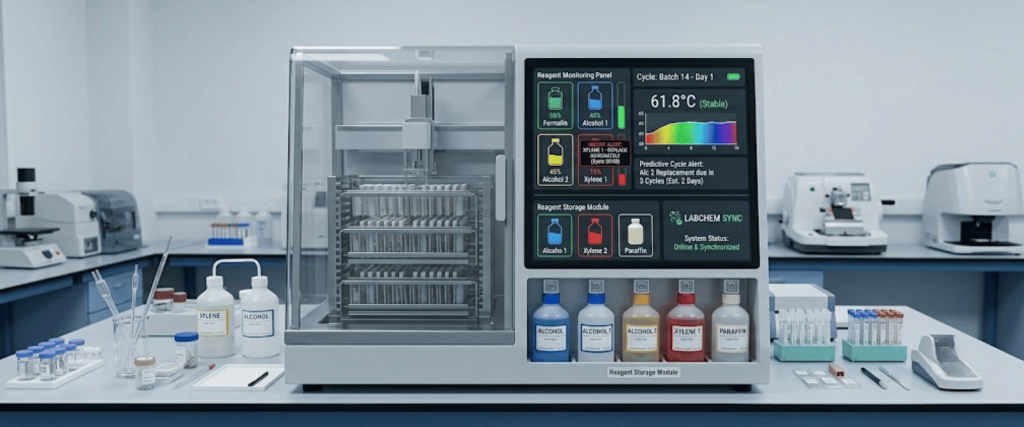
This prevents degraded alcohol or contaminated clearing agents from carrying over to subsequent batches.
Enclosed retort designs prevent evaporation of toxic chemicals like xylene and formalin during processing.
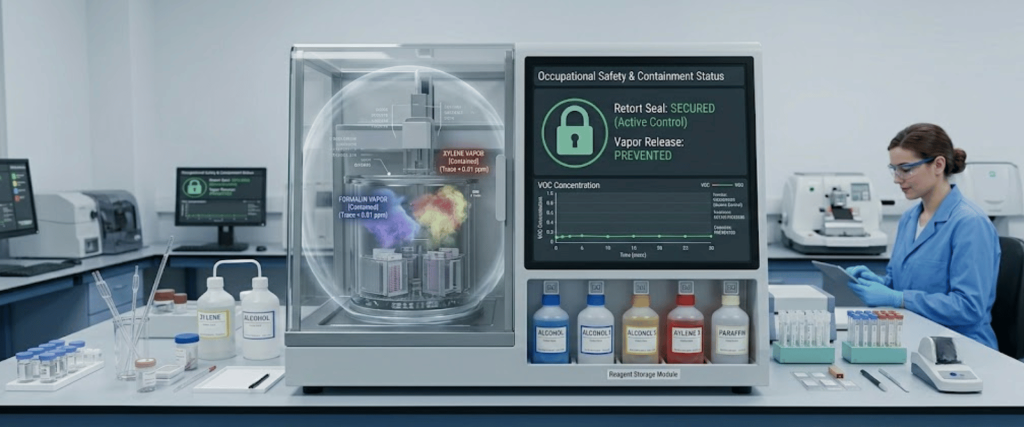
This not only protects laboratory staff from chemical exposure but also maintains reagent concentration consistency throughout each cycle.
Before understanding where errors occur, it helps to understand what tissue processing actually involves. Every sample travels through four sequential chemical stages.
Each stage requires precise timing, correct temperature, and adequate agitation. A deviation in any one of these variables can degrade the final tissue section.
Manual tissue processing introduces several failure points that directly affect diagnostic outcomes.
These errors compound. An under-fixed tissue that is also over-cleared produces a section that stains poorly and is difficult for a pathologist to interpret confidently.
| Factor | Manual Processing | Automated Processing |
|---|---|---|
| Timing accuracy | Operator-dependent | Programmed, exact |
| Overnight operation | Requires staff presence | Fully unattended |
| Agitation consistency | Variable, hand-moved | Mechanical, uniform |
| Temperature control | Manually monitored | Sensor-regulated |
| Reagent tracking | Manual logs | Automated usage alerts |
| Throughput | Limited by technician's speed | 100–300 cassettes per run |
| Chemical exposure risk | High (open baths) | Low (closed retort) |
| IHC suitability | Inconsistent results | Reproducible for IHC |
Automated tissue processors are used across a wide range of laboratory environments.
The downstream effect of consistent tissue processing is measurable. When fixation and dehydration are uniform, staining results, including routine H&E and advanced immunohistochemistry (IHC), become reproducible across batches and between different labs.
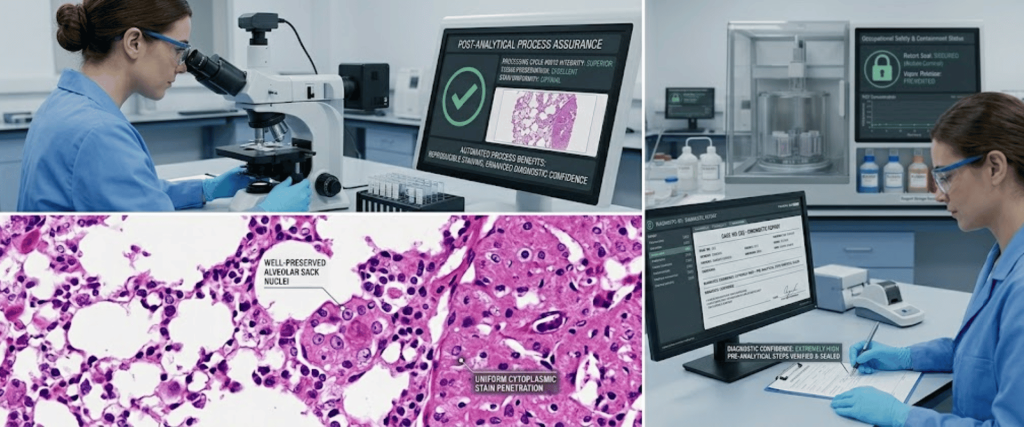
When pathologists work with consistently processed sections, they can make morphological assessments with greater confidence, and requests for repeat sections are also reduced.
An automated processor is only as reliable as its maintenance schedule.
Laboratories pursuing ISO 15189 accreditation will find that automated processors make documentation significantly easier, since the machine generates a complete processing record for every run.
Automated tissue processors eliminate sample preparation errors by replacing human judgment with calibrated, repeatable machine control at every stage of the processing cycle.
Consistent timing, regulated temperature, mechanical agitation, and intelligent reagent management work together to produce tissue sections that stain reliably and support accurate pathological diagnosis.
For any laboratory processing more than a minimal daily caseload, automation is not merely a convenience; it is a quality system in its own right.
It prevents timing errors, temperature fluctuations, inconsistent agitation, reagent carryover, and exposure-related concentration changes, all of which can occur with manual processing.
Yes. Programmable overnight cycles allow cassettes loaded in the afternoon to be fully processed and ready for embedding by the following morning, with no staff required during the run.
Yes. The consistency of automated processing is essential for reliable IHC results, as variable fixation or dehydration can produce false-negative or inconsistent staining patterns.
Depending on the model, automated processors can handle between 100 and 300 cassettes in a single run, far beyond what manual methods can reliably achieve.
Laboratories processing more than 20–30 cases per day typically recover the equipment investment within 12–18 months through reduced labor hours and lower reagent waste.
APPLIED PHYSICS TECHNICAL RESOURCE
Pathology workflow, containment, sterilization, biological safety and clinical-laboratory equipment selection. Product and standards references should be interpreted for the actual instrument, facility, protocol and configuration.

Enter your details below to save your shopping cart for later. And, who knows, maybe we will even send you a sweet discount code :)
Allow notifications to get real-time updates about your shopping cart and who knows, you may even receive a sweet discount code 😊