
Technicians in full cleanroom suits monitor automated robots assembling EV battery modules on a bright, sterile production line

The Role of Cleanroom Foggers in Electric Vehicle Battery Manufacturing Lines

In the high-stakes world of Electric Vehicle (EV) battery manufacturing, invisible threats can lead to catastrophic failures.

A single microscopic particle in an electrode coating or a pocket of stagnant humid air during electrolyte filling can result in thermal runaway, reduced battery life, or massive product recalls.

Cleanroom foggers have emerged as a critical diagnostic tool in this sector.

They are not just for basic compliance; they are the primary method for visualizing the invisible aerodynamics that protect lithium-ion cells from contamination and moisture.

This article explores the technical role of foggers in battery Dry Rooms and cleanrooms, addressing the unique challenges of maintaining ISO standards in moisture-sensitive environments.

Why Airflow Visualization is Critical in Battery Production

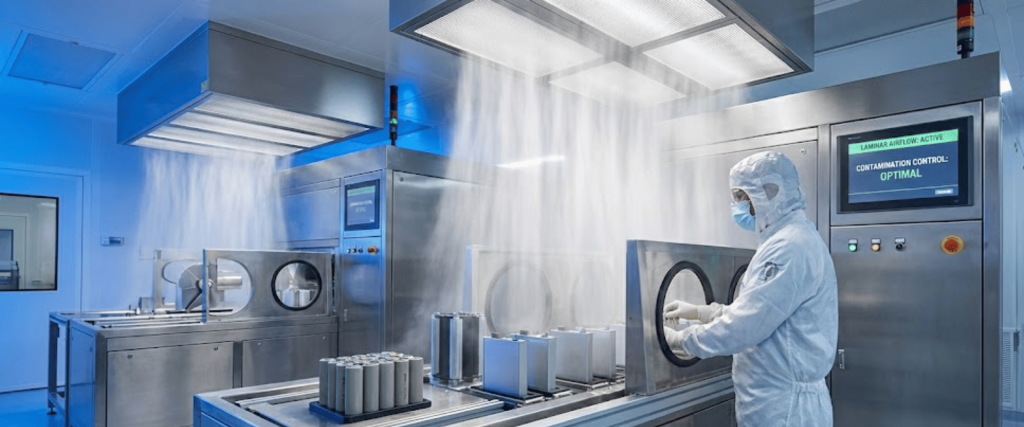
EV battery production lines, whether for cylindrical, prismatic, or pouch cells,s rely on Unidirectional Airflow (Laminar Flow) to wash particles away from the product.

Cleanroom production line with workers in full protective suits operating machinery and computers under laminar airflow.

If this airflow is disrupted, contaminants settle on sensitive surfaces.

ISO 14644-3 Compliance

Regulatory standards (ISO 14644-3) mandate airflow visualization tests to verify that clean air moves from the supply filter (HEPA/ULPA) to the return vents without creating turbulence or dead zones.
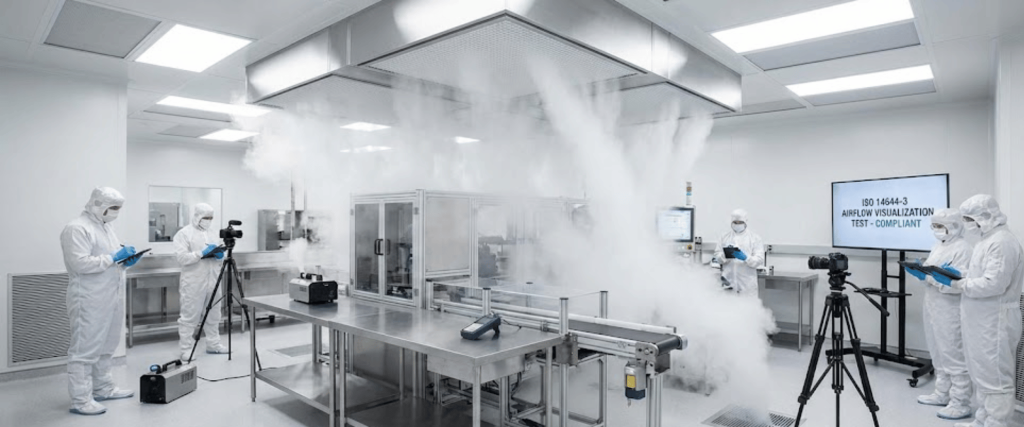
Technicians in full cleanroom suits conducting an airflow visualization test with fog machines, cameras, and monitoring equipment.

The Dead Zone Danger

In battery manufacturing, heavy machinery (calendering rolls, stacking machines) often blocks airflow. This creates dead zones, areas where air stagnates.
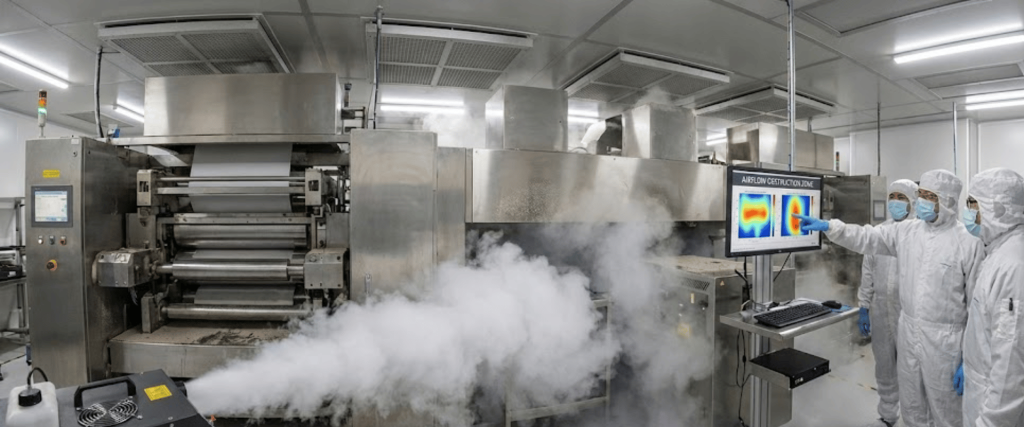
Workers in cleanroom suits monitor airflow thermal maps on a monitor beside industrial sterilization equipment emitting dense vapor.
  • Particulates accumulate: Metal shavings or dust can settle on the separator film, causing internal short circuits.
  • Moisture lingers: In dry rooms, stagnant air pockets may hold higher humidity levels than the room sensors detect, degrading the lithium chemistry.

The Dry Room Dilemma: Fogging Without Moisture Damage

The most distinct challenge in battery manufacturing is the Dry Room.
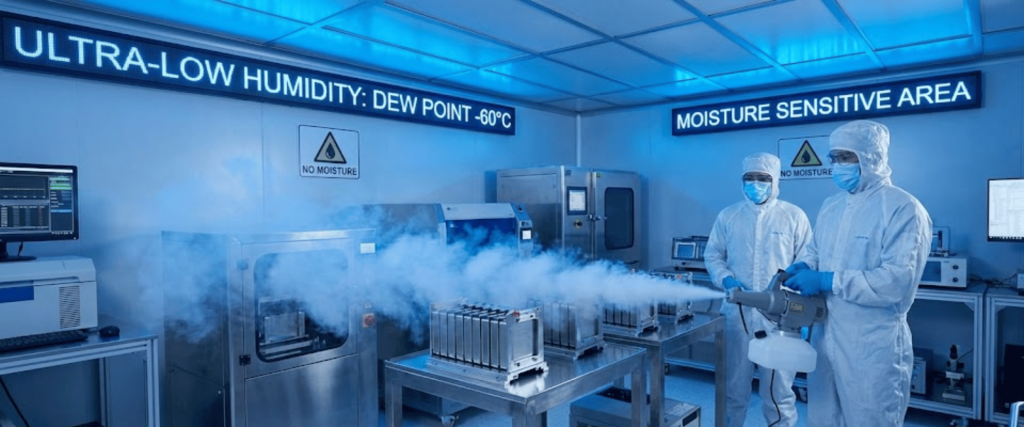
Two technicians in cleanroom suits spray inert fog over battery cells inside an ultra-low humidity, moisture-sensitive lab

Lithium reacts violently with moisture to form Hydrofluoric Acid (HF) and Lithium Hydroxide, which corrodes equipment and ruins battery performance. Standard cleanroom foggers use water, which poses a risk.

How to Fog Safely in a Dry Room?

Engineers must choose the right fog technology to visualize airflow without compromising the dew point (typically -40°C to -60°C).

Fogger TypeSuitability for Battery Dry RoomsNotes
LN2 (Ultrapure) FoggersHighUses liquid nitrogen and DI water. Creates a dense, cryogenic fog that evaporates instantly. It is clean and leaves no residue, making it the industry standard for high‑sensitivity areas.
CO₂ FoggersMediumUses dry ice. Produces a heavy fog that stays close to the floor. Useful for checking low‑level exhaust, but it may not accurately show neutral air movement patterns.
Standard Water FoggersLow / RestrictedHigh moisture risk. Should only be used during at-rest commissioning (before materials are introduced) and must be followed by a strict dry‑down cycle.

Key Applications Along the Battery Line

Different stages of the EV battery line require specific airflow strategies.
1) Electrode Coating & Drying

  • The Hazard: Toxic solvent vapors (e.g., NMP) and conductive dust.
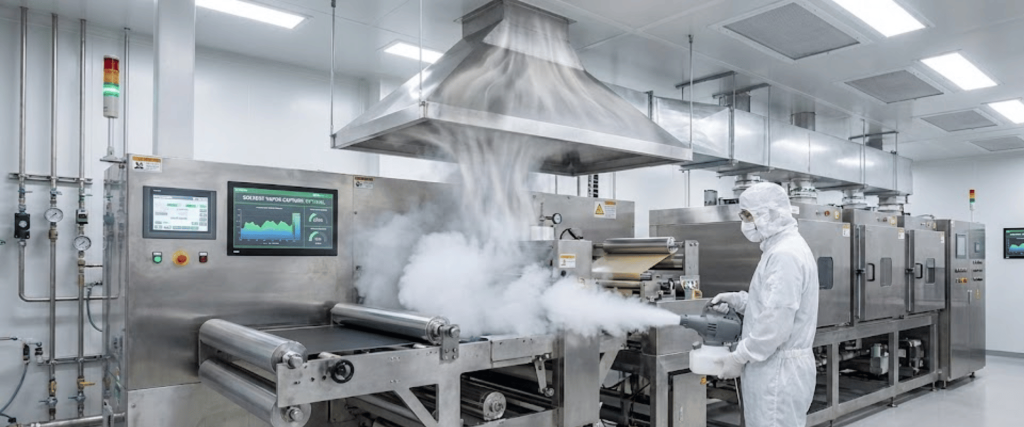
  • The Fogger’s Role: Foggers visualize the capture efficiency of exhaust hoods. The fog should flow smoothly from the coating head directly into the exhaust vent, ensuring no solvent vapors escape into the room.
Worker in cleanroom suit operating industrial freeze-drying equipment as vapor rises around stainless-steel production line.

2) Cell Assembly (Stacking/Winding)

  • The Hazard: Particle generation from cutting and friction.
  • The Fogger’s Role: Verifies that the laminar flow curtain effectively curtains off the machine operator from the product. Fog visualization ensures that when an operator reaches into the line, their particulate shed is blown away from the open cell.
Technician in full cleanroom suit handling sterile equipment inside a controlled laminar-flow pharmaceutical manufacturing room.

3) Electrolyte Filling (The Critical Zone)

  • The Hazard: Extreme moisture sensitivity and toxic fumes.
  • The Fogger’s Role: This is often an ISO 5 (Class 100) zone inside a dry room. Ultrapure foggers are used to confirm positive pressure inside the filling enclosure. The fog should visibly push out of the enclosure gaps, proving that no external room air (contaminants) can enter.
Cleanroom technicians in full protective suits monitor a robotic glovebox amid fog/smoke inside an ISO‑5 laboratory.

Benefits of Using Cleanroom Foggers

  • Optimized Scavenging Rates: By visualizing the smoke path, engineers can adjust fan speeds to ensure fumes are scavenged efficiently without using excessive energy.
  • Thermal Runaway Mitigation: In safety tests, foggers simulate smoke from a battery fire to verify that the emergency ventilation system can rapidly evacuate the smoke before it obscures vision or suffocates workers.
  • Reduced Scrap Rates: Identifying turbulence near the winding machines prevents microscopic foreign metal particles (FMP) from landing on the anode/cathode, directly improving yield.

Conclusion

Integrating high-purity cleanroom foggers into EV battery manufacturing is a strategic necessity for optimizing yield and ensuring safety.

By visualizing invisible airflow patterns, manufacturers can proactively eliminate dead zones and moisture risks within critical Dry Rooms before they impact production.

This diagnostic capability directly translates to reduced scrap rates, superior battery performance, and verifiable adherence to ISO standards.

Ultimately, making the airflow visible is the only way to guarantee the integrity of high-stakes lithium-ion environments.

Frequently Asked Questions (FAQs)

1. Are water-based foggers safe for Dry Rooms?

Standard water foggers pose a high moisture risk to lithium. Instead, use Ultrapure LN2 foggers, which evaporate instantly and maintain the strict low-humidity levels required for battery production.

2. How often should airflow tests be performed?

Tests should be conducted during initial facility commissioning, after any major equipment layout changes, and as part of a routine annual recertification to ensure ongoing ISO compliance.

3. Will the fog leave residue on battery components?

Ultrapure LN2 and CO2 foggers are completely residue-free. You must avoid glycol or oil-based foggers, as they leave sticky contaminants that can cause battery cell failure or chemical instability.


Leave a Reply

Your email address will not be published. Required fields are marked *

Related Posts

About Applied Physics USA

Since 1992, Applied Physics Corporation has been a leading global provider of precision contamination control and metrology standards. We specialize in airflow visualization, particle size standards, and cleanroom decontamination solutions for critical environments.

Trending Articles