

Description
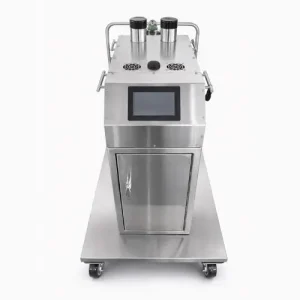
AP175 Ultrapure Cleanroom Fogger – High Output LN₂ Fogging for Large-Scale Airflow Visualization & Validation
AP175 LN₂ Fogger for Cleanroom Smoke Studies, ISO Validation & Airflow Mapping
The AP175 Ultrapure Cleanroom Fogger is a high-output LN₂ fogging system engineered for large cleanroom environments, delivering high fog density, extended runtime, and long-distance airflow visualization.
Positioned between the AP100 and AP200, the AP175 is designed for environments requiring significantly more fog volume and coverage than standard systems, while maintaining controlled, stable fog delivery using a dewar-style LN₂ system.
Using Applied Physics’ ultrapure fogging technology, the AP175 generates a dense, residue-free fog using Liquid Nitrogen (LN₂) and DI / WFI water, enabling precise visualization of:
- Airflow patterns
- Turbulence and eddies
- Dead zones
- Contamination pathways
Across:
- Pharmaceutical cleanrooms (USP <797>, <800>)
- Semiconductor fabs
- ISO 14644 environments
- Large GMP production suites
AP175 Performance Overview
- Fog Output Volume: ≈ 27–29 m³/min
- Fog Density: ≈ 2600–2900 ml/min
- Operating Time: ≈ 95–110 minutes
- Visual Fog Distance: ≈ 30–40 feet
- Fog Outputs: Dual 80mm outlets
- System Type: Dewar-Style LN₂ System
These values scale appropriately above the AP100 platform (~15.5 m³/min baseline) while maintaining realistic performance expectations for dewar-driven systems.
Dewar-Style LN₂ Fogger – Proven Performance in Cleanroom Environments
The AP175 utilizes a dewar-style LN₂ system, a widely used and proven method for cleanroom smoke studies and airflow visualization.
How Dewar Systems Work
Dewar systems rely on:
- Natural evaporation of liquid nitrogen
- Passive pressure generation inside the tank
- Controlled release of LN₂ into the heating chamber
This process creates a stable, predictable fog generation system without mechanical pressurization.
Benefits of Dewar-Style Systems in Cleanroom Applications
1. Proven and Trusted Technology
Dewar systems are widely used across:
- Pharmaceutical manufacturing
- Semiconductor facilities
- ISO-certified cleanrooms
They are a known, accepted standard for airflow visualization and validation.
2. Predictable and Repeatable Performance
Dewar-style systems provide:
- Stable fog generation under consistent conditions
- Repeatable results for validation testing
- Reliable performance across smoke study cycles
This is critical for:
- ISO 14644 compliance
- USP <797> validation
- GMP documentation
3. Simplicity and Reliability
With fewer active components, dewar systems offer:
- Reduced system complexity
- Lower maintenance requirements
- High operational reliability
Fewer failure points = more dependable testing in critical environments
4. Cleanroom Compatibility
Dewar systems are well suited for controlled environments because they:
- Maintain a clean, passive fog generation process
- Introduce no additional mechanical contamination risk
- Integrate easily into existing validation protocols
5. Smooth, Low-Turbulence Fog Introduction
Ultrapure LN₂ foggers operate at very low exit pressure, which:
- Minimizes disturbance to airflow
- Allows accurate visualization of real airflow behavior
- Prevents artificial turbulence
This is essential for high-accuracy smoke studies.
6. Scalable for Large Cleanroom Environments
When properly engineered—as in the AP175—dewar systems can:
- Deliver high fog volumes
- Maintain extended runtime
- Provide long visible airflow distances
Making them suitable for:
- Large ISO suites
- Semiconductor cleanrooms
- Open production environments
Why Fog Density Matters
Fog density is the primary driver of visibility.
Higher fog density allows:
- Longer visible airflow paths
- Better turbulence detection
- Improved airflow modeling
With ~2600–2900 ml/min, the AP175 delivers:
- High-clarity airflow visualization
- Strong contrast for video documentation
- Improved detection of airflow disruptions
AP175 vs Other AP Series Foggers
| Model | Fog Volume | Fog Density | Runtime | Distance | Best Use |
|---|---|---|---|---|---|
| AP50 | ~10–12 m³/min | ~1000–1200 ml/min | ~75 min | ~18–25 ft | Medium rooms |
| AP95 | ~19–20 m³/min | ~1900–2000 ml/min | ~85–95 min | ~25–35 ft | Medium–Large rooms |
| AP100 | ~15.5 m³/min | ~1520 ml/min | ~90 min | ~30–40 ft | Large rooms |
| AP175 | ~27–29 m³/min | ~2600–2900 ml/min | ~95–110 min | ~30–40 ft | Large environments |
| AP200 | ~32+ m³/min | ~3200+ ml/min | ~100+ min | ~30–50 ft | Massive facilities |
Applications of the AP175 Fogger
- Cleanroom smoke studies (ISO 14644-3 Annex B7)
- USP <797> airflow validation
- HEPA filter testing
- Laminar flow verification
- Turbulence mapping
- Contamination pathway analysis
- Semiconductor airflow testing
- Large-scale cleanroom certification
What Liquids Are Used
- Liquid Nitrogen (LN₂)
- De-ionized Water (DI)
- Sterile Water
- Water for Injection (WFI)
Produces:
- 2–3 micron ultrapure fog
- No contamination
- No residue
- No cleanup required
When Should You Choose the AP175?
Choose the AP175 when:
- AP100 output is insufficient
- AP200 is larger than required
- You are working in large cleanroom environments
- You need high fog density with extended runtime
- You require proven, reliable dewar-style performance
AP175 – High Output, Proven System
The AP175 delivers:
- High fog volume
- Strong fog density
- Long runtime
- Reliable, predictable performance
It is engineered for teams that require consistent, dependable airflow visualization in large cleanroom environments.
AP175 · AP Series LN₂
175 L passive/dewar AP Series platform
AP175 is part of the current passive/dewar AP Series family. Select it from the actual application, study duration, handling requirement and delivery restriction.
Technology
LN₂-based Applied Physics fogger platform.
Capacity reference
Nominal 175 L Dewar-style tank reference for this catalog model.
Selection
Compare AP35, AP95 and AP175 within the passive/dewar family; compare AP30, AP50, AP100 and AP200 when self-pressurization is preferred.
Delivered fog matters more than free-air output.
Hose length, diameter, bends, Y/T adapters, a restrictive injection port and enclosure pressure can all reduce or redistribute the fog that actually reaches the test area. For isolators and RABS, evaluate the intended delivery path under representative pressure conditions.
Before ordering
- Room/enclosure dimensions
- RABS/isolator pressure condition
- Hose and penetration dimensions
- Number of injection points
Final specification source
Use the current Applied Physics quote and product sheet for the exact configuration being purchased.
Use the product’s existing Request a Quote or Add To Order control so the requested item remains attached to the existing RFQ workflow.
Technical FAQ
Questions engineers and validation teams ask
Product relationship
Applied Physics Manufactured Product
This product is part of an Applied Physics product line. Applied Physics is the product brand and manufacturer. Model-specific specifications and engineering documentation on this page remain authoritative.
Applied Physics portfolio: Semiconductor
Product family: Cleanroom Foggers › AP Series LN₂ Foggers › AP175 · 175 LCatalog relationship: Applied Physics Manufactured Product
Related Applied Physics resources
Continue through the Semiconductor portfolio
Use these technical and portfolio pages to compare applications and related equipment. To keep this exact product attached to an RFQ, use the product’s existing Request a Quote or Add To Order control.


Reviews
There are no reviews yet.