
Last Updated: September 28, 2026
The global particle counters market reached USD 276.43 million in 2026 and continues to grow at a compound annual rate of 7.21% through 2031, according to Mordor Intelligence’s 2026 particle counters market analysis. Organizations across semiconductor fabrication, pharmaceutical manufacturing, and biotech research are actively evaluating a TSI alternative for particle metrology to balance cost, performance, and integration needs.
Applied Physics has served these industries since 1992, delivering precision contamination control and semiconductor metrology solutions tailored to critical manufacturing environments. Applied Physics has served these industries since 1992, delivering precision contamination control and semiconductor metrology solutions tailored to critical manufacturing environments.
Particle metrology is the science of measuring airborne particle size distribution, concentration, and number density across a defined sampling volume. This measurement forms the foundation for cleanroom validation, semiconductor yield optimization, and pharmaceutical contamination control under ISO 14644 and GMP standards.
A TSI alternative for particle metrology must distinguish between aerosol particles (measured by mobility diameter) and particles detected by optical methods (measured by aerodynamic diameter). Real-time monitoring requires time resolution in the single-digit second range, fast enough to detect transient contamination events during process excursions. Applied Physics’s Cleanroom Monitoring System (CRMS) delivers continuous measurement of airborne particle counts, differential pressure, temperature, and humidity with immediate alert capability when thresholds are exceeded.
Measurement uncertainty depends on three factors: sampling efficiency, instrument drift, and signal-to-noise ratio. A strong TSI alternative for particle metrology must maintain calibration traceability through ISO 21501-4 standards while operating reliably in harsh production cleanroom environments.
ISO 21501-4 defines the reference method for optical particle counters and establishes calibration procedures that ensure measurement accuracy across instruments and facilities. This standard is non-negotiable for any particle metrology system used in regulated environments.
The standard specifies that calibration must use monodisperse aerosol particles of known size and concentration. Polystyrene latex (PSL) spheres remain the industry standard, though the ACTRIS intercomparison study (2026) recommends using alternative particle sources to verify size accuracy in future measurements, reflecting growing recognition that single-source calibration may mask systematic errors in the nanoparticle range.
Applied Physics delivers calibration wafer standards and metrology solutions that support ISO-compliant validation workflows. When evaluating a TSI alternative for particle metrology, verify that the system includes documented calibration certificates traceable to NIST or equivalent national standards laboratories.
Semiconductor fabrication demands sub-micron and nanoparticle detection to prevent yield loss at advanced nodes. A 5-nanometer process node requires detection and control of particles below 10 nanometers, a threshold where conventional optical particle counters fail and condensation particle counter technology becomes essential.
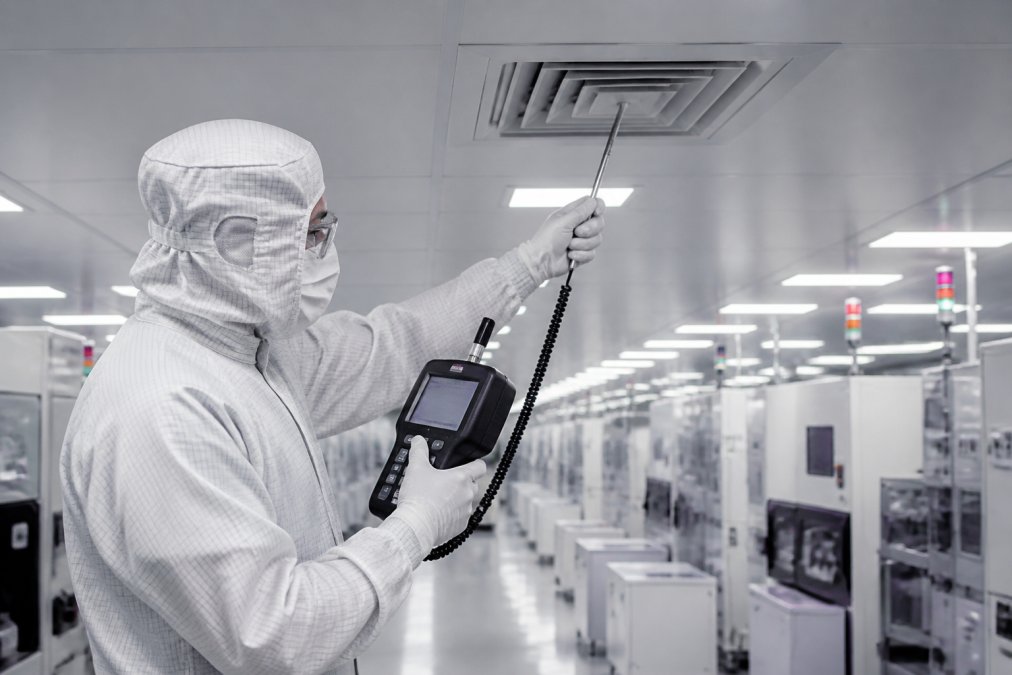
Technician in full protective cleanroom suit with hood and gloves operating a handheld particle counter device while monitoring airflow in a controlled semiconductor fabrication environment with bright overhead lighting and cleanroom infrastructure visible
The Applied Physics Handheld Condensation Particle Counter Model 3800 detects particles as small as 0.01 micrometers (10 nanometers) with a measuring range of 0 to 100,000 particles per cubic centimeter at ±10% accuracy. Real-time monitoring systems like the CRMS integrate particle counting with environmental data to provide holistic cleanroom visibility, supporting both local server control and cloud-based monitoring.
Measurement accuracy in semiconductor cleanrooms depends on sampling location and frequency. ISO 14644-1 specifies minimum sample counts based on cleanroom classification; an ISO Class 6 fab requires 2.83 cubic meters of air sampled per location. A TSI alternative for particle metrology must support programmable sampling protocols that meet these requirements without manual intervention.
Condensation particle counters (CPCs) work by supersaturating air with a working fluid, typically butanol or water, then counting the droplets that form around each particle nucleus. This approach detects particles as small as 3-5 nanometers, far smaller than optical methods can resolve.
The trade-off is sensitivity to particle volatility. Some particles remain stable in the supersaturated environment; others may partially evaporate, leading to undercounting. A TSI alternative for particle metrology must specify the working fluid and operating temperature to ensure compatibility with your exhaust stream composition.
The TSI CPC 3762 exhibits a substantial decrease in counting efficiency for particles in the 6-10 nanometer diameter range ResearchGate study on particle counting efficiency, sometimes exceeding 50% at 8 nanometers. Coincidence correction, which accounts for multiple particles arriving simultaneously, only remains viable up to approximately 8×10⁵ particles per cubic centimeter. ScienceDirect research on dilution systems as alternatives to coincidence correction documents that dilution systems provide a more reliable alternative than mathematical correction algorithms.
Applied Physics offers the Handheld Condensation Particle Counter Model 3800 with integrated data logging for up to 10,000 measurements, USB connectivity for real-time data transfer, and optional thermal printer output for field documentation. The device operates on six AA batteries for up to eight hours or AC power for continuous monitoring.
Sub-micron particles (0.1-1 micrometer) and nanoparticles (0.001-0.1 micrometer) require different detection strategies because their behavior shifts from settling under gravity to remaining suspended in air currents. Optical particle counters excel at detecting particles above 0.5 micrometers but lose sensitivity below that threshold. Condensation particle counters excel at detecting nanoparticles but cannot size-classify them without additional instrumentation.
For most facilities, a hybrid approach works best: deploy optical counters for routine ISO Class monitoring and reserve condensation particle counters for targeted nanoparticle validation studies. Applied Physics’s CRMS supports this hybrid model by integrating multiple sensor types into a unified monitoring platform with centralized data logging and alert management.
Filter-based sampling collects particles on a membrane over a defined period, typically 4 to 24 hours, then counts them offline using scanning electron microscopy (SEM). This approach provides excellent size resolution but cannot detect transient contamination events that occur during process excursions.
Real-time monitoring delivers instantaneous particle concentration data, enabling immediate response when thresholds are exceeded. An optical particle counter provides real-time counts in 5-10 size bins; SEM analysis of a filter sample can resolve hundreds of size classes but requires 24-48 hours of post-processing.
For cleanroom certification, filter-based sampling meets regulatory requirements. For process control, detecting when a filter has failed or a tool is shedding particles, real-time monitoring is essential. Many facilities use both approaches.
Applied Physics’s Microbial Air Sampler 3080 Series combines real-time sampling with microbiological culture analysis, enabling simultaneous detection of viable and non-viable particles. The device draws air at a stable 100 liters per minute with ±2.5% accuracy, supporting ISO 14698-1 compliance for pharmaceutical and biotech cleanrooms.
Time resolution determines whether you can catch transient events. Real-time optical counters typically update every 1-5 seconds. Condensation particle counters may require 10-30 seconds per measurement cycle. A TSI alternative for particle metrology must match your facility’s process dynamics; a semiconductor fab running 5-nanometer processes needs sub-second resolution, while a compounding pharmacy may accept 5-minute sampling intervals.
Measurement accuracy in particle metrology encompasses three distinct concepts: counting accuracy (did the counter detect the correct number of particles?), sizing accuracy (did it assign the correct size to each particle?), and concentration accuracy (does the reported concentration match the true concentration?). Understanding which parameter matters most for your application is critical to selecting a TSI alternative for particle metrology that will not generate false compliance failures or missed contamination events.
Counting Accuracy and the ±10% Standard
A TSI alternative for particle metrology must achieve ±10% counting accuracy, the standard specified in ISO 21501-4, across the full operating range. This accuracy floor is achievable by most modern instruments but requires regular calibration and environmental controls. Temperature fluctuations, humidity spikes, and electronic drift all degrade accuracy over time.
Counting accuracy is most critical in cleanroom certification, where you must demonstrate compliance with ISO 14644 particle count limits, and in process control, where you need to detect when a tool begins shedding particles above baseline. If your facility’s ISO Class 6 limit is 1,000 particles per cubic centimeter and your instrument reads 1,050, you cannot definitively say whether you have exceeded the limit or fallen within the ±10% uncertainty margin. Many facilities adopt a “guard band” approach, setting their internal action limit at 90% of the regulatory limit, ensuring compliance even if the instrument reads high.
Sizing Accuracy and the Nanoparticle Challenge
Sizing accuracy, the ability to correctly assign a particle to its size bin, is where condensation particle counters and optical counters diverge most sharply. Optical counters measure light scattering, which correlates to particle diameter but is not a direct size measurement. A 0.5-micrometer polystyrene latex sphere scatters light differently than a 0.5-micrometer metallic oxide particle, leading to systematic sizing errors if the optical counter is calibrated only on PSL.
For semiconductor fabs, sizing accuracy in the 5-20 nanometer range is critical because particles in this size range directly impact yield at advanced process nodes. A TSI alternative for particle metrology should be validated against your actual particle population, not just PSL calibration spheres.
Signal-to-Noise Ratio: The Overlooked Parameter
Signal-to-noise ratio (SNR) measures how clearly the instrument distinguishes particle signals from background noise. In cleanroom environments where particle concentrations are very low, a weak SNR causes missed particle detections. In semiconductor exhaust streams where concentrations exceed 10⁶ particles per cubic centimeter, poor SNR causes false positives.
SNR is determined by detector sensitivity, electronic noise floor, and optical or electrical path design. In practice, SNR failures manifest as erratic reporting in low-concentration environments or wildly fluctuating counts in high-concentration environments. To evaluate SNR, ask the vendor for the instrument’s “lower detection limit” and “upper concentration limit.” A wide gap between these limits indicates good SNR.
Time Resolution and Transient Event Detection
Time resolution determines the fastest rate at which the instrument can deliver independent measurements. Faster time resolution enables detection of brief contamination spikes but increases data volume. Slower time resolution reduces noise but may miss transient events.
A semiconductor fab running 5-nanometer processes experiences rapid tool state changes; a filter failure can release 10⁶ particles per cubic centimeter in under 10 seconds, requiring sub-second time resolution. A compounding pharmacy has slower contamination dynamics; a 5-minute sampling interval is sufficient.
Applied Physics’s Cleanroom Monitoring System achieves real-time data updates with 1-5 second reporting intervals. For handheld instruments, time resolution is typically 10-30 seconds per measurement cycle, suitable for episodic validation but not for continuous process monitoring.
Trading Off Accuracy, Resolution, and Cost
These three parameters form a trade-off triangle. You can optimize for any two, but the third will suffer:
When selecting a TSI alternative for particle metrology, identify which two parameters matter most for your application, then accept the trade-off on the third.
Purchase price tells only part of the story. A comprehensive total cost of ownership (TCO) analysis for a TSI alternative for particle metrology must account for calibration, maintenance, training, data management, and integration labor.
Handheld Condensation Particle Counter TCO Profile
A handheld CPC like the Model 3800 carries lower upfront cost but higher per-measurement labor burden. Each measurement requires operator time: setup, sampling, data logging, and interpretation. For a pharmaceutical cleanroom conducting quarterly requalification surveys, this translates to roughly 40-80 operator hours annually, adding $3,000-$12,000 in labor cost. Annual calibration and fluid refill are predictable. Over five years, total cost reaches $30,000-$65,000.
This model works well for facilities with episodic validation needs, multiple locations requiring portable instrumentation, budget constraints favoring capital conservation, and staff with existing aerosol measurement expertise.
Integrated Cleanroom Monitoring System TCO Profile
An integrated system like the CRMS carries higher upfront cost but distributes labor across continuous operation. Once installed, the system operates autonomously, logging data 24/7 without operator intervention. Annual calibration and preventive maintenance are higher in absolute terms but lower per measurement when amortized across thousands of daily data points.
Integration labor is the hidden cost driver. A typical CRMS deployment requires 240-380 hours of professional services. Over five years, including hardware amortization, annual calibration, and maintenance, total cost reaches $80,000-$220,000.
This model works well for facilities with continuous monitoring requirements, high-value production where contamination events cost more than monitoring infrastructure, existing IT infrastructure that can absorb integration labor, and regulatory requirements for documented, auditable measurement trails.
Application-Specific Decision Matrix
Low-frequency, single-location facilities (e.g., a small compounding pharmacy conducting quarterly cleanroom certification) should deploy a handheld CPC. Medium-frequency, multi-location facilities (e.g., a contract manufacturing organization with three cleanrooms) benefit from a hybrid approach: one handheld CPC for mobile surveys plus one fixed monitoring station for the primary cleanroom. High-frequency, large facilities (e.g., a semiconductor fab with 10+ process areas) require an integrated system with multiple sensor nodes.
Hidden Costs and Risk Factors
Most facilities underestimate three cost categories: validation downtime (if your cleanroom must be offline for 40 hours to validate a new monitoring system, that carries a hidden cost); data management and archival (integrated systems generate 50,000-500,000 data points per month, requiring IT infrastructure); and calibration supply chain (certified reference aerosols have limited shelf life and 4-8 week lead times, requiring a 6-month supply buffer).
Handheld CPCs require quarterly battery replacement, annual fluid refill, and periodic cleaning of optical surfaces. Integrated systems require monthly sensor checks, quarterly filter replacement, and semi-annual system validation. Establish a spare parts inventory: keep one backup handheld unit on hand and maintain a 12-month supply of filters and consumables.
Applied Physics’s products are designed for rapid deployment and low maintenance burden. The Handheld Condensation Particle Counter Model 3800 requires no installation; unbox, calibrate, and measure.
A TSI alternative for particle metrology must integrate with legacy data acquisition systems without requiring wholesale replacement. Integration complexity depends on communication protocol support. Modern instruments support USB, Ethernet, RS-485, and cloud APIs. Legacy systems may only accept data via serial connections or manual file uploads.
Applied Physics’s products support multiple connectivity options. The Handheld Condensation Particle Counter Model 3800 includes Windows 10-compatible software with USB data transfer, enabling integration with most contemporary data management platforms. The Cleanroom Monitoring System supports both local server control (AirCare Automation) and cloud-based monitoring (Elemental Machines).
Data format compatibility matters more than most engineers expect. Evaluate whether the vendor provides format conversion utilities or API documentation that enables custom integration. A TSI alternative for particle metrology should also support data logging with sufficient local storage to operate independently if network connectivity is lost. The Model 3800 stores up to 10,000 measurements on-device. The CRMS supports both local and cloud data storage, with automatic synchronization when connectivity is restored.
Switching from an established vendor to a TSI alternative for particle metrology requires careful planning to avoid measurement gaps or compliance violations. The transition typically unfolds in three phases: parallel operation, cutover validation, and post-implementation monitoring.
During parallel operation (typically 4-12 weeks), run the new instrument alongside your existing system. Compare measurements on the same air samples to establish equivalence and identify systematic differences. Document all discrepancies in a transition log for regulatory review.
Cutover validation involves demonstrating that the new system meets all applicable standards. For ISO 14644 cleanroom certification, conduct a full particle count survey using the new instrumentation, then compare results to the baseline established with the previous system. For GMP-regulated facilities, the validation protocol must be documented, executed, and approved by Quality Assurance before the new system assumes responsibility for compliance monitoring.
Applied Physics provides validation support through its technical team. The Cleanroom Monitoring System includes pre-installation design consultation, on-site installation and commissioning, sensor calibration certification, and staff training. Post-implementation monitoring focuses on detecting instrument drift and maintaining calibration traceability. Establish a quarterly recalibration schedule using certified reference aerosols. Monitor data trends for systematic shifts that may indicate sensor degradation.
The transition typically takes 3-6 months from decision to full operational deployment.
Choosing a TSI alternative for particle metrology is fundamentally a decision about operational flexibility and long-term cost management. Applied Physics has delivered precision contamination control and semiconductor metrology solutions since 1992, supporting cleanroom managers, process engineers, and quality assurance teams across pharmaceutical, semiconductor, and biotech industries. Our Handheld Condensation Particle Counter Model 3800 detects nanoparticles as small as 10 nanometers with real-time data logging and integrated analysis software. The Cleanroom Monitoring System provides continuous ISO 14644 compliance monitoring with modular hardware options for local control or cloud-based oversight. Contact Applied Physics to discuss how our aerosol instrumentation, calibration standards, and integration expertise can simplify your particle metrology validation and reduce total cost of ownership.
ISO 21501-4 establishes calibration and performance standards for optical particle counters used in cleanroom monitoring. The standard requires traceability to NIST-certified calibration sources, defines particle size accuracy thresholds, and specifies sampling efficiency across different size ranges. Compliance ensures your particle metrology measurements are reproducible and defensible during regulatory audits. Most pharmaceutical and semiconductor facilities require ISO 21501-4 certification for any particle counting instrument used in GMP or ISO 14644 compliance work.
Particle size distribution directly impacts semiconductor yield because even sub-micron particles can cause defects on wafers during fabrication. Particles in the 0.1-1 micrometer range pose the highest risk for photolithography and etching processes. Precise measurement of particle size distribution allows engineers to identify contamination sources, adjust filtration strategies, and maintain the airborne particle concentration targets required for each process node. Real-time monitoring of size distribution enables faster response to cleanroom excursions, reducing scrap and rework costs.
Calibration traceability ensures your particle measurements are accurate and defensible. Without traceability to NIST standards, you cannot prove your instrument is detecting particles at the claimed size or concentration. In semiconductor fabrication, this matters because yield loss claims, supplier disputes, and process validations all depend on credible measurement data. Traceability also satisfies audit requirements from customers and regulatory bodies. Instruments without current, documented traceability can produce data that regulators or customers reject, forcing costly re-testing and process re-qualification.
Prioritize detection limit (ability to measure sub-10 nm particles for advanced semiconductor nodes), time resolution (how quickly the instrument responds to concentration changes), sampling efficiency across your target size range, and integration capability with your existing data systems. Also evaluate total cost of ownership including maintenance, calibration frequency, and downtime. For pharmaceutical cleanrooms, verify ISO 14698-1 compatibility for microbial sampling. For semiconductor fabs, confirm the instrument meets your specific process node requirements and can handle the particle concentration ranges in your facility without coincidence correction errors.
Condensation particle counters (CPCs) excel at detecting particles down to 0.01 micrometers with high sensitivity and real-time response, making them ideal for research and process monitoring. Filter-based sampling captures particles for later analysis but lacks real-time feedback. Scanning mobility spectrometers provide detailed size distribution data but require longer measurement times. The best choice depends on your application: CPCs for real-time monitoring, scanning mobility for detailed characterization, and filter sampling for compliance documentation.
APPLIED PHYSICS TECHNICAL RESOURCE
Wafer inspection, SSIS calibration, particle deposition references, process control and semiconductor measurement workflows. Product and standards references should be interpreted for the actual instrument, facility, protocol and configuration.

Enter your details below to save your shopping cart for later. And, who knows, maybe we will even send you a sweet discount code :)
Allow notifications to get real-time updates about your shopping cart and who knows, you may even receive a sweet discount code 😊