
ELGA water purification systems, the UV chamber balances high-voltage lamp electronics against a continuous stream of pressurized, ultrapure water.
The only barrier preventing catastrophic chamber flooding and shorted ballasts is the dual compression seal seated on the quartz sleeve.
Over thousands of operating hours, intense 185/254 nm radiation and heat degrade these elastomeric O-rings, leading to hairline leaks and sudden TOC spikes.
Applying the correct inspection and replacement protocols protects delicate quartz glassware, keeps downstream water pure, and prevents costly laboratory downtime.
The UV chamber separates the wet process flow from the dry electrical components by seating the UV lamp inside an optical-grade quartz sleeve.
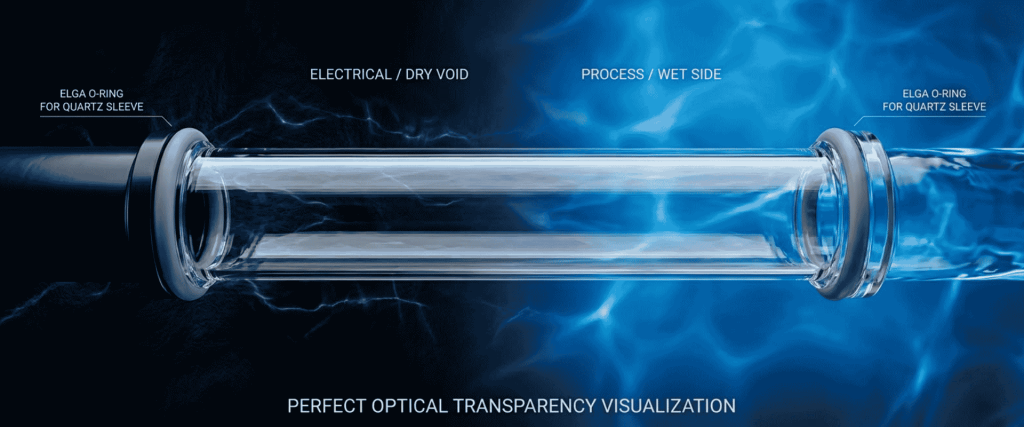
Quartz is chosen because it allows deep UV radiation (especially the fragile 185 nm photolysis line) to penetrate into the water with minimal attenuation.
To isolate the water stream under system operating pressure (typically 1.5 to 4 bar), the assembly relies on a dual-seal geometry:
Both ends must be sealed with matched O-rings. If either seal loses elasticity or shifts off-center, water bypasses the collar, tracks along the outer sleeve wall, and enters the dry enclosure.
Following a consistent procedure eliminates the two biggest risks during chamber maintenance: cracking the quartz sleeve and introducing contaminants into the water stream.
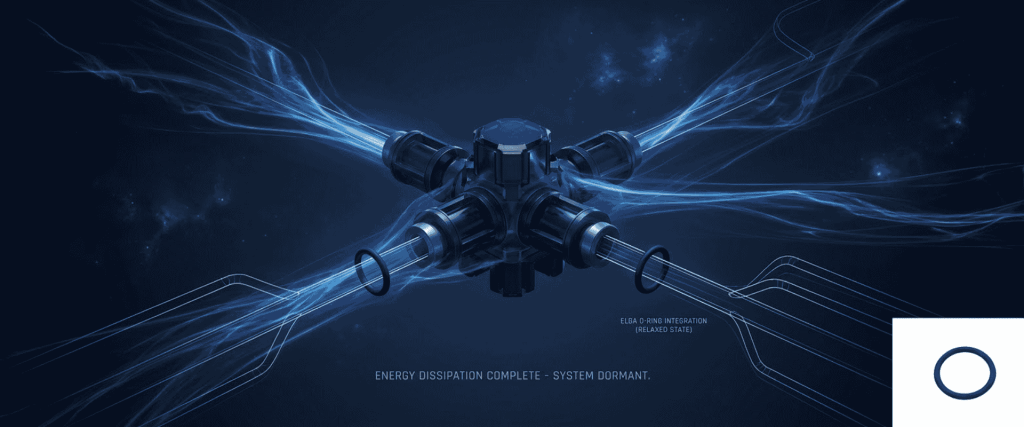
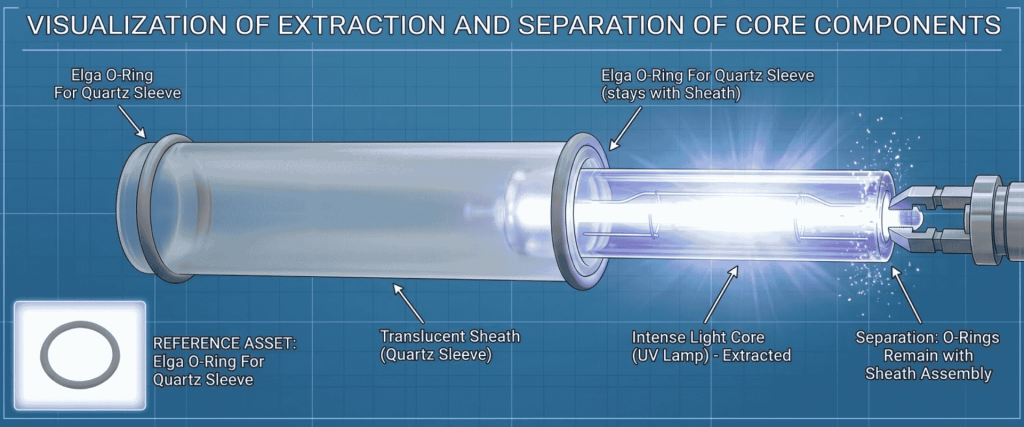
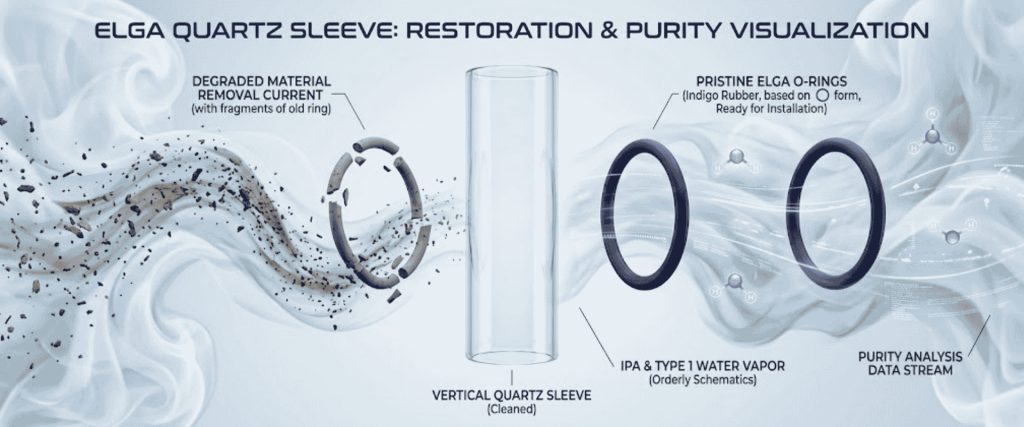
Ring11936).
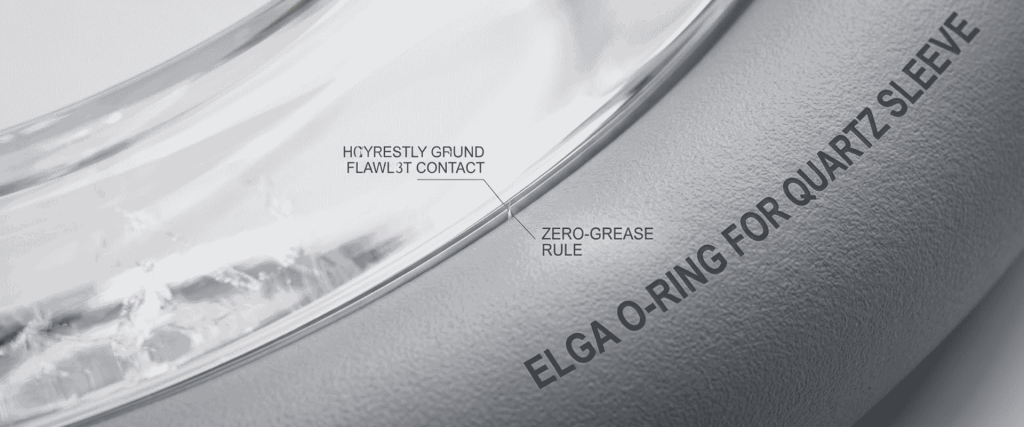
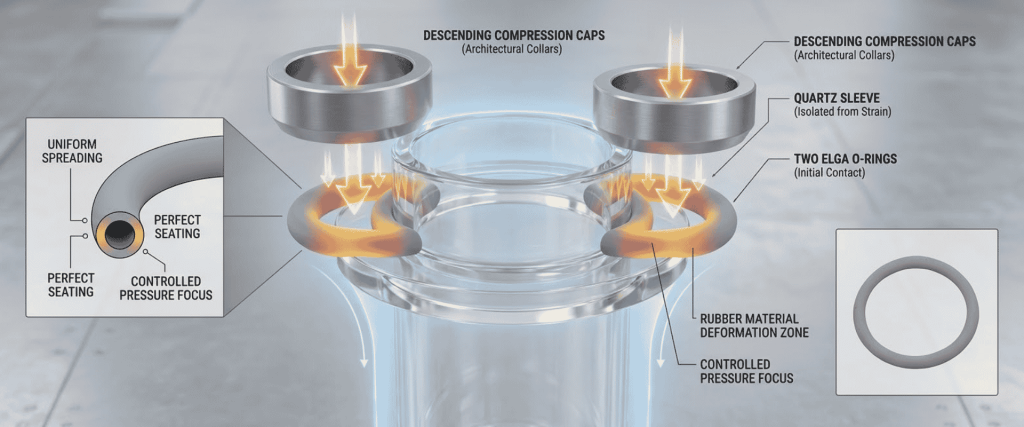
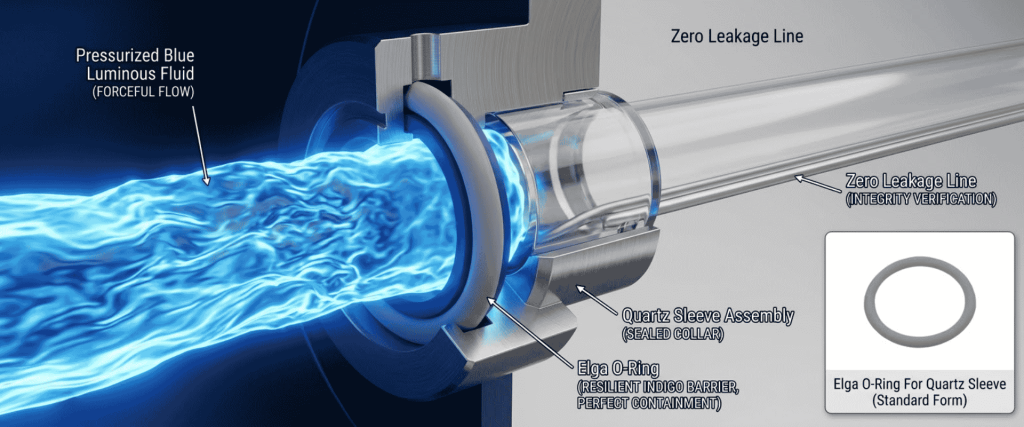
A leaking ELGA UV chamber is rarely caused by a defective metal housing. In almost every case, leaks trace back to physical degradation of the elastomeric O-ring or mistakes made during service.
Standard elastomers fail rapidly inside a UV reactor. The combination of intense 254 nm germicidal flux, 185 nm vacuum-UV radiation, and dissolved ozone ($O_3$) generated in the chamber attacks polymer chains:
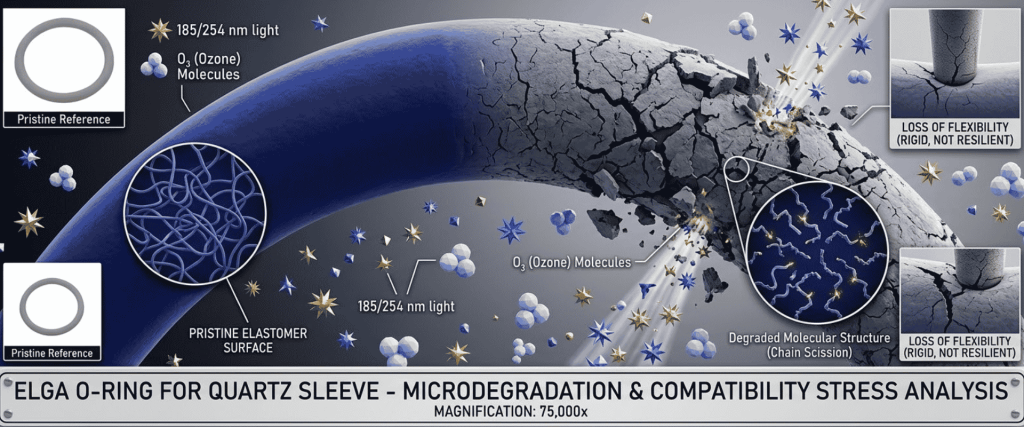
Once elasticity is lost, even small variations in line pressure or thermal cycling will open small leak channels around the quartz boundary.
UV lamps operate with surface temperatures between 40°C and 80°C. Over an 8,000-to-10,000-hour service cycle, this continuous heat bakes the rubber seal directly onto the quartz glass surface.
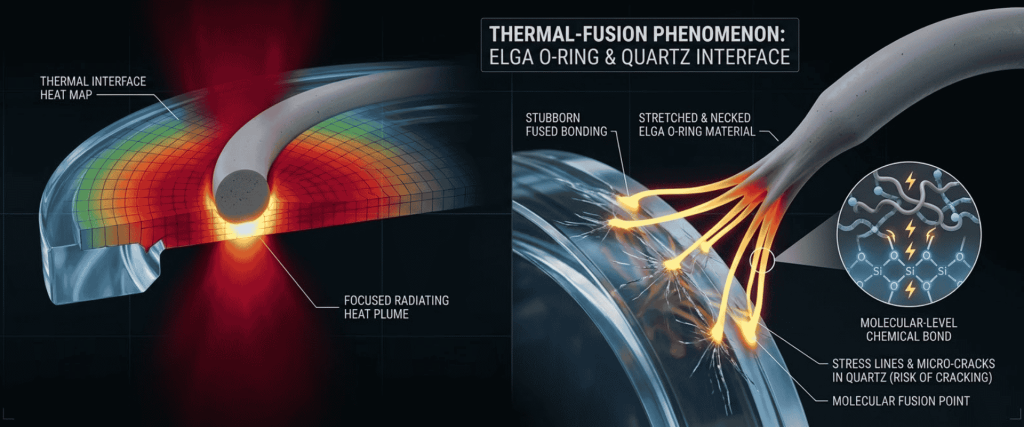
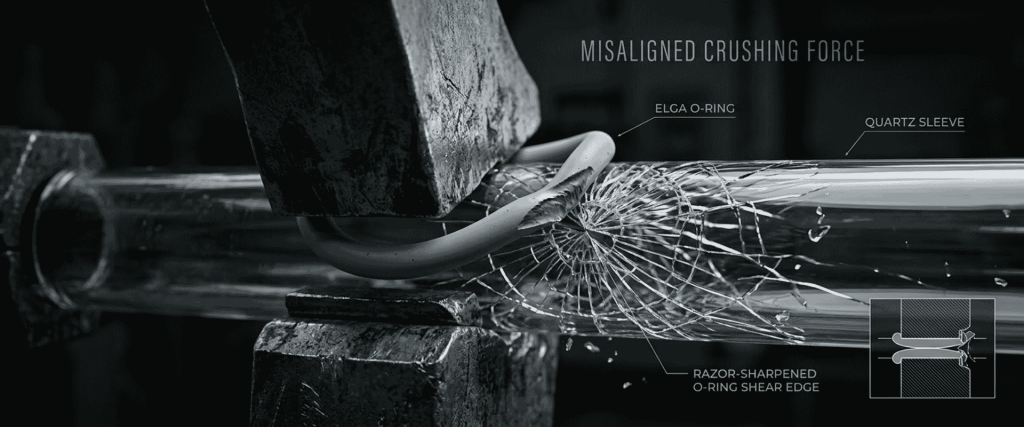
When technicians pull the quartz sleeve for routine inspection, the hardened rubber sticks to the sleeve. Tugging or prying at a stuck seal applies uneven point loads to the thin glass, frequently cracking or shattering the fragile quartz tube.
When a technician spots water dripping from the chamber collar, the natural reaction is often to grab a wrench and tighten the compression cap. With quartz assemblies, this almost always backfires:
UV lamps lose photo-oxidation output after 12 months of runtime and must be swapped. Technicians frequently replace the lamp while leaving the old O-rings in place to save time.
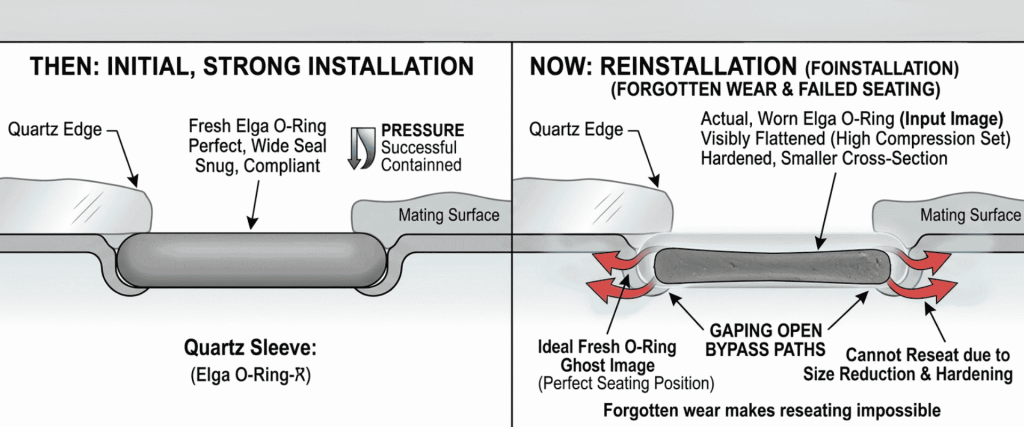
A compressed, hardened seal will not reseat properly once the mechanical compression on the end-cap has been released. Re-pressurizing a reused O-ring is one of the most common causes of immediate leaks following routine service.
| Performance Factor | Fresh Replacement O-Ring (Ring11936) | Aged O-Ring (12–18 Months In-Service) | Worn / Reused O-Ring |
| Material Elasticity | Resilient; high elastic memory | Low; high compression set | Brittle, flattened profile |
| Surface Hardness | 70–75 Shore A | 85+ Shore A (surface glazed) | Hardened; microscopic cracks |
| Sealing Mechanism | Continuous radial and axial contact | Relies on high clamp force | Incomplete; open bypass paths |
| Risk of Sleeve Breakage | None; slides smoothly during service | High; bonded to quartz wall | Extreme; requires force to detach |
| Impact on Water Purity | Zero chemical or organic shedding | Low-to-moderate surface erosion | Organic fragment/plasticizer release |
| Recommended Action | Install dry or water-lubricated | Replace immediately alongside lamp | Discard immediately; do not reuse |
The performance of an ultrapure water loop depends on chemical inertness. A poorly formulated aftermarket seal poses two distinct threats:
Substandard elastomers exposed to 185 nm radiation break down quickly, releasing plasticizers, sulfur compounds, and curing agents into the effluent water. This leads to unexplained TOC spikes that ruin sensitive LC-MS, HPLC, and trace analytical baselines.
Flaking material from degrading seals travels downstream, prematurely clogging final point-of-use (POU) 0.22 µm membrane filters and sterile polishers.
Using factory-dimensioned seals manufactured from UV-stable fluoroelastomer compounds ensures clean chemical compatibility with high-purity water, maintaining baseline TOC levels below 5 ppb.
Preventing UV chamber leaks in ELGA water systems comes down to routine maintenance and careful mechanical handling.
Because the quartz sleeve isolates high-voltage electrical components from pressurized water, a degraded O-ring puts more than your water purity at risk; it threatens critical system electronics.
Make it standard laboratory practice to replace both quartz sleeve O-rings (Part Ring11936) during every annual UV lamp service, never reuse old seals, seat the rings without hydrocarbon lubricants, and tighten compression caps by hand.
This disciplined approach protects expensive quartz glassware, prevents water damage to internal ballasts, and keeps your pure water supply steady and compliant.
They should be replaced every 12 months, ideally during the scheduled annual replacement of the UV lamp (approximately every 8,000 to 10,000 hours of runtime). Never reuse an O-ring after the chamber compression cap has been opened.
No. Greases, oils, and vacuum lubricants should never be used in Type 1 or Type 2 water systems. Hydrocarbon and silicone films wash directly into the pure water stream, fouling polishing cartridges and causing major TOC spikes. Wet the seal with Type 1 water if lubrication is needed.
The quartz sleeve uses a dual-end mechanical seal to isolate the internal lamp bore while allowing water to flow evenly across its outer surface. One O-ring seals the inlet collar, and the second seals the outlet collar. Both must be replaced together to maintain balanced sealing pressure.
APPLIED PHYSICS TECHNICAL RESOURCE
Laboratory water quality, purification architecture, distribution, biofilm control and application-led system selection. Product and standards references should be interpreted for the actual instrument, facility, protocol and configuration.

Enter your details below to save your shopping cart for later. And, who knows, maybe we will even send you a sweet discount code :)
Allow notifications to get real-time updates about your shopping cart and who knows, you may even receive a sweet discount code 😊