
The highly regulated world of pharmaceutical and biotechnology manufacturing, maintaining sterility in cleanroom isolators is non-negotiable.
Contamination can compromise product safety, lead to costly recalls, and endanger patient health. Effective viable air monitoring is a cornerstone of contamination control strategies.
The R2S Microbial Air Sampler stands out as a reliable tool for slit-to-agar sampling in these critical environments.
Understanding Cleanroom Isolators and the Need for Viable Monitoring
Cleanroom isolators provide an ISO 5 (Class 100) environment for aseptic processing. However, even in these controlled spaces, airborne microorganisms can pose risks. Regular monitoring helps detect potential breaches early.
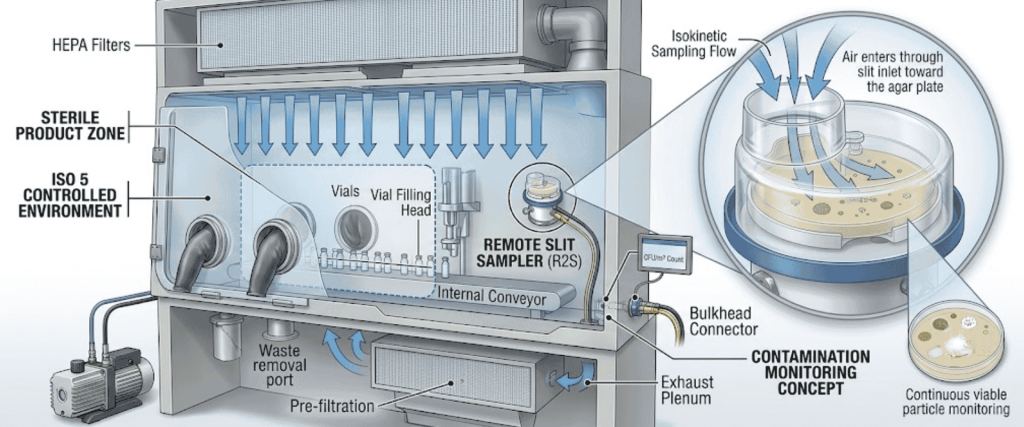
The R2S Sampler, also known as the Remote Slit Sampler, is designed specifically for use in isolators, laminar airflow hoods, and other critical zones. It uses the slit-to-agar method, drawing air through a narrow slit and impacting it onto a standard 90mm agar plate.
Key Features
- Multiple flow rates: 28.3 LPM (1 CFM), 50 LPM, and 100 LPM for flexible sampling volumes.
- Remote operation capability up to 75 feet, ideal for confined spaces.
- Compact design: only 5.5 inches tall and 5 inches in diameter.
- Compatible with standard agar plates, reducing operational costs.
- Low particulate generation, preserving the clean environment.
These features make the R2S an excellent choice for routine monitoring in isolators.
Best Practices for Slit-to-Agar Sampling in Isolators
Implementing effective sampling protocols ensures accurate data and compliance.
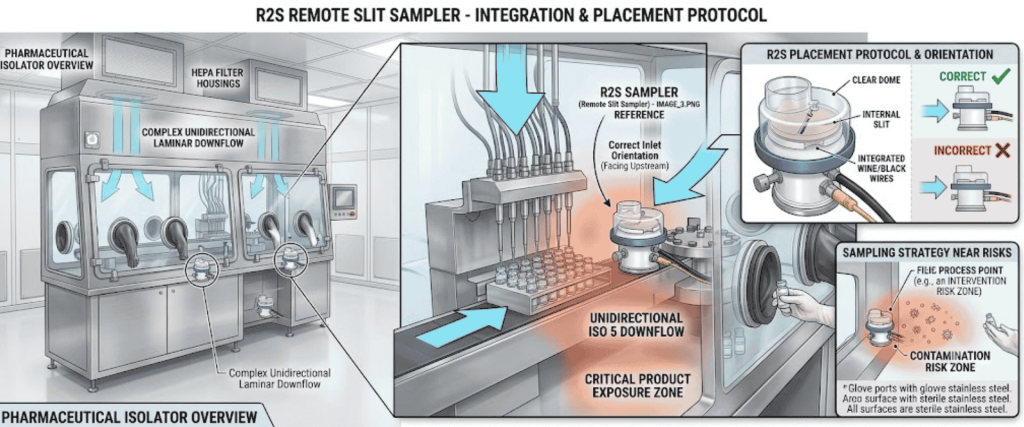
1) Placement and Positioning
Position the sampler at critical points where product exposure is highest, such as near filling lines or open product handling areas. Ensure the inlet is oriented correctly to capture representative air samples.
2) Sampling Frequency and Volume
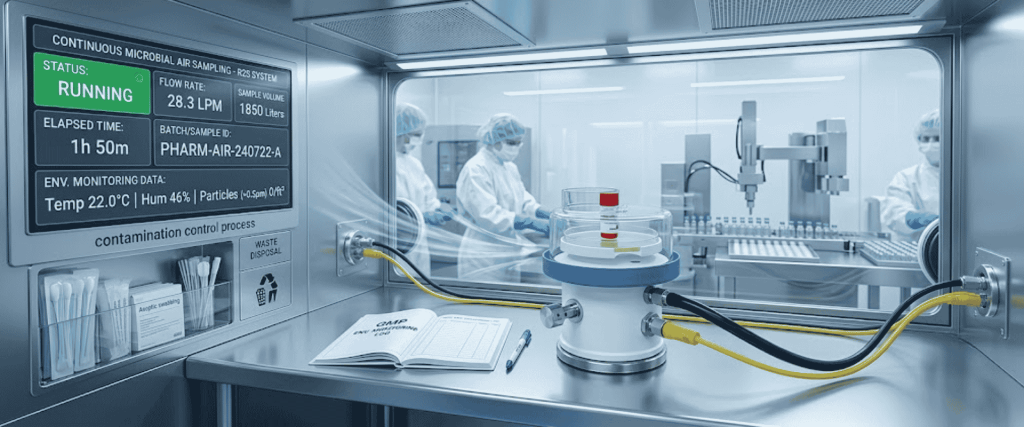
Follow risk-based approaches per USP <1116> and EU GMP Annex 1. For Grade A zones, sample volumes should be sufficient to detect low levels of contamination. Typical volumes range from 1 m³ or more per sample.
3) Media Selection and Handling
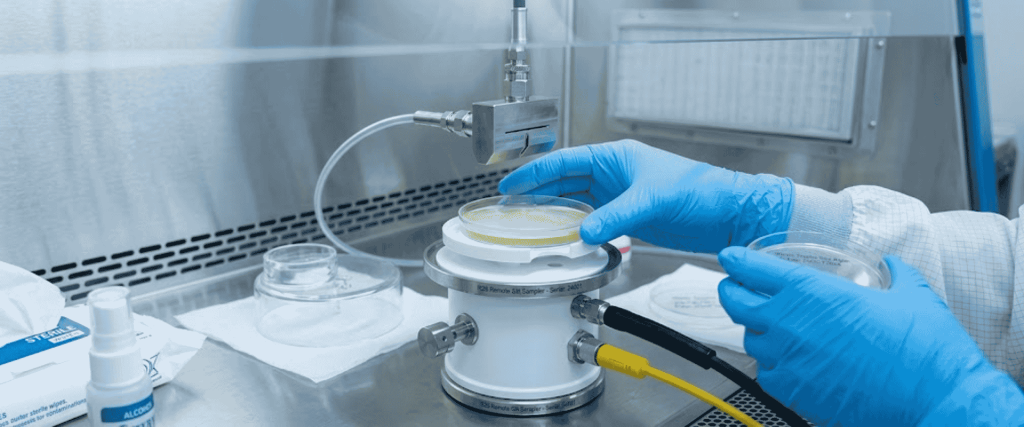
Use Tryptic Soy Agar (TSA) or other validated media. Pre-incubate and post-incubate plates according to validated protocols. Handle plates aseptically to avoid false positives.
Comparison of Common Viable Air Sampling Methods
The table below summarizes practical differences among the most widely used approaches in pharmaceutical cleanrooms and isolators.
| Method | Key Advantages | Limitations | Best Use Case |
| Slit-to-Agar (R2S) | High efficiency; time-resolved data; remote installation; continuous capable | Requires rotating agar; fixed slit geometry | Isolators, Grade A continuous monitoring |
| Sieve Impactor (e.g. P100) | Portable; multiple orifice sizes; good for spot checks | Less ideal for permanent remote install | General cleanrooms, portable investigations |
| Passive Settle Plates | Simple, no equipment, low cost | Low sensitivity; not quantitative for air volume | Supplementary background monitoring only |
Common Challenges and Practical Solutions
- False positives from media handling: Use pre-incubated plates and strict aseptic technique when loading the R2S turntable. The chemically sanitizable dome reduces the risk of introducing contaminants during plate changes.
- Sampler positioning interference: The low-profile remote head minimizes disruption of unidirectional airflow. Periodic smoke studies with an ultrapure fogger confirm that the installed location does not create eddies.
- Calibration drift: Schedule flow verification at least quarterly (or more frequently if required by the quality system). Document results and investigate any deviation beyond established limits.
- Data overload: The V100 controller and associated software help organize dual-sampler results into clear reports, reducing the administrative burden of continuous monitoring programs.
Regulatory Framework and Compliance Considerations
A formal biocontamination-control program is required under multiple overlapping standards.
- ISO 14698-1 and ISO 14698-2 establish principles for assessing and controlling biocontamination in cleanrooms and provide guidance on evaluation of monitoring data. See the official ISO page for ISO 14698-1:2003.
- EU GMP Annex 1 (2022 revision) places strong emphasis on continuous monitoring in Grade A, risk-based location selection, and the need for rapid detection of excursions.
- FDA Guidance for Industry, Sterile Drug Products Produced by Aseptic Processing expects manufacturers to establish scientifically sound environmental monitoring programs that include viable air sampling at critical locations.
- USP <1116> and related chapters provide additional microbiological control concepts for aseptic processing environments.
Building a Complete Contamination-Control Strategy
Viable air sampling is only one pillar of a comprehensive program. Facilities that achieve consistent low bioburden typically combine the R2S with complementary technologies.
- Airflow visualization: Ultrapure cleanroom foggers such as the AP200 Ultrapure Cleanroom Fogger or the AP50 Ultrapure Cleanroom Fogger allow engineers to map unidirectional airflow patterns and identify stagnation zones before they become contamination risks.
- Particle counting: Real-time non-viable particle counters provide continuous trending that can correlate with viable recoveries.
- Surface and personnel monitoring: Contact plates, swabs, and glove prints complete the picture of potential contamination sources.
- Compressed-gas sampling: Dedicated samplers such as the RCG series address another critical utility often overlooked in isolator environments.
By integrating the R2S into this broader toolkit, quality teams gain both the granular data needed for daily decisions and the long-term trends required for continuous process verification.
Conclusion
The R2S Microbial Air Sampler provides accurate, reliable, and compliant microbial monitoring for cleanroom isolators and controlled environments.
Its remote-slit design, calibrated flow options, and seamless integration support effective contamination control strategies.
When combined with particle counting, airflow visualization, and surface monitoring tools, the R2S helps facilities maintain a complete environmental monitoring program.
Frequently Asked Questions (FAQs)
1. What is the primary advantage of slit-to-agar sampling over sieve impactors in isolators?
The continuous rotation of the agar plate provides a time-resolved record of recoveries, which is valuable for correlating contamination events with process steps. The remote-slit architecture also allows permanent installation inside the isolator with minimal disruption.
2. Which flow rate should I choose for the R2S?
28.3 LPM (1 CFM) is the traditional pharmaceutical standard and aligns with many historical data sets. 50 LPM and 100 LPM reduce sampling time for the same 1 m³ volume and are useful when faster turnaround is needed, provided the recovery efficiency has been validated at the higher flow.
3. Can the R2S be used for continuous monitoring during filling operations?
Yes. When controlled by the V100, dual R2S units can be programmed for continuous or sequential sampling throughout the batch, supporting the continuous-monitoring expectations of EU GMP Annex 1 for Grade A environments.