Continuous ISO 14644-1 Environmental Verification Using Point-of-Use Handheld Airborne Particle Counters
The ISO 14644-1 standard defines cleanroom classes from ISO 1 to ISO 9.
Each class specifies the maximum allowable particle concentration per cubic meter of air for various particle sizes, typically ranging from 0.1 μm to 5 μm.
Verification isn’t a one-time event; it requires periodic or continuous monitoring to ensure operational activities haven’t compromised the environment.
Handheld particle counters provide a flexible way to validate these levels.
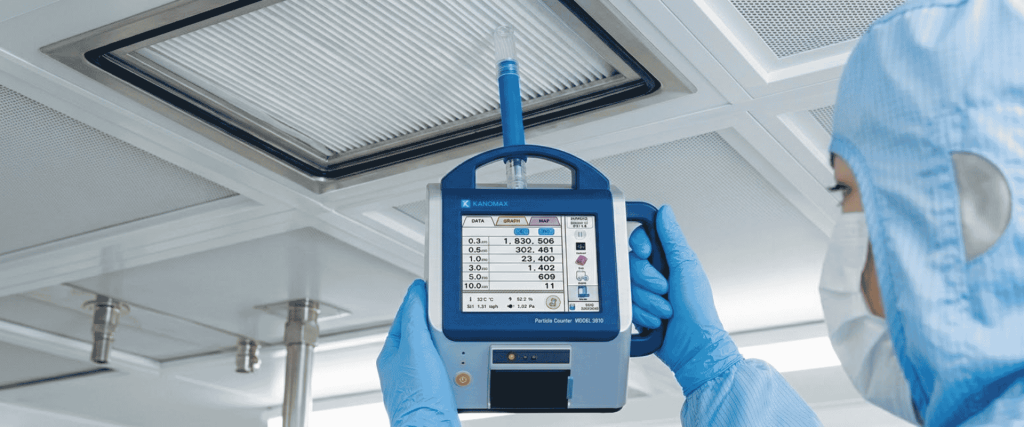
By moving the sensor to the exact location where sensitive work is performed, operators can capture data at the point of use that fixed sensors mounted on walls or ceilings might miss.
Advantages of Point-of-Use Handheld Monitoring
Point-of-use verification focuses on precision and mobility. Here is why handheld units from us are integral to a modern cleanroom strategy:
1) Immediate Contamination Detection
A handheld counter allows technicians to scan surfaces, seals, and HEPA filter faces to detect leaks or particle spikes in real time. This immediate feedback enables faster corrective actions, reducing the risk of product loss.
2) Flexibility in Dynamic Environments
Cleanrooms are rarely static. New equipment, changing personnel counts, and shifting workflows can alter airflow patterns.
Portable particle counters offer the agility to test new configurations immediately, ensuring that ISO 14644-1 limits are maintained regardless of changes in the room layout.
3) Simplified Calibration and Validation
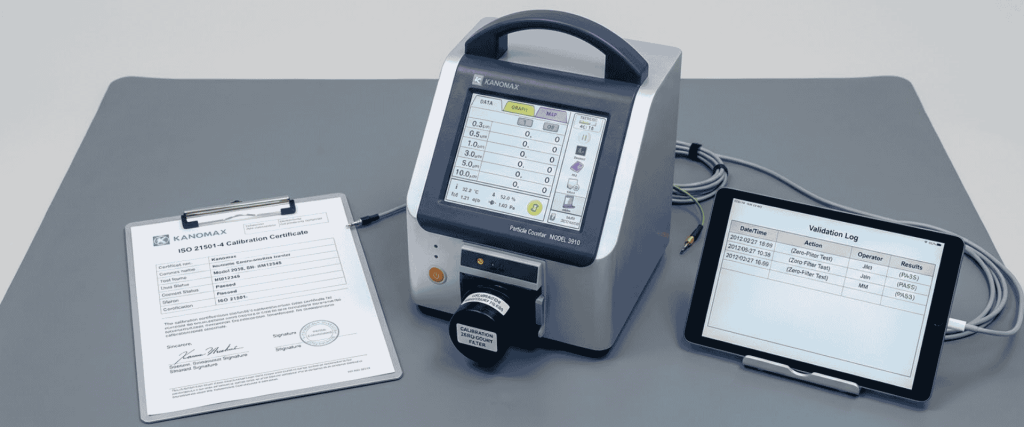
Our handheld counters are designed to meet ISO 21501-4 calibration standards. This ensures that the data collected is accurate, repeatable, and ready for use in official compliance reports or audits.
Key Features of Our Portable Particle Counters
The efficiency of an environmental verification program depends on the hardware used. The portable particle counters available through us are built for professional rigor.
Technical Comparison: Handheld vs. Fixed Monitoring Systems
Implementing a Continuous Verification Strategy
To successfully use handheld counters for ISO 14644-1 verification, organizations should follow a structured sampling plan. This includes defining the number of sampling locations based on the cleanroom’s area, ensuring the probe is positioned at work-height, and documenting results consistently.
By integrating handheld units into daily Standard Operating Procedures (SOPs), facilities move from a reactive posture to a proactive one. Instead of waiting for a quarterly audit to find a problem, teams can verify cleanliness before every shift or batch run.
Conclusion
They provide the necessary bridge between permanent monitoring and the need for localized, point-of-use accuracy.
With the right portable technology, maintaining a sterile or clean environment becomes a manageable, data-driven process that protects both the product and the end-user.
Frequently Asked Questions (FAQs)
1. What is the benefit of a handheld counter over a fixed sensor?
Handheld counters offer mobility, allowing you to test specific workstations, tools, or HEPA filters where fixed sensors cannot reach. They are also more cost-effective for small-scale operations needing spot verification.
2. Does the device comply with ISO 21501-4?
Yes, professional-grade handheld particle counters from us are calibrated to ISO 21501-4 standards, ensuring accurate and consistent measurement of particle size and concentration.
3. Can these devices detect particles smaller than 0.3 micrometers?
Most standard handheld units have a sensitivity starting at 0.3 μm. For specialized applications requiring 0.1 μm sensitivity, specific high-sensitivity models are required, which are typically larger or utilized in different configurations.
4. How often should a handheld particle counter be calibrated?
To maintain accuracy for ISO 14644-1 verification, it is generally recommended to calibrate the device annually or as specified by the manufacturer and your internal quality system.
APPLIED PHYSICS TECHNICAL RESOURCE
Continue from the technical question to the application
Airflow visualization, smoke studies, tracer delivery, particle monitoring and controlled-environment validation. Product and standards references should be interpreted for the actual instrument, facility, protocol and configuration.