
Last Updated: August 11, 2026
Ultrapure water foggers generate ultra-fine mist using deionized water or liquid nitrogen to visualize airflow patterns and validate contamination control in controlled environments. Unlike standard humidifiers or decorative foggers, ultrapure water foggers produce consistent, non-contaminating fog that reveals how air moves through cleanrooms, biosafety cabinets, and laminar flow workstations without introducing particles or minerals that compromise product integrity.
At Applied Physics, we’ve worked with cleanroom managers and process engineers for over three decades to understand what separates effective airflow visualization from equipment that simply produces visible mist. The difference comes down to water purity, droplet size consistency, and fog persistence, three factors that directly impact whether your validation actually shows you what’s happening in your critical environment.
The core function is straightforward: the fogger atomizes ultra-pure water into microscopic droplets suspended in air. These droplets follow airflow patterns, making invisible air currents visible to the human eye and to video documentation systems. When you see the fog move in unexpected directions, pool in corners, or fail to clear from dead zones, you’re observing real contamination risks that standard particle counters alone might miss.
This visualization capability matters because airflow patterns determine whether contaminants reach your product or settle safely away from it. A cleanroom that passes initial certification can develop dead zones as equipment shifts, wear patterns change, or HVAC performance degrades. Ultrapure water foggers let you detect these changes without waiting for particle count failures or regulatory findings.
Cleanrooms face a fundamental challenge: you cannot see where contaminants will go without understanding how air moves. Particle counts tell you what’s already in the environment, but they don’t show you the pathways that brought those particles there or where new ones will travel next.
Standard tap water or mineral-laden water creates its own contamination problem. Dissolved minerals, chlorine, and trace elements deposit on surfaces as water evaporates, creating residue that introduces exactly the particles you’re trying to prevent. Ultrapure water, whether deionized water processed through reverse osmosis or liquid nitrogen vapor, leaves no mineral buildup and no contaminant trail.
The problem compounds in pharmaceutical manufacturing and semiconductor fabrication. A single particle in the wrong location can render a batch unusable. In semiconductor fabs targeting sub-10nm nodes, even trace mineral contamination on wafers or in laminar flow zones creates yield losses that cost thousands per hour of downtime. In sterile compounding pharmacies operating under USP 797 standards, airflow failures mean potential microbial contamination in medications intended for patient injection.
Ultrapure water foggers solve this by providing real-time, visible evidence of airflow integrity. You see laminar flow patterns, identify turbulence zones, and spot recirculation problems that particle counts alone would not reveal until contamination had already occurred. This proactive visibility prevents the costly discovery of airflow failures during production runs or regulatory audits.
Cleanroom airflow visualization using ultrapure water foggers reveals laminar flow integrity, turbulence patterns, and air velocity distribution across work zones. When you introduce ultra-fine fog into a cleanroom with properly functioning laminar flow, you observe a smooth, directional movement of air from supply diffusers toward return vents. Disruptions in this pattern indicate equipment placement problems, filter degradation, or HVAC imbalances that require immediate correction.
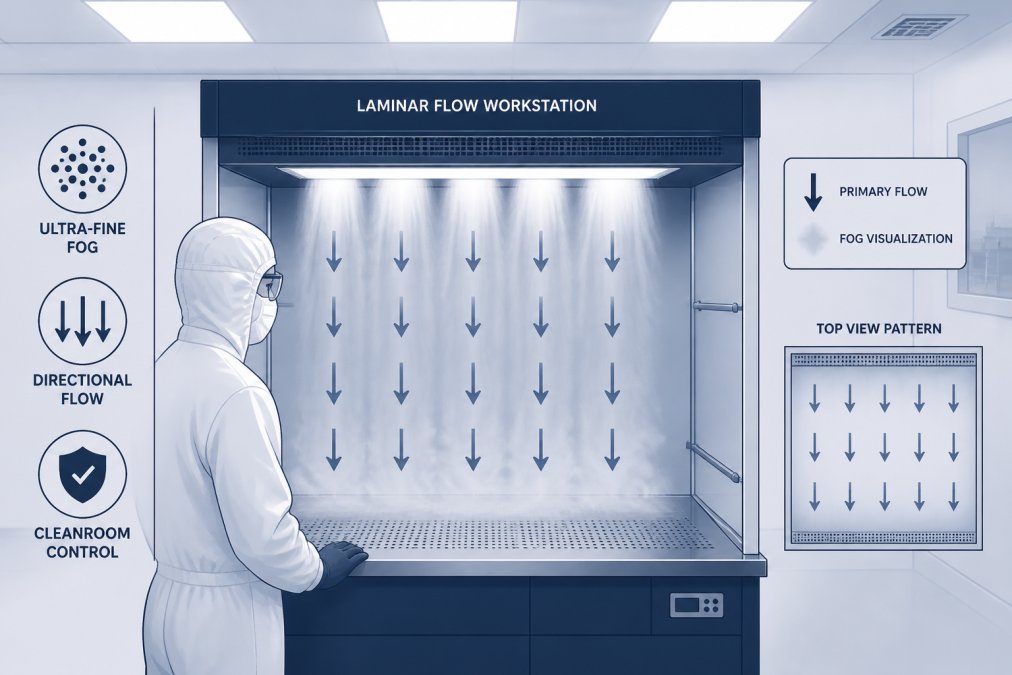
Cleanroom technician in protective suit observing ultra-fine fog flowing smoothly downward across a laminar flow workstation, with fog patterns clearly showing directional airflow movement under bright overhead lighting in a sterile pharmaceutical environment
The visualization process works because fog particles are small enough to follow air currents but visible enough for human observation and video documentation. You introduce the fog near the top of the cleanroom or near air supply points, then observe how it disperses. Ideal laminar flow shows fog moving uniformly downward with minimal lateral drift. Turbulent zones show fog swirling, eddying, or stalling, clear indicators of contamination risk.
This method catches problems that instrumentation alone misses. A particle counter positioned at one location tells you the count at that point, not whether air is moving correctly throughout the entire zone. Airflow visualization shows you the complete picture: where air enters, how it moves through the space, and where it exits. Dead zones where fog accumulates instead of clearing represent areas where contaminants will settle rather than being exhausted.
Proper ultrapure water fogging reveals the actual flow behavior without introducing contamination that would compromise your validation.
The distinction between ultrapure water and standard tap water determines whether your fogging creates validation data or contaminates your environment. Tap water contains dissolved minerals, chlorine residue, and trace elements that deposit as water evaporates, leaving behind particles that defeat the purpose of cleanroom validation.
When standard water fog evaporates in a cleanroom, mineral residue remains on surfaces, equipment, and in the air as suspended particles. This mineral buildup introduces exactly the contaminants you’re trying to detect and control. In semiconductor manufacturing, calcium and magnesium deposits interfere with wafer processing and metrology equipment. In pharmaceutical compounding, mineral particles create the very contamination risk your airflow validation is designed to prevent.
Ultrapure water, processed through reverse osmosis, deionization, or generated as liquid nitrogen vapor, leaves no residue. DI water contains fewer than 10 parts per million of dissolved solids, eliminating mineral deposit risk. Liquid nitrogen fogging produces vapor with zero mineral content, making it the purest option for ultra-sensitive applications like sub-10nm semiconductor validation.
The cost difference between ultrapure and standard water is minimal. A reverse osmosis system or deionized water supply costs far less than the contamination consequences of using tap water in your cleanroom. One batch loss from mineral-induced defects exceeds the annual cost of proper water purification.
ISO 14644-1 cleanroom certification requires documented evidence of unidirectional airflow velocity and pattern integrity as part of initial qualification (IQ) and periodic requalification. Ultrapure water fogging provides visual, documented proof of laminar flow performance that satisfies regulatory auditors and validates your cleanroom classification across ISO 14644 Classes 3 through 8.
The standard specifies minimum airflow velocities: Class 5 cleanrooms require 0.45 meters per second (±20%) of unidirectional airflow, while Class 6 and 7 spaces require 0.36 meters per second. Visual airflow documentation using fog satisfies this requirement more completely than particle count data alone. When you document fog movement patterns on video with timestamp and location markers, you create evidence that shows the complete airflow picture rather than isolated measurement points.
Proper fog testing methodology follows these steps: (1) Introduce fog at multiple supply points across the cleanroom ceiling or air intake zones, (2) observe fog movement for a minimum of 60 seconds at each location to establish pattern consistency, (3) document any areas where fog stalls, swirls, or fails to move toward exhaust points, (4) record video with clear identification of the cleanroom zone, time, and date for audit documentation. This visual record becomes part of your facility’s qualification file and supports requalification audits.
For ISO 14644 Class 5 cleanrooms used in pharmaceutical manufacturing and semiconductor processing, airflow visualization becomes critical during annual or biennial requalification. Equipment shifts, filter degradation, and HVAC performance changes can compromise airflow integrity without immediately affecting particle counts. Fog testing reveals these changes before they create contamination events, allowing corrective action during scheduled maintenance rather than emergency interventions. The FDA and PDA expect cleanroom operators to maintain documented evidence of airflow integrity; fog visualization provides that evidence in a format that auditors recognize and accept.
Common acceptance criteria for fog testing include: (1) Laminar flow pattern visible across 90% or more of the work surface, (2) no visible turbulence or eddy patterns in critical work zones, (3) fog clearing from the space within 30-60 seconds of source removal, (4) no dead zones where fog accumulates instead of being exhausted. If fog testing reveals areas that fail these criteria, you document the finding, implement corrective action (such as HVAC adjustment or equipment repositioning), and repeat fog testing to confirm resolution before resuming production activities.
Proper documentation includes: date and time of testing, cleanroom classification being validated, names and signatures of personnel performing the test, video or photographic evidence of fog patterns, any deviations from expected airflow behavior, and corrective actions taken. This documentation package satisfies FDA Form 483 observations related to environmental monitoring and supports your defense during regulatory inspections.
Ultrasonic foggers generate fog through high-frequency vibration of a piezoelectric element that atomizes water into ultra-fine droplets. Over time, mineral deposits accumulate on the piezoelectric surface, reducing atomization efficiency and eventually causing complete failure. Proper maintenance prevents mineral buildup and extends equipment life significantly.
The maintenance process begins with water quality control. Using only ultrapure water, DI water or distilled water with less than 10 ppm dissolved solids, prevents mineral accumulation on the piezoelectric element. Many facilities make the mistake of using tap water or lightly filtered water, which deposits minerals within days of operation. This shortens equipment life and forces frequent replacement of fogging components.
Regular cleaning of the piezoelectric element extends equipment performance. Monthly disassembly and inspection of the fogging chamber allows you to identify early mineral buildup before it affects fog consistency. A soft brush and ultrapure water rinse removes surface deposits. For heavier buildup, a dilute white vinegar solution dissolves mineral deposits without damaging the piezoelectric element or internal seals.
Replacement of fogging cartridges or piezoelectric elements should follow manufacturer specifications rather than waiting for failure. Preventive replacement costs less than emergency repairs and eliminates unplanned downtime during critical validation activities.
Storage conditions matter for extended equipment life. When storing fogging equipment between uses, ensure the fogging chamber is completely empty to prevent mineral deposits from drying inside. Store equipment in a clean, dry environment away from dust and contaminants that could enter the system during storage.
Contact Us →
Pharmaceutical manufacturers use ultrapure water foggers to validate airflow in sterile compounding environments, biosafety cabinets, and isolator systems that require USP 797 compliance. Compounding pharmacies operate under strict contamination control standards, and airflow validation directly supports regulatory compliance and patient safety. When a pharmacy validates laminar flow integrity using fog visualization, they document that air moves correctly across the compounding surface, protecting medications from microbial and particulate contamination.
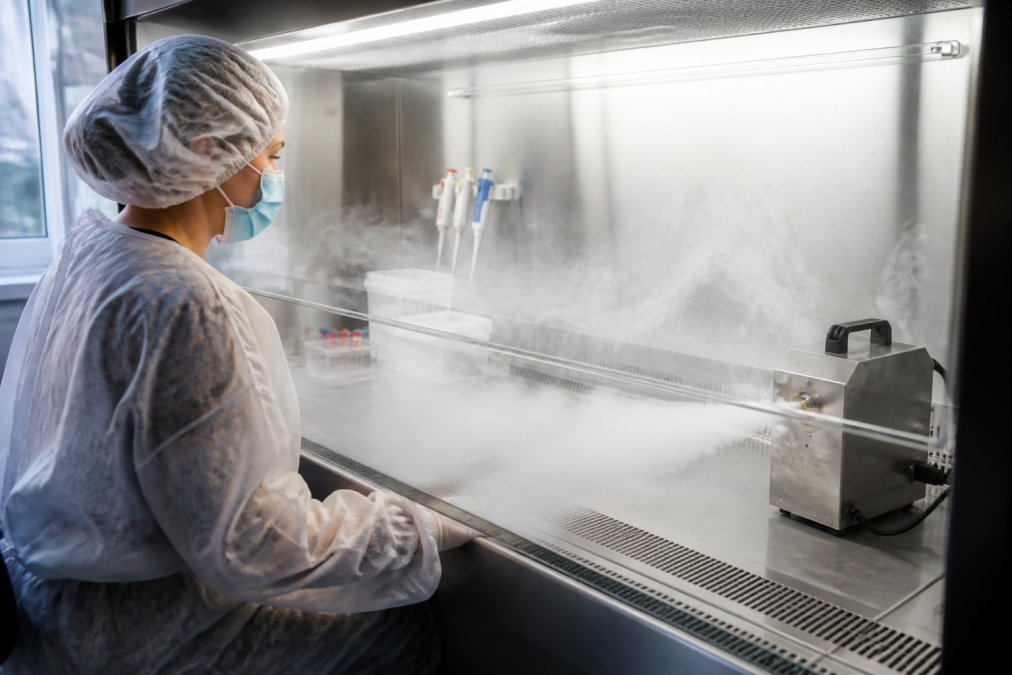
Quality assurance officer in sterile compounding pharmacy wearing protective equipment observing ultra-fine fog flowing across a biosafety cabinet work surface, with fog patterns clearly visible under bright lighting in a controlled pharmaceutical environment
Semiconductor fabrication facilities use ultrapure water foggers for HVAC validation, fab bay airflow mapping, and sub-10nm particle detection support. At 5nm and sub-5nm node production, even trace mineral contamination creates yield-limiting defects. Fabs use fog visualization to validate that cleanroom airflow removes particles from critical process areas and prevents particle migration between process tools.
Biotech research institutions use ultrapure water fogging in ISO-certified cleanroom environments where cell culture, vaccine production, or gene therapy work requires contamination control. Airflow visualization confirms that the facility maintains proper environmental conditions for sensitive biological processes.
Nanotechnology research centers rely on ultrapure water foggers for particle metrology support and cleanroom validation. When working with nanoparticles and sub-micron materials, cleanroom integrity becomes critical for both product quality and researcher safety. Fog visualization reveals whether the facility maintains proper containment and airflow patterns.
These applications share a common requirement: visual, documented proof that airflow patterns protect products and processes from contamination. Ultrapure water fogging provides that proof in a form that satisfies regulatory auditors, internal quality teams, and operational managers.
Systematic troubleshooting of ultrapure water foggers requires a diagnostic sequence that isolates whether the problem originates from water quality, equipment condition, or operational setup. Begin with the most common cause: water purity degradation.
Water Quality Diagnostics
Fog generation stops or becomes inconsistent when water purity drops below acceptable levels. Test your DI water supply using a conductivity meter; ultrapure water should measure below 10 microsiemens per centimeter (µS/cm). If conductivity exceeds 20 µS/cm, your water source has degraded significantly. Check your deionization cartridge’s service life, most cartridges remain effective for 500-1000 liters of water before requiring replacement. If you’ve exceeded the cartridge’s rated capacity, regenerate or replace it immediately. If conductivity is within acceptable range but fogging still fails, proceed to equipment diagnostics.
Piezoelectric Element and Mineral Buildup
Weak or no fog output typically indicates mineral buildup on the piezoelectric element, the most common failure mode in ultrasonic foggers. Disassemble the fogging chamber and inspect the piezoelectric surface under bright light. White, tan, or brownish deposits indicate mineral accumulation. Clean the element using a soft-bristled brush (avoid metal brushes that damage the ceramic surface) and ultrapure water rinse. For stubborn deposits, soak the chamber in a dilute white vinegar solution (1 part white vinegar to 4 parts ultrapure water) for 15 minutes, then rinse thoroughly with ultrapure water and allow to air dry completely before reassembly.
If cleaning does not restore fog output, the piezoelectric element may have internal damage or delamination. Measure the element’s resonant frequency using a multimeter set to resistance mode; a healthy piezoelectric element typically shows resistance in the 100-500 ohm range at its operating frequency. If resistance exceeds 1000 ohms or shows no frequency response, the element requires replacement.
Inconsistent Fog Density and Persistence
Inconsistent fog density across multiple uses suggests either low water level or restricted air intake ports. Check water level before each use and refill to the marked line using only ultrapure water. Inspect air intake ports for dust, lint, or debris accumulation and clean using compressed air at 30-40 PSI or a soft brush. If fog density remains inconsistent after these checks, the piezoelectric element may be producing droplets that are too large, indicating partial mineral coating or element wear.
Fog that dissipates too quickly usually indicates that cleanroom humidity is too low or that droplet size has increased. Cleanroom humidity should be maintained between 45-65% relative humidity for optimal fog persistence. If humidity is within range but fog still dissipates in under 20 seconds, the piezoelectric element is likely degraded and requires replacement. Fog that persists too long (over 90 seconds) suggests droplets are too large; this indicates the same element degradation and requires replacement.
Sputtering, Turbulent Fog, or Incomplete Atomization
Equipment that produces fog but with visible turbulence, sputtering, or incomplete atomization indicates water supply contamination or low water level. Verify water purity first using a conductivity meter. If purity is acceptable, check water level and refill if necessary. If the problem persists after refilling with fresh ultrapure water, the piezoelectric element likely has internal damage or partial delamination. Attempt one cleaning cycle with dilute vinegar solution; if sputtering continues, replace the piezoelectric element.
Decision Framework for Repair Versus Replacement
Use this framework to decide whether to repair or replace equipment:
Storage and Prevention
When storing fogging equipment between uses, ensure the fogging chamber is completely empty to prevent mineral deposits from drying inside and hardening. Store equipment in a clean, dry environment away from dust and contaminants that could enter the system during storage. If equipment will be stored for more than two weeks, run a final cleaning cycle with ultrapure water and allow the chamber to dry completely before sealing.
Maintenance schedules reduce troubleshooting frequency: inspect the piezoelectric element monthly, replace the DI cartridge every 6-12 months depending on water usage, and perform a complete system cleaning every quarter. This preventive approach eliminates most emergency failures and ensures your fogger is ready when validation activities are scheduled.
Ultrapure water foggers solve a critical problem in cleanroom operations: making invisible airflow visible so you can validate contamination control before failures occur. By choosing equipment designed specifically for industrial airflow visualization, with consistent fog generation, proper water purity handling, and documented performance, you gain the evidence needed for regulatory compliance and operational confidence.
Applied Physics has supported cleanroom validation and contamination control for more than three decades, offering equipment specifically engineered for pharmaceutical manufacturing, semiconductor fabrication, and biotech research environments. Our ultrapure water foggers and complementary aerosol measurement equipment provide the precision contamination control and airflow visualization that ISO 14644 certification and GMP compliance require. Contact us to discuss how ultrapure water fogging can strengthen your facility’s validation protocols and reduce contamination risk.
Ultrapure water (deionized or DI water) contains no dissolved minerals, salts, or contaminants that would deposit on sensitive equipment or contaminate the cleanroom environment. Standard tap water leaves mineral residue that interferes with particle count readings, damages semiconductor wafers, and violates ISO 14644 contamination standards. Ultrapure water fog disperses completely without leaving residue, ensuring accurate airflow visualization and maintaining the integrity of your controlled environment.
Standard fog machines use mineral-laden tap water or glycol-based solutions that leave visible deposits and contaminate cleanrooms. Ultrapure water foggers use deionized water and ultrasonic or liquid nitrogen atomization to create fine, contaminant-free fog particles that disperse completely. This difference is critical for GMP compliance, semiconductor metrology, and pharmaceutical manufacturing where even trace mineral deposits can cause product failures or regulatory violations.
No. Because they use ultrapure water with no dissolved minerals, the fog evaporates completely without leaving deposits. This makes them safe for use around wafer inspection equipment, cleanroom surfaces, and sterile compounding areas. Standard fogging equipment leaves visible mineral buildup that requires expensive cleaning cycles and creates contamination risks.
Even with ultrapure water, ultrasonic transducers require regular cleaning and validation. Use only deionized water to refill your system, inspect transducers monthly for scale deposits, and follow your equipment manufacturer’s recommended maintenance schedule. Reverse osmosis-treated water is ideal for preventing any residual mineral accumulation. Proper maintenance ensures consistent fog density and extends equipment lifespan.
APPLIED PHYSICS TECHNICAL RESOURCE
Airflow visualization, smoke studies, tracer delivery, particle monitoring and controlled-environment validation. Product and standards references should be interpreted for the actual instrument, facility, protocol and configuration.

Enter your details below to save your shopping cart for later. And, who knows, maybe we will even send you a sweet discount code :)
Allow notifications to get real-time updates about your shopping cart and who knows, you may even receive a sweet discount code 😊