Cleanroom airflow validation is essential in pharmaceutical, semiconductor, and sterile medical-device manufacturing.
Airflow visualization studies (smoke studies/AVS) help demonstrate that air moves as intended, protects critical areas, and minimizes turbulence around open products and processes.
Traditional liquid-nitrogen (LN2) foggers produce residue-free fog but may have limits in fog density, throw distance, operating time, and buoyancy control.
The AP50 Ultrapure Cleanroom Fogger by Applied Physics USA is designed to support clear and effective airflow visualization for cleanroom validation.
Introducing the AP50 Ultrapure Cleanroom Fogger
The AP50 belongs to the AP-series of ultrapure LN2 foggers. It combines liquid nitrogen with deionized (DI) or water-for-injection (WFI) water to generate a dense, neutrally buoyant fog.
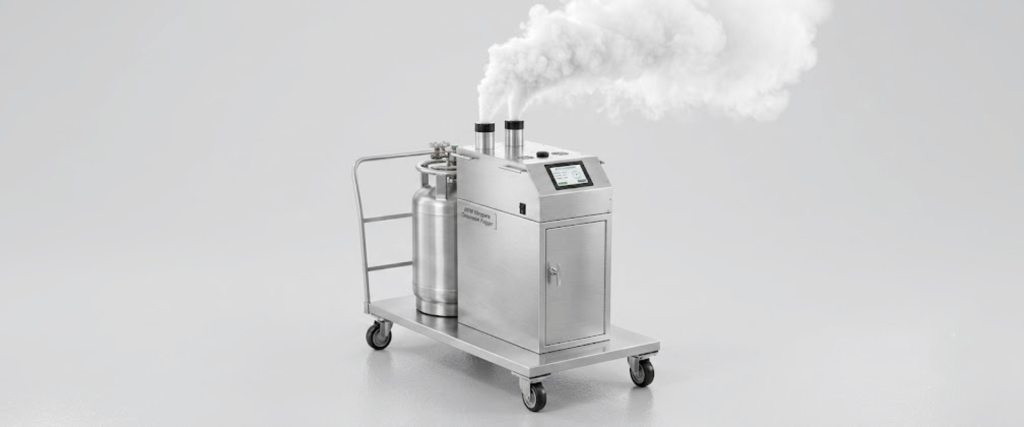
Dual independent fog valves allow operators to adjust plume volume and shape on demand. The system is portable, cleanroom-compatible, and designed for continuous operation during extended smoke-study sessions.
Key published performance
- Fog output of 10–12 m³ per minute, approximately double the volume of earlier AP35-class units
- Visible airflow distance of 18–25 feet under typical cleanroom conditions
- Continuous runtime of up to 75 minutes per fill
- Total fog volume of 750–900 m³ per operating cycle
These numbers translate directly into fewer interruptions, fuller three-dimensional mapping, and clearer video evidence for auditors.
The Critical Role of Airflow Visualization in Cleanrooms
Airflow visualization, or smoke studies, helps confirm that cleanroom air moves in the intended direction without turbulence, stagnant areas, or reverse flow.
Standards and guidance, including ISO 14644-3, EU GMP Annex 1, and FDA aseptic processing guidance, recognize airflow testing as an important part of cleanroom qualification.
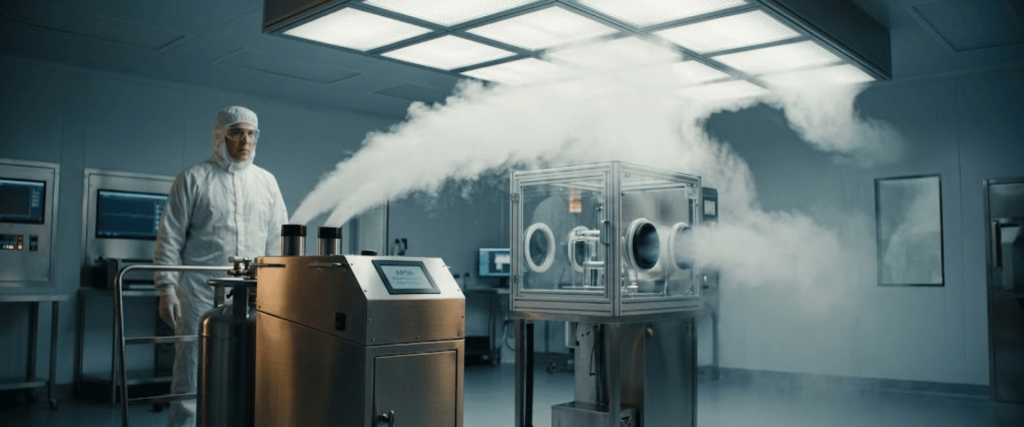
Video records are commonly reviewed during inspections, including tests under both static and dynamic conditions.
A high-quality, non-toxic fog source makes airflow patterns visible around HEPA filters, isolators, RABS doors, and critical process areas. This helps identify airflow risks, reduce repeat testing, and support compliance.
Limitations of Traditional LN2 Foggers
Conventional LN2-only foggers generate fog by rapidly expanding liquid nitrogen. While chemically pure, several practical shortcomings limit their usefulness in modern validation work.
- Low fog density and volume: Many legacy units produce only 2–5 m³ of fog per minute. The plume dissipates before it can travel across larger cleanrooms or map three-dimensional flow fields.
- Limited visible distance: Visible airflow often ends within 8–12 feet, insufficient for mapping open suites or long unidirectional-flow benches.
- Short continuous runtime: Frequent refilling interrupts video capture and forces operators to restart test sequences.
- Buoyancy challenges: Pure LN2 fog can be colder and denser than ambient air, causing the tracer to sink rather than follow true airflow paths, especially problematic in low-velocity zones.
- Single-nozzle design: Restricted plume geometry makes simultaneous visualization of multiple zones difficult.
These limitations become acute when validating large semiconductor fabs, multi-chamber isolators, or Grade A filling lines, where complete spatial coverage is mandatory.
Key Performance Advantages of the AP50
Higher Density and Dual-Valve Control
Two independently controllable fog valves produce denser, more persistent plumes. Operators can create wide sheets for overall room mapping or focused streams for local turbulence investigation near equipment openings.
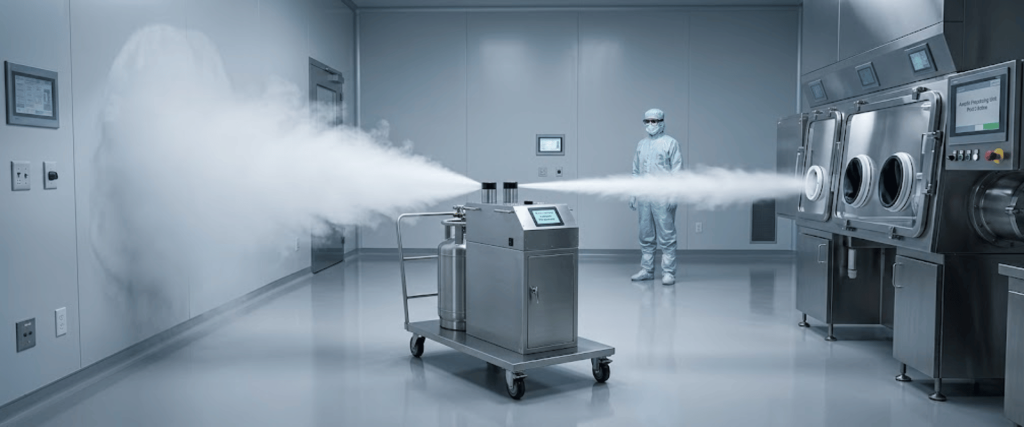
The higher volumetric output ensures the tracer remains visible long enough to travel across large unidirectional-flow zones.
Neutral Buoyancy for Accurate Path Following
By blending LN2 with DI/WFI water, the AP50 generates fog particles whose temperature and density closely match ambient cleanroom air.
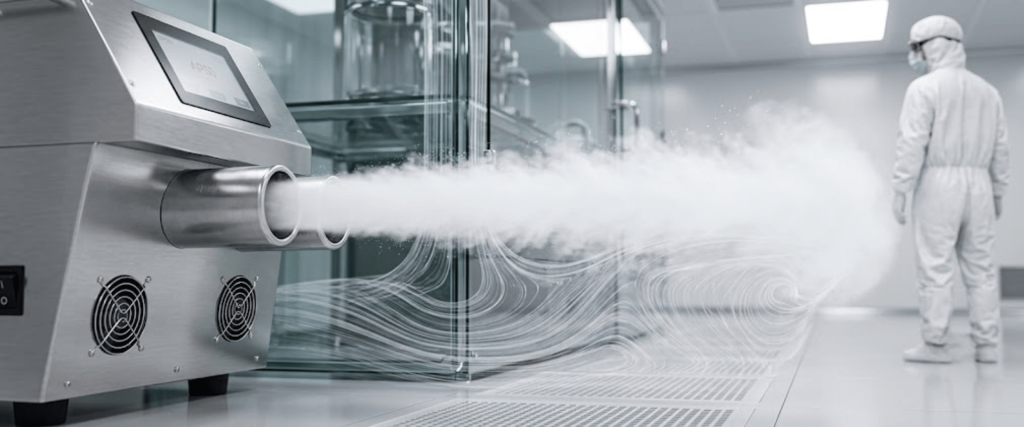
The tracer, therefore, follows true airflow rather than sinking under gravity. This characteristic is especially valuable when characterizing low-velocity regions, return-air paths, or the interface between Grade A and Grade B zones.
Extended Runtime and Operational Efficiency
Seventy-five minutes of continuous fog generation allows complete static and dynamic studies without mid-test refills.
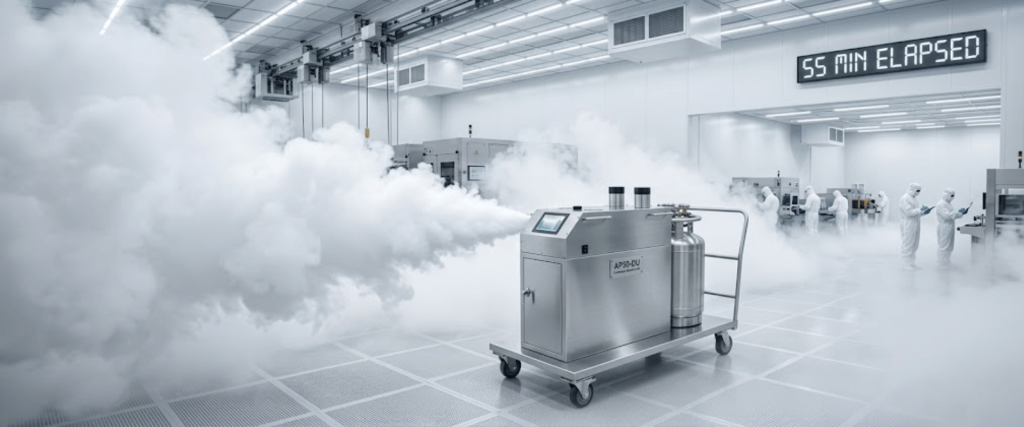
Validation teams can capture uninterrupted video sequences that satisfy both internal quality requirements and external regulatory expectations.
Performance Comparison: AP50 versus Typical Traditional LN2 Foggers
The following table summarizes the practical differences that affect smoke-study outcomes.
| Parameter | Traditional LN2 Fogger | AP50 Ultrapure Fogger |
| Fog Output | 2–5 m³/min | 10–12 m³/min |
| Visible Distance | 8–12 feet | 18–25 feet |
| Continuous Runtime | Often < 40 min | Up to 75 min |
| Total Fog per Cycle | Typically < 300 m³ | 750–900 m³ |
| Nozzle Configuration | Usually single | Dual independent valves |
| Buoyancy Control | Often sinks (cold fog) | Neutral (LN2 + DI/WFI) |
Applications Across Critical Industries
Pharmaceutical Aseptic Processing
In Grade A filling suites and isolators, the AP50 enables clear visualization of first-air protection, recovery after interventions, and the absence of ingress from surrounding Grade B areas.
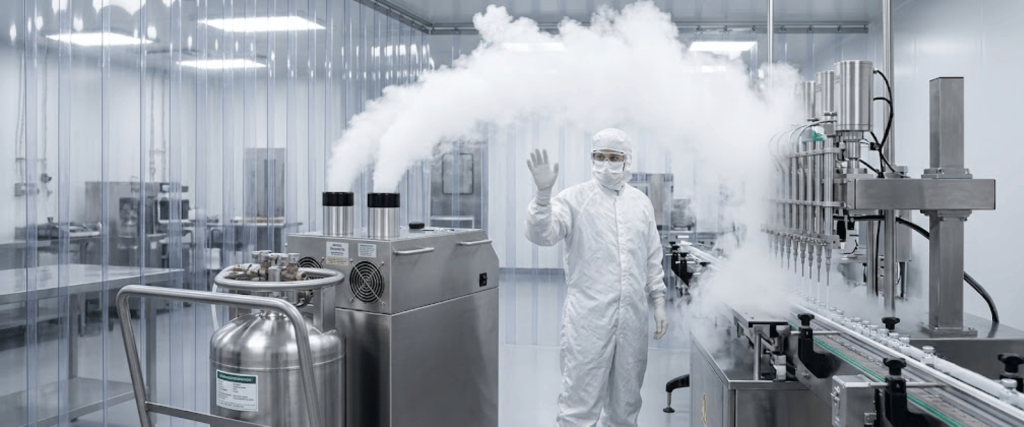
Extended runtime supports both static smoke studies and dynamic studies performed with operators present, exactly the scenarios regulators examine most closely.
Semiconductor and Microelectronics
Large-scale fabs require mapping of extensive unidirectional-flow zones and minienvironments. The AP50’s high output and long throw distance allow efficient coverage of tool bays and open cleanroom corridors.
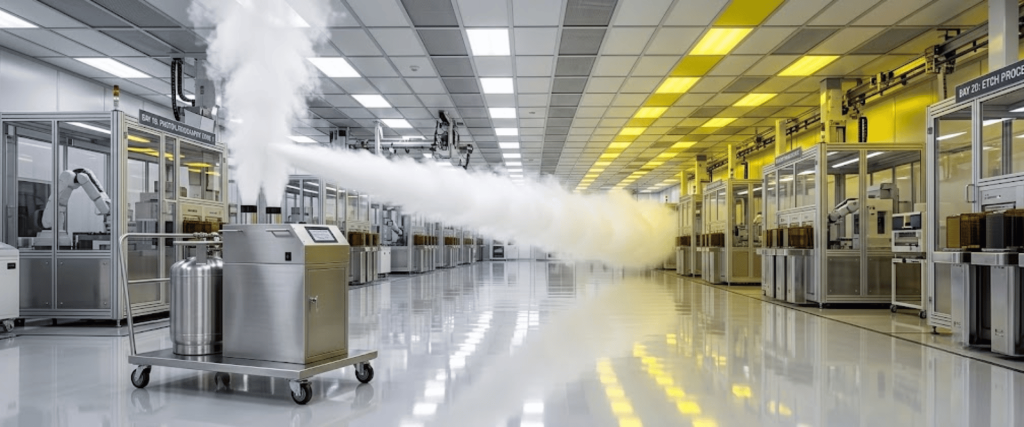
For even larger spaces, facilities often pair the AP50 with the higher-capacity AP200 Ultrapure Cleanroom Fogger.
Medical Device and Barrier Isolators
Smaller barrier systems and RABS benefit from the controllable dual plumes.
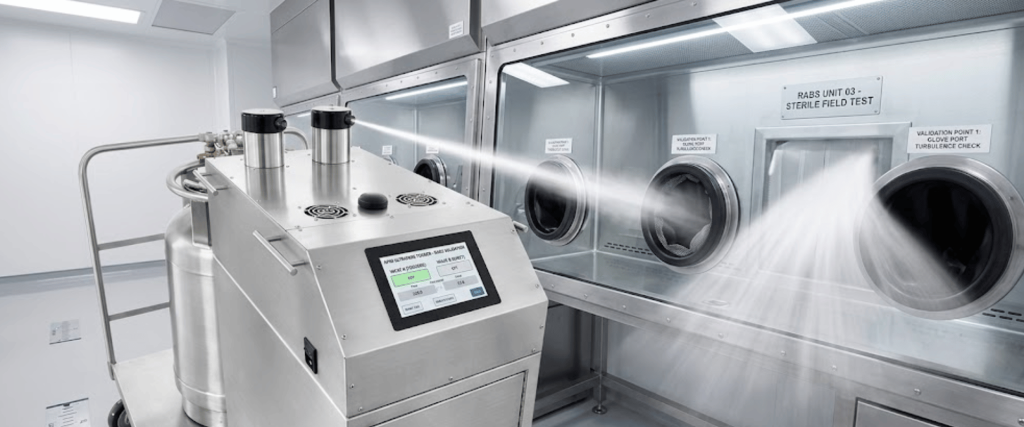
The same technology that powers the AP50 is scaled in the compact AP30 LN2 Ultrapure Cleanroom Fogger, offering facilities a consistent product family for both large suites and tight isolators.
A Complete Contamination-Control Toolkit
Airflow visualization is only one element of a robust contamination-control strategy. Applied Physics USA supplies complementary tools that work alongside the AP50.
- The CRF2-S Sanitizing Fogger for hydrogen-peroxide bio-decontamination of small enclosures and isolators.
- A full range of ultrapure foggers (AP30, AP50, AP200) covering every scale from bench-top isolators to full fab bays, see the complete cleanroom fogger overview.
- Microbial air samplers and particle standards that close the loop between visualized airflow and measured cleanliness.
Together, these instruments help facilities move from qualitative observation to quantitative, audit-ready contamination control. Visit appliedphysicsusa.com for the full product portfolio and technical resources.
Conclusion
Traditional LN2 foggers established the principle of pure, residue-free airflow visualization.
The AP50 Ultrapure Cleanroom Fogger advances that principle with substantially higher fog volume, longer continuous operation, dual-valve flexibility, and true neutral buoyancy.
These improvements reduce study time, improve data quality, and strengthen regulatory confidence.
Whether validating a new isolator, re-qualifying an existing Grade A suite, or mapping airflow in a semiconductor cleanroom, the AP50 provides the dense, controllable, and persistent tracer that modern compliance demands.
Facilities are ready to close the performance gap in their smoke studies, which can explore the AP50 and the broader AP-series lineup directly through Applied Physics USA.
Frequently Asked Questions (FAQs)
1. Does the AP50 leave any residue after a smoke study?
No. The fog is generated from liquid nitrogen and deionized or WFI water. Once the fog evaporates, no residual particles or films remain on surfaces or in the air.
2. How does the AP50 compare with glycol-based or pure CO₂ foggers?
Glycol systems can leave oily residues and may not be acceptable in sterile environments. Pure CO₂ foggers often produce colder, denser plumes that sink. The AP50’s LN2-plus-water chemistry yields neutral buoyancy and zero residue, aligning more closely with ISO 14644-3 expectations for a non-contaminating tracer.
3. Can one AP50 unit cover a large semiconductor cleanroom?
For very large open areas, the AP50 still provides excellent local mapping. Many facilities use multiple units or step up to the AP200 for maximum volumetric output. The dual valves on the AP50 already allow efficient coverage of typical process bays and minienvironments.
4. Is the AP50 suitable for both static and dynamic smoke studies?
Yes. The 75-minute continuous runtime comfortably accommodates sequential static and dynamic sequences, including operator interventions, without the need to interrupt and refill.
5. Where can I find additional guidance on performing airflow visualization studies?
Authoritative sources include ISO 14644-3:2019, the FDA Guidance for Industry on aseptic processing, the overview at GMP Insiders, and practical articles such as the five tips published by Cleanroom Technology. Applied Physics USA also maintains technical resources and product-specific application notes.