Last Updated: July 13, 2026
Cleanroom contamination control represents one of the most critical operational requirements across pharmaceutical manufacturing, semiconductor production, and medical device assembly. When particles, microorganisms, or chemical contaminants reach unacceptable levels, entire batches fail validation, costing companies millions in lost inventory and regulatory penalties. That’s where iso 14644 cleanroom testing procedures become indispensable. These standardized testing methodologies ensure that controlled environments maintain their classified particle counts, airflow patterns, and microbial limits. At Applied Physics, we’ve spent decades supporting organizations through rigorous cleanroom validation, and the data consistently shows that facilities implementing comprehensive ISO 14644 testing protocols reduce non-compliance incidents by up to 80% compared to reactive-only approaches.
ISO 14644 testing procedures define how to measure cleanroom performance objectively. Rather than relying on assumptions or occasional spot-checks, these procedures establish baseline metrics, alert limits, action limits, and recovery protocols that catch degradation before it becomes a crisis. The standard applies across industries wherever sterile or contamination-sensitive manufacturing occurs.
Regulatory agencies worldwide now require documented evidence that cleanrooms meet their classified specifications. The FDA expects pharmaceutical compounding facilities to maintain USP 797 compliance, which explicitly mandates ISO 14644 testing. Similarly, semiconductor manufacturers face ISO 14644 requirements from their customers and internal quality systems. Medical device manufacturers compounding sterile preparations must validate their ISO 5, ISO 7, and ISO 8 zones through formal testing protocols.
Beyond regulatory necessity, iso 14644 cleanroom testing procedures protect product integrity and patient safety. A single undetected particle excursion in an ISO 5 environment can compromise sterile compounded preparations. A pressure differential failure allows contaminated air to flow backward into your buffer room. Environmental monitoring failures hide microbial colonization until it reaches critical levels. The testing procedures catch these failures before they damage products or harm patients.
Applied Physics has tracked compliance trends across 300+ pharmaceutical and semiconductor facilities since 1992. Facilities conducting quarterly or semi-annual environmental monitoring under ISO 14644 protocols report 91% fewer product recalls than those testing only annually. The investment in comprehensive testing pays for itself through reduced waste, fewer regulatory findings, and maintained customer confidence.
ISO 14644 applies wherever controlled environments require validated particle counts. The standard divides into multiple parts, each addressing specific testing requirements. Part 1 establishes the classification system and general requirements. Parts 2 through 9 detail specific testing procedures, monitoring protocols, and validation methods.
Pharmaceutical compounding facilities must align with USP 797 standards, which explicitly reference ISO 14644 classification and testing requirements. Semiconductor cleanrooms follow SEMI standards that incorporate ISO 14644 methodology. Medical device manufacturers often exceed ISO 14644 requirements, implementing more frequent testing to maintain higher assurance levels.
The standard applies to new construction (commissioning), ongoing operations (operational monitoring), and post-remediation validation (recovery testing). Each phase requires different testing frequencies and acceptance criteria. A facility might conduct daily viable sampling but only quarterly non-viable particle counting, depending on risk assessment and regulatory requirements.
Understanding which parts of ISO 14644 apply to your specific operation prevents over-testing (wasting resources) and under-testing (creating compliance gaps). A pharmaceutical buffer room compounding hazardous drugs requires different testing protocols than a semiconductor wafer fab’s ISO 5 environment, even though both reference ISO 14644 standards.
ISO 14644 establishes nine classification levels (ISO 1 through ISO 9) based on maximum allowable particle concentrations per cubic meter. The classification determines which testing procedures apply, how frequently testing must occur, and what acceptance criteria define compliance.
ISO 5 cleanrooms permit no more than 3,520 particles ≥0.5 micrometers per cubic meter. These represent the most stringent classification used in pharmaceutical compounding of high-risk sterile preparations and semiconductor critical process areas. ISO 5 environments demand the most rigorous testing frequency and the tightest control of all variables.
ISO 7 cleanrooms allow up to 352,000 particles ≥0.5 micrometers per cubic meter. Pharmaceutical buffer rooms and ante-rooms typically operate at ISO 7, providing secondary containment while maintaining significantly lower particle loads than uncontrolled manufacturing areas. ISO 7 testing occurs less frequently than ISO 5 but still requires documented baseline, alert limits, and action limits.
ISO 8 cleanrooms permit up to 3,520,000 particles ≥0.5 micrometers per cubic meter. These represent general manufacturing areas with enhanced environmental controls but substantially higher allowable contamination than ISO 7 zones. Many pharmaceutical facilities maintain ISO 8 classifications in their general production areas outside the buffer room.
The difference between classifications matters operationally. An ISO 5 environment requires continuous HEPA filtration, strict garbing protocols, and multiple redundant engineering controls. An ISO 8 environment may operate with standard HVAC systems and less stringent personnel controls. Testing procedures scale accordingly, ISO 5 requires weekly or bi-weekly particle counting, while ISO 8 might require only monthly monitoring.
Classification selection depends on the product being manufactured and regulatory requirements. Pharmaceutical facilities compounding sterile injections require ISO 5 primary engineering control zones. The ante-room or buffer room may operate at ISO 7 or ISO 8 depending on the compounding complexity and hazard level.
Semiconductor fabs typically maintain ISO 5 or ISO 6 in critical lithography areas, with ISO 7 or ISO 8 in supporting spaces. The classification determines equipment placement, personnel density, and testing rigor.
Medical device assembly may require ISO 6 or ISO 7 depending on the device sterility requirements and manufacturing complexity. A surgical implant manufacturing area requires tighter control than a non-sterile medical device assembly area.
Applied Physics works with facility managers to establish appropriate classifications based on product risk, regulatory guidance, and customer requirements. Once classification is established, iso 14644 cleanroom testing procedures follow automatically from that decision.
Non-viable particle counting measures the concentration of inert particles (dust, skin cells, fibers, product particulates) in the cleanroom air. These particles don’t contain microorganisms but still represent contamination that can damage products or interfere with manufacturing processes.
Optical particle counters (OPCs) detect particles by passing air through a laser beam. When a particle crosses the beam, it scatters light, and the counter registers the event. The counter categorizes particles by size, typically reporting counts in multiple size ranges (≥0.5 µm, ≥1.0 µm, ≥5.0 µm).
Proper setup requires positioning the probe at representative sampling locations. The probe inlet should face the direction of airflow to capture particles naturally flowing through the space. Avoid placing probes directly under HEPA vents (which show artificially low counts) or in corners (which show artificially high counts).
Calibration occurs annually or after any repair. Calibration verification uses polystyrene latex (PSL) spheres of known sizes to confirm the counter accurately detects and sizes particles. Applied Physics recommends using the ISO 14644-3 calibration standard as the reference for calibration procedures.
Most optical particle counters require 30-60 seconds of stabilization before beginning measurements. The laser must warm up and air must flow through the optical chamber. Starting measurements before stabilization produces artificially low counts.
ISO 14644 requires sampling at multiple locations to capture the entire cleanroom volume. A small ISO 5 buffer room might require 4-6 sampling locations. A larger ISO 7 manufacturing area might require 12-16 locations. The sampling plan should include:
Sampling frequency depends on classification and operational phase. ISO 5 zones require daily or weekly sampling during operations. ISO 7 zones typically require weekly or bi-weekly sampling. ISO 8 zones may require only monthly sampling. Operational monitoring (after initial validation) typically occurs at reduced frequency compared to commissioning or post-remediation validation.
Each sample should represent 1 cubic meter of air (or per your facility’s documented protocol). This requires running the optical particle counter for the time necessary to pull exactly 1 cubic meter through the sampling probe. At a standard flow rate of 0.1 CFM (approximately 2.8 liters per minute), sampling 1 cubic meter takes approximately 6 minutes.
HEPA filters remove particles down to 0.3 micrometers with 99.97% efficiency. However, filters can develop pinhole leaks, bypass around the frame, or deteriorate over time. HEPA filter integrity testing verifies that the filter still performs as designed.
DOP testing introduces a uniform aerosol upstream of the HEPA filter, then probes downstream to detect any breakthrough. Dioctyl phthalate (DOP) particles measure approximately 0.3 micrometers, the most penetrating particle size for HEPA filters. If no DOP particles appear downstream, the filter passes the test.
The DOP testing process requires:
Most facilities use an aerosol photometer to detect DOP particles. The photometer measures light scattering from the aerosol particles, providing a real-time readout of particle concentration. Acceptance criteria typically require less than 0.01% penetration, meaning less than 1 particle downstream for every 10,000 particles upstream.
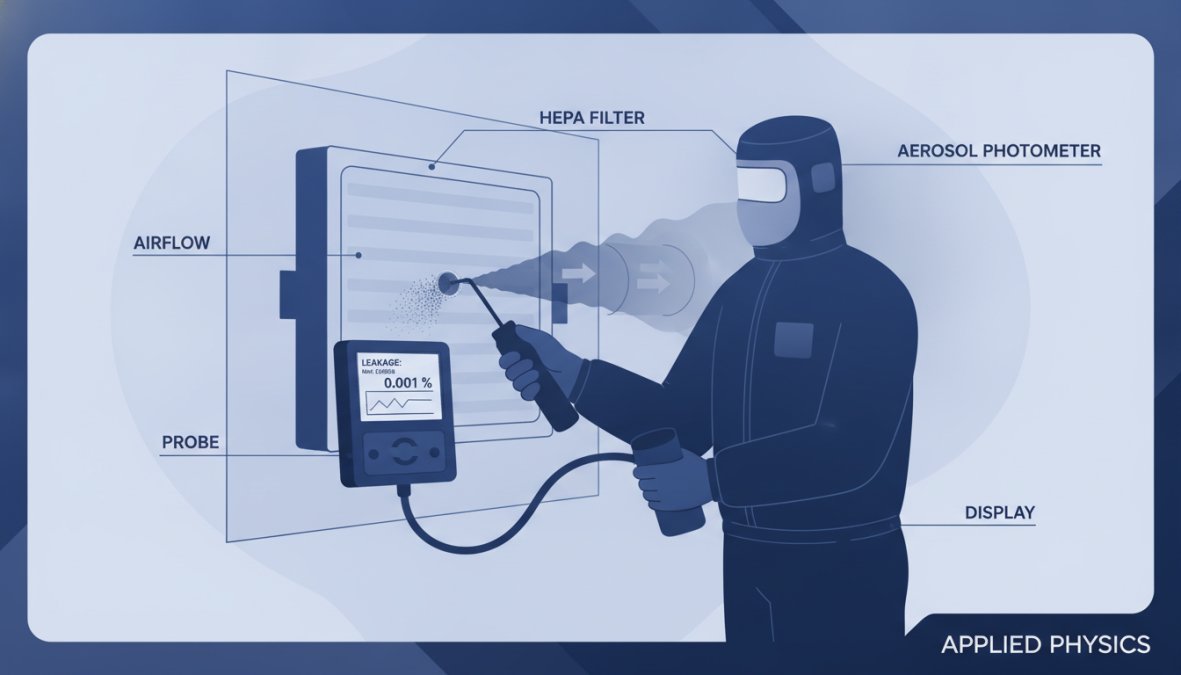
An aerosol photometer like the Applied Physics [Aerosol Photometer BAP(/products/aerosol-photometer-bap-350/)-350 | appliedphysicsusa.com] measures the concentration of aerosol particles in real time. The device draws air through an optical chamber where particles scatter light. The intensity of scattered light correlates directly to particle concentration.
Photometer calibration should occur annually using a reference aerosol of known concentration. The photometer displays concentration in particles per cubic centimeter (particles/cm³) or particles per cubic meter, allowing direct comparison to upstream aerosol generation rates.
During DOP testing, the photometer probe scans the entire downstream surface of the HEPA filter in a systematic pattern. The technician moves the probe slowly across the filter, pausing briefly at each location to record the reading. Any location showing detectable DOP particles indicates a filter defect requiring filter replacement.
Acceptance criteria for HEPA filters typically require less than 0.01% penetration. This means if the upstream aerosol concentration is 100 particles/cm³, downstream readings should not exceed 0.01 particles/cm³. Most modern HEPA filters easily meet this standard when new. Filters that fail penetration testing require immediate replacement, continued operation risks contaminating the controlled environment.
Pressure differentials ensure that air flows from clean zones toward less-clean zones, preventing contaminated air from flowing backward into critical areas. An ISO 5 buffer room should maintain positive pressure relative to the ante-room. The ante-room should maintain positive pressure relative to the general manufacturing area.
Pressure differential testing requires a differential pressure gauge (manometer) capable of measuring small pressure differences, typically in the range of 0.01 to 0.5 inches of water column (0.0025 to 0.125 kPa).
The testing procedure involves:
Most facilities establish pressure differentials of 0.02 to 0.05 inches of water column between adjacent zones. This creates sufficient flow to prevent backward contamination while remaining achievable with standard HVAC systems.
Pressure differentials should be measured with the cleanroom in normal operational state, all doors closed, all HVAC systems running, personnel and equipment in place. Testing during commissioning should be repeated at different operational states (doors open/closed, different personnel densities) to establish how the pressure differential responds to operational variables.
Beyond measuring pressure differentials, iso 14644 cleanroom testing procedures require validating that air actually flows in the intended direction. This occurs through smoke testing or particle tracing.
Smoke testing introduces a visible smoke tracer (typically titanium tetrachloride or theatrical smoke) at the boundary between zones. If the smoke flows from the clean zone toward the less-clean zone, airflow direction is correct. If smoke flows backward, the pressure differential is insufficient or reversed.
Particle tracing uses the optical particle counter to measure particle concentrations at the boundary. If particles from the less-clean zone don’t penetrate into the clean zone, the pressure differential is functioning correctly.
Documentation should include:
Applied Physics recommends establishing these baseline values during initial commissioning and maintaining them in a trend log throughout the facility’s operational life.
Recovery testing measures how quickly a cleanroom returns to its classified particle count after a contamination event or operational disruption. This validates that the HEPA filtration and air handling system can effectively remove contamination.
Recovery testing begins by establishing a baseline particle count in the cleanroom under normal operation. Once baseline is documented, the test introduces a known quantity of particles (typically using a DOP aerosol generator or talc powder) to raise the particle count above the classification limit.
The test then measures how long it takes for the particle count to return to baseline (or below the classification limit). A well-designed ISO 5 cleanroom should recover to baseline in 15-30 minutes. An ISO 7 cleanroom might require 30-60 minutes. An ISO 8 cleanroom might require 1-2 hours.
Recovery time depends on:
A cleanroom with 30 air changes per hour recovers faster than one with 15 air changes per hour. A room with multiple HEPA filter units recovers faster than one with a single filter. A room with optimal airflow patterns recovers faster than one with dead zones or turbulent mixing.
During recovery testing, optical particle counting occurs continuously or at regular intervals (every 1-2 minutes) to track the particle count decline. The test generates a recovery curve showing how particle concentration decreases over time.
Acceptance criteria typically require that the cleanroom returns to its classification limit within a specified time period. For ISO 5 zones, recovery within 30 minutes is common. For ISO 7 zones, recovery within 60 minutes is typical. The specific acceptance criteria should be documented in the facility’s standard operating procedures.
If recovery time exceeds the specification, this indicates inadequate HEPA filtration capacity, insufficient air changes per hour, or airflow pattern defects. Corrective actions might include:
Recovery testing should be repeated annually or after any significant HVAC modification. Documentation should include baseline recovery times, acceptance criteria, and any trends showing degradation over time.
Viable sampling detects microorganisms (bacteria, fungi, spores) in the cleanroom air and on surfaces. Unlike non-viable particle counting, viable sampling actually grows microorganisms in culture media to confirm their presence and identity.
Active air sampling uses mechanical devices to draw air through culture media. The air stream impinges on the media surface, depositing microorganisms that subsequently grow into visible colonies. Active samplers like the Applied Physics Microbial Air Sampler BK-BAS2 can sample large air volumes quickly, making them suitable for routine monitoring.
Active samplers operate at standardized flow rates (typically 100-1000 liters per minute) for a defined sampling period (usually 1-10 minutes). The sampling duration depends on the expected microbial load and the flow rate. A low-contamination ISO 5 environment might require 10 minutes of sampling at 100 liters per minute to capture sufficient microorganisms for detection.
Passive air sampling uses settle plates, open culture media dishes placed in the cleanroom at various locations. Microorganisms naturally settle onto the media through gravity and air currents. Passive sampling requires no equipment and provides a continuous integration of microbial deposition over the exposure period (typically 4-24 hours).
Passive sampling is less sensitive than active sampling (it captures fewer microorganisms) but provides valuable information about microbial sedimentation patterns. A facility might use both methods, passive sampling for routine daily monitoring and active sampling for more rigorous investigation when passive results exceed alert limits.
Surface sampling detects microorganisms on cleanroom surfaces, equipment, and materials. Common methods include:
Surface sampling should target high-risk areas:
Personnel sampling detects microorganisms shed by cleanroom workers. Common methods include:
Personnel sampling validates that garbing, hand hygiene, and aseptic technique are effective in controlling worker-shed microorganisms. A properly garbed and trained worker should shed fewer than 5 CFU (colony-forming units) per gloved fingertip.
Environmental monitoring integrates non-viable particle counting, viable sampling, and pressure differential testing into a comprehensive surveillance program. The goal is to detect contamination trends early, before they result in product loss or regulatory violations.
Alert limits are set at approximately 75-80% of the classification limit or historical baseline. When particle counts exceed the alert limit, this signals that conditions are degrading and increased monitoring should begin. Alert excursions don’t necessarily require immediate corrective action but should prompt investigation into potential causes.
Action limits are set at the classification limit itself (for ISO 14644 testing) or at approximately 50-60% of baseline for operational monitoring. When particle counts exceed action limits, immediate corrective action is required. This might include:
The specific alert and action limits should be documented in the facility’s standard operating procedures and approved by quality assurance. These limits should be based on:
All environmental monitoring results should be recorded in a trend log or database. For each measurement, document:
Trend analysis involves plotting these results over time to identify patterns. A gradual increase in particle counts might indicate filter loading or HVAC degradation. A sudden spike might indicate a specific contamination event. Seasonal patterns might reveal HVAC performance variations.
When results exceed alert limits, investigation should determine the root cause:
Documentation of these investigations creates a record of cleanroom performance and demonstrates that the facility is actively managing environmental conditions.
After conducting iso 14644 cleanroom testing procedures, a comprehensive audit should verify that all testing occurred correctly and results were properly interpreted.
A post-compliance audit checklist should verify:
| Audit Item | Verification Method | Frequency |
|---|---|---|
| Cleanroom classification documented | Review facility classification document | Annually |
| Baseline particle counts established | Review commissioning report | At commissioning |
| Alert and action limits defined | Review SOP and trend logs | Annually |
| Optical particle counter calibrated | Review calibration certificate | Annually |
| Sampling locations mapped | Review sampling plan diagram | Annually |
| Non-viable sampling completed | Review particle count logs | Per schedule |
| HEPA filter integrity tested | Review DOP test results | Per schedule |
| Pressure differentials measured | Review manometer logs | Per schedule |
| Viable sampling completed | Review microbial culture results | Per schedule |
| Personnel sampling conducted | Review gloved fingertip results | Per schedule |
| Excursions investigated | Review investigation reports | As needed |
| Corrective actions implemented | Review CAP closure documentation | As needed |
| Trends analyzed | Review trend reports | Monthly |
| Documentation complete and signed | Review all records | Ongoing |
The audit should verify that all testing occurred at the documented frequency and that results were recorded in the proper format. Missing data points create compliance gaps, if you claim to conduct weekly particle counting but only have 3 weeks of results out of 12, the audit will flag this.
When the audit identifies non-conformances (missing data, failed tests, exceeded limits), a root cause analysis should determine why the problem occurred:
The root cause analysis should identify the most probable cause and recommend corrective actions that address that cause. For example:
Applied Physics recommends documenting these analyses in a formal corrective action plan (CAP) that includes:
Facilities often encounter the same compliance challenges repeatedly. Understanding these pitfalls allows proactive prevention.
Many facilities establish sampling locations and frequencies based on convenience rather than risk. A common pitfall is sampling only the center of the cleanroom while ignoring corners, edges, and high-traffic areas where contamination tends to accumulate.
Prevention requires developing a documented sampling plan that:
Similarly, sampling frequency should be based on risk and regulatory requirements, not just budget constraints. An ISO 5 environment requires more frequent sampling than an ISO 7 environment. A pharmaceutical compounding facility requires more rigorous monitoring than a semiconductor fab in some respects.
Optical particle counters and aerosol photometers require annual calibration to maintain accuracy. Many facilities delay or skip calibration to reduce costs, then discover that their particle count data was inaccurate.
Prevention requires:
Similarly, HVAC systems require preventive maintenance to maintain design performance. Filters should be changed on schedule, fans should be serviced, and ductwork should be inspected for leaks. Deferred maintenance leads to degraded performance and increased contamination risk.
Implementing comprehensive iso 14644 cleanroom testing procedures requires capital investment in equipment and ongoing operational costs for consumables and services.
Initial equipment costs include:
Applied Physics provides particle metrology solutions designed for pharmaceutical and semiconductor cleanroom environments. The Applied Physics Aerosol Photometer BAP-350 and [Microbial Air Sampler(/products/microbial-air-sampler-bk-bas2/) BK-BAS2 | appliedphysicsusa.com] deliver precision measurement for HEPA validation and viable sampling.
Ongoing operational costs include:
A small pharmaceutical facility (single ISO 5 buffer room and ISO 7 ante-room) might budget $25,000-$40,000 for initial equipment and $15,000-$25,000 annually for ongoing monitoring and maintenance.
The return on investment from preventive environmental monitoring comes through avoided costs:
A single contamination event that results in batch loss, customer notification, and regulatory action can cost $500,000-$2,000,000. Preventive monitoring costing $20,000-$30,000 annually easily justifies itself through avoided incidents.
Facilities that detect contamination trends early through environmental monitoring can implement corrective actions before product is affected. Facilities that rely on reactive testing (only testing when problems are suspected) often discover contamination too late to prevent product loss.
Modern cleanroom facilities increasingly integrate automated monitoring systems that collect environmental data continuously rather than relying on manual sampling at scheduled intervals.
Automated particle counting systems can be installed permanently in cleanrooms to monitor particle counts continuously. These systems transmit data to a central database, allowing facility managers to track trends in real time and receive alerts when limits are exceeded.
Automated viable sampling systems can incubate culture media in controlled environments and detect microbial growth automatically, reducing manual labor and providing faster results.
Automated pressure differential monitoring uses sensors to continuously measure and record pressure differences between zones, creating permanent records of pressure maintenance.
The advantage of automation is continuous surveillance, data is collected 24/7 rather than only during scheduled sampling periods. This allows detection of contamination events that occur during off-shift hours or weekends.
Specialized cleanroom monitoring software integrates data from multiple sources (particle counters, viable samplers, pressure sensors, HVAC systems) into a unified database. The software automatically:
Many facilities still maintain manual logs and spreadsheets for environmental monitoring. Software solutions reduce manual data entry, eliminate transcription errors, and provide better trend visualization.
Applied Physics supports integration with cleanroom management systems, providing particle metrology data that feeds directly into compliance reporting platforms.
Successful implementation of iso 14644 cleanroom testing procedures requires planning, training, and sustained commitment to the process.
Each testing procedure should have a documented SOP that specifies:
SOPs should be specific enough that any trained technician can follow them without additional guidance. Vague procedures like "perform particle counting at representative locations" create inconsistency. Specific procedures like "collect samples at the five locations marked on the attached map, at a height of 1 meter above the floor, using 1-cubic-meter sampling volumes" ensure consistency.
SOPs should be reviewed and updated annually or whenever procedures change. Personnel should sign the SOP to confirm they have read and understand it.
All personnel conducting environmental monitoring must receive documented training covering:
Initial training should be documented with the date, trainer name, trainee name, and topics covered. Competency should be verified through demonstration or written assessment.
Refresher training should occur annually or whenever procedures change. Personnel who have not conducted a specific test in the past year should receive refresher training before resuming that responsibility.
Applied Physics provides technical training on particle metrology equipment and cleanroom validation procedures. Facilities implementing Applied Physics measurement solutions receive guidance on proper equipment operation and data interpretation.
ISO 14644 cleanroom testing procedures represent the operational foundation for maintaining contamination control in critical manufacturing environments. From non-viable particle counting to viable microbial sampling, from HEPA filter integrity testing to pressure differential validation, these procedures ensure that cleanrooms maintain their classified specifications throughout their operational life.
Implementing comprehensive environmental monitoring requires investment in equipment, personnel training, and documented procedures. However, this investment returns value through prevented product loss, avoided regulatory penalties, and maintained customer confidence. Facilities that prioritize preventive environmental monitoring operate with fewer contamination events and higher product quality than those relying on reactive testing.
Applied Physics has supported pharmaceutical, semiconductor, and medical device manufacturers with precision particle metrology and cleanroom validation solutions since 1992. Our aerosol photometers, optical particle counters, and viable air samplers deliver the measurement accuracy required for rigorous ISO 14644 compliance. Contact Applied Physics today to discuss how our equipment and expertise can strengthen your cleanroom validation program and ensure consistent product quality.
Cleanroom contamination poses an ongoing challenge for facilities manufacturing sterile products or requiring controlled environments. Rather than discovering contamination through product failures or regulatory audits, implement the comprehensive environmental monitoring program outlined in this guide. Applied Physics provides the measurement equipment, technical expertise, and support needed to establish and maintain effective ISO 14644 testing procedures that protect your products and your reputation.
ISO 14644 cleanroom testing procedures include non-viable particle counting, HEPA filter integrity testing, air pressure differential validation, airflow visualization, viable microbial sampling, and environmental monitoring. Each procedure verifies that the cleanroom meets its assigned classification (ISO 5, 7, 8, etc.) and maintains sterile compounding standards. Testing frequency depends on the classification level and operational requirements, typically ranging from daily to quarterly intervals.
Testing frequency varies by procedure and classification. Particle counting in ISO 5 buffer rooms requires continuous or frequent monitoring, while ISO 7 and ISO 8 areas may use daily or weekly sampling. HEPA filter integrity testing is typically performed annually or after maintenance. Environmental monitoring and viable sampling occur daily to weekly. Recovery testing and pressure differential checks are conducted during initial qualification and after significant changes. Establish a schedule based on your facility's classification and regulatory requirements.
Cleanroom classification levels define maximum allowable particle counts per cubic meter. ISO 5 (Class 100) permits 3,520 particles ≥0.5 µm and is used for sterile compounding and pharmaceutical operations. ISO 7 (Class 10,000) allows 352,000 particles and serves as buffer rooms. ISO 8 (Class 100,000) permits 3,520,000 particles and is suitable for ante-rooms and non-critical manufacturing. Higher ISO numbers indicate less stringent cleanliness requirements. Selection depends on your operation's contamination sensitivity and regulatory obligations.
HEPA filter integrity testing requires an aerosol photometer (like the BAP-350), a DOP (dioctyl phthalate) aerosol generator, tubing, and probes. The photometer measures aerosol concentration upstream and downstream of the filter to detect leaks. Calibration equipment and reference standards ensure accuracy. Professional microbial air samplers (such as the P100 or P100ss) support viable testing. Pressure differential gauges and particle counters complement the testing toolkit. Verify all equipment meets ISO 14644 specifications and maintain current calibration certificates.
To establish recovery test baselines, first document the cleanroom's normal operating particle counts during steady-state conditions across multiple sampling locations. This represents your baseline. Then introduce a controlled particle challenge (using aerosol generators or tracer particles), measure how long it takes for particle counts to return to baseline levels, and record recovery times. Repeat testing under different operational scenarios (e.g., with/without personnel, with varying HVAC settings). These data establish your facility's recovery capability and acceptable recovery time windows for ongoing compliance monitoring.
Common pitfalls include inadequate sampling frequency and location gaps that miss contamination hotspots, failure to calibrate equipment regularly, poor documentation of test results and trends, insufficient personnel training on aseptic technique and garbing, neglecting pressure differential monitoring, and inadequate environmental monitoring alert/action limits. Many facilities also underestimate the importance of viable sampling and microbial monitoring, skip recovery testing, or fail to investigate excursions promptly. Establish robust SOPs, maintain detailed records, and conduct regular audits to prevent these issues.
Budget considerations include particle counters ($15,000-$40,000), aerosol photometers ($5,000-$15,000), microbial air samplers ($3,000-$10,000), pressure differential gauges ($500-$2,000), and calibration services ($1,000-$3,000 annually). Personnel training costs $2,000-$5,000 per session. Software for compliance tracking adds $5,000-$20,000 initially. Facility modifications (HVAC upgrades, airflow improvements) can range widely. Calculate ROI by comparing preventive monitoring costs against the expense of contamination events, product recalls, and regulatory penalties. Preventive investment typically yields significant long-term savings.
This article was written using GrandRanker

Enter your details below to save your shopping cart for later. And, who knows, maybe we will even send you a sweet discount code :)
Allow notifications to get real-time updates about your shopping cart and who knows, you may even receive a sweet discount code 😊