
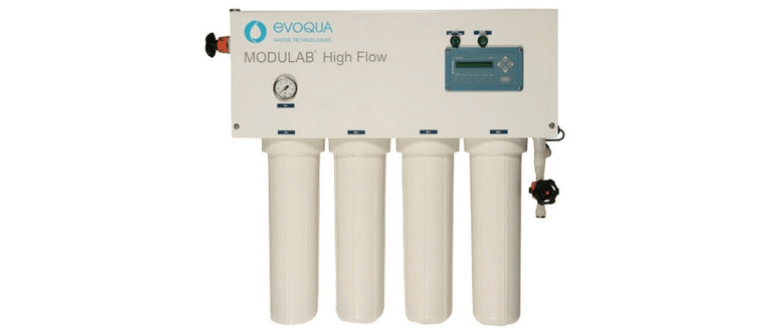
Modern high-throughput laboratories require uncompromised 18.2 MΩ·cm Type 1 water, yet simultaneous multi-station draws often cause severe flow surges that reduce resin contact time and trigger sudden drops in resistivity.
The Modulab High Flow System eliminates this hydraulic strain by utilizing high-capacity polishing cylinders, dual-wavelength UV oxidation, and integrated ultrafiltration to maintain steady ultrapure delivery at rates up to 14 liters per minute.
Supported by an intuitive digital interface that tracks real-time resistivity, temperature, and setpoint alarms, the system guarantees continuous regulatory compliance while preventing out-of-spec water from ever reaching critical analytical or biological workflows.
Achieving 18.2 MΩ·cm requires water to contain virtually zero un-ionized minerals, dissolved gases, or ionic contaminants. When volumetric demand surges, three primary failure mechanisms threaten water quality.
Ion exchange deionization relies on diffusion kinetics. As water passes through mixed-bed resin cartridges, cations ($Na^+$, $Ca^{2+}$) and anions ($Cl^-$, $SO_4^{2-}$) must migrate to the active exchange sites on the resin beads.
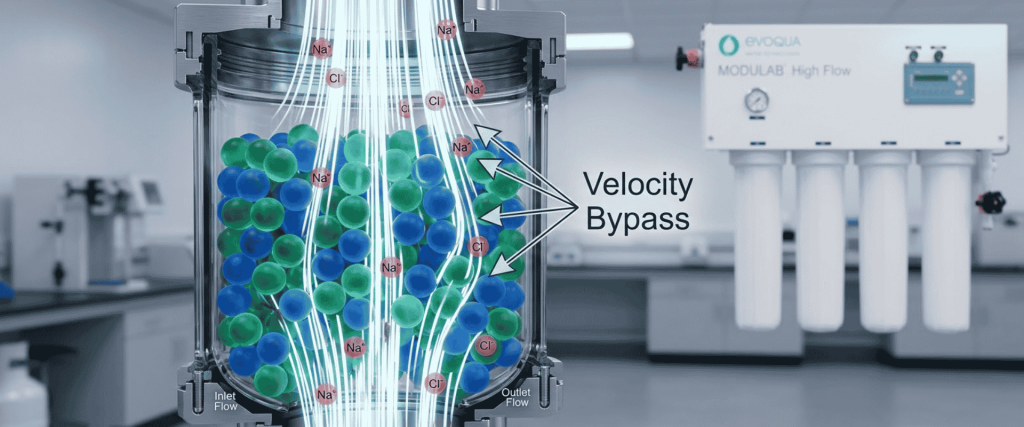
When flow velocity doubles or triples without an increase in resin volume, Empty Bed Contact Time (EBCT) drops sharply. Ions bypass unreacted resin sites and carry through to the dispense point, leading to immediate resistivity decay.
High flow rates create uneven pressure distributions across standard cartridge housings. Water naturally follows the path of least resistance, carving high-velocity channels through the resin bed.
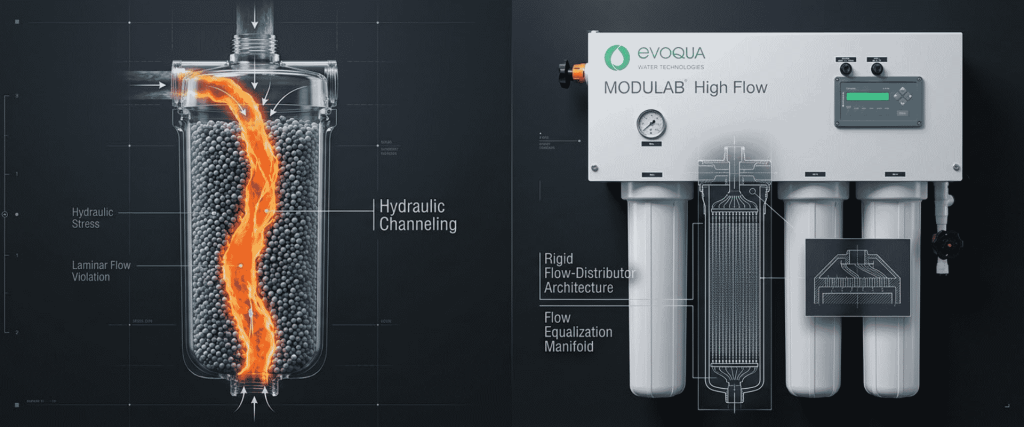
Channeling leaves substantial portions of the resin unused while overloading specific pathways, causing premature breakthrough long before the total exchange capacity of the cartridge is exhausted.
Surging flow rates can strip trace organic compounds and dissolved carbon dioxide ($CO_2$) from pipe walls and filter housings.
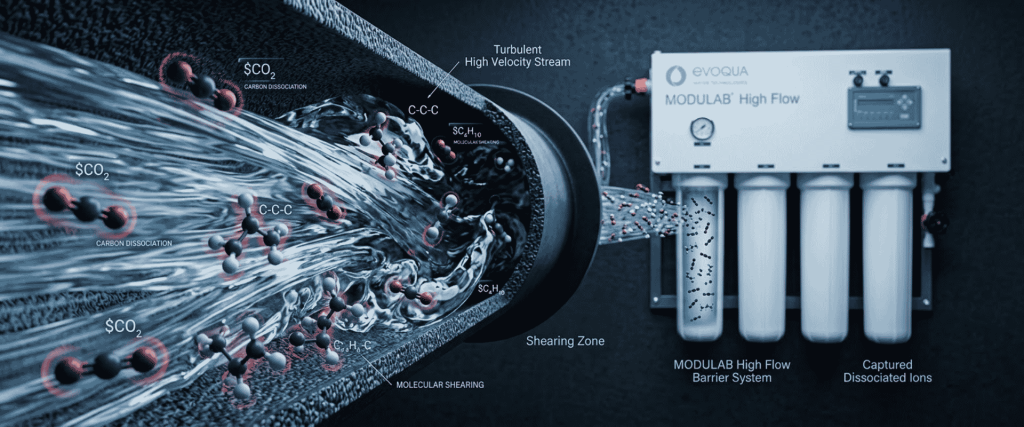
In the presence of water, dissolved $CO_2$ forms carbonic acid ($H_2CO_3$), which dissociates into hydrogen and bicarbonate ions ($H^+$ and $HCO_3^-$). Even micro-scale ionic loading from dissolved gases will quickly drag resistivity down from 18.2 MΩ·cm to 15 MΩ·cm or lower.
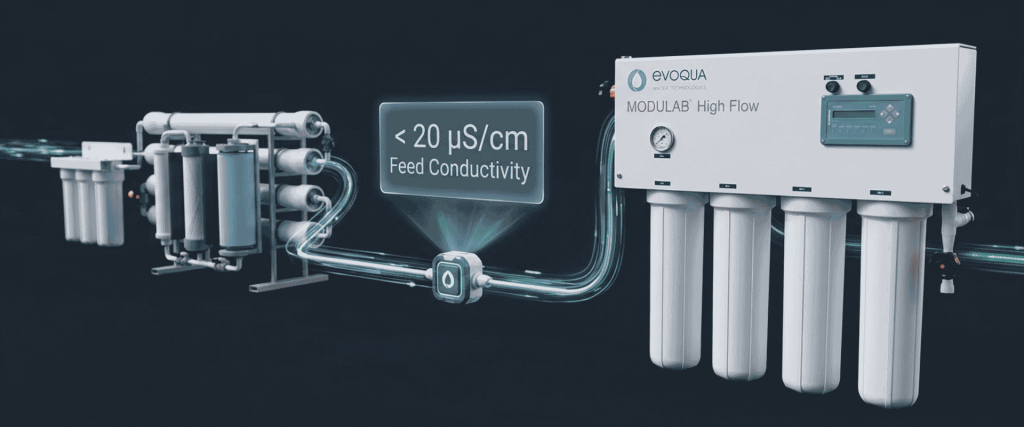
The Modulab High Flow System is engineered specifically to eliminate peak-flow purity drops, delivering consistent Type 1 water at rates up to 14 LPM (3.7 GPM) from pretreated reverse osmosis (RO) or deionized (DI) feed sources.
To prevent fluidization and channeling at 14 LPM, the Modulab utilizes large-format, high-capacity polishing cylinders.
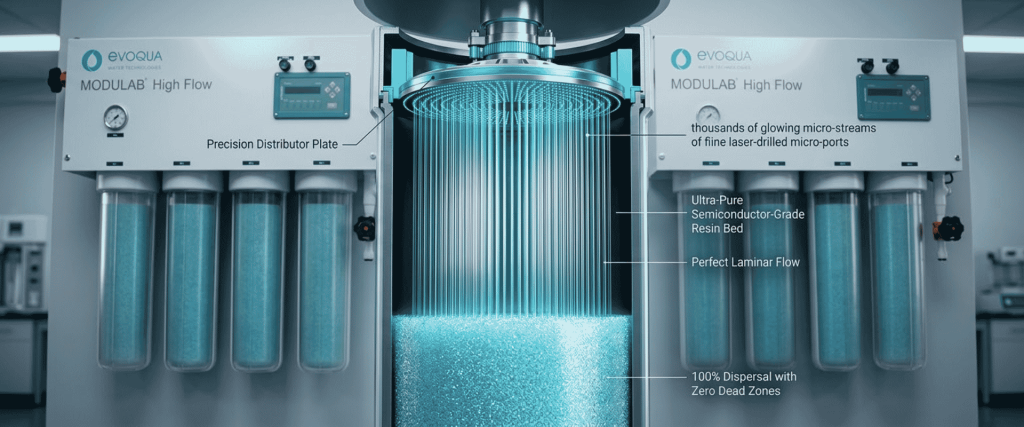
The internal flow distributors disperse incoming water evenly across the entire surface area of semiconductor-grade mixed-bed resins. This design preserves optimal contact time even at maximum flow velocity.
For organic-sensitive and low-TOC configurations, water passes through an inline dual-wavelength ultraviolet chamber (185 nm and 254 nm).
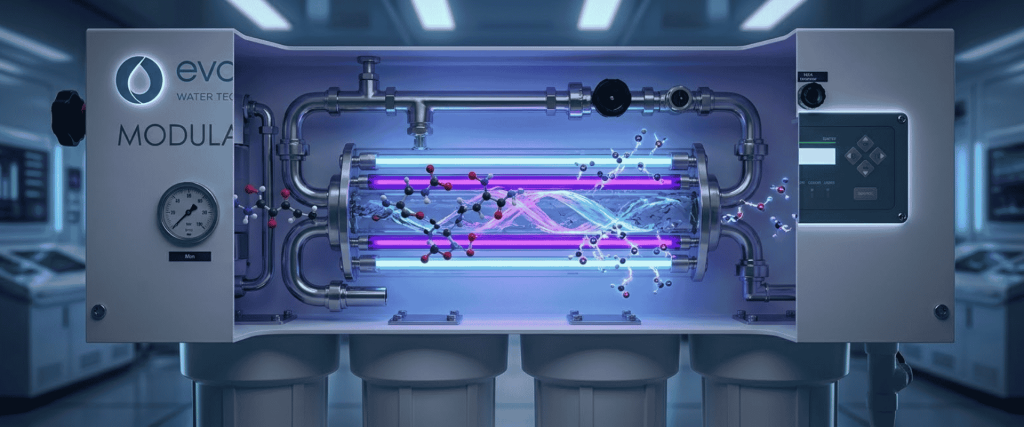
The 185 nm radiation generates hydroxyl free radicals that photolyze trace organics into charged ionic species, which are captured by the downstream polishing resin to maintain TOC levels below 15 ppb.
In biological and clinical settings, flow surges must not introduce endotoxins or nucleases.
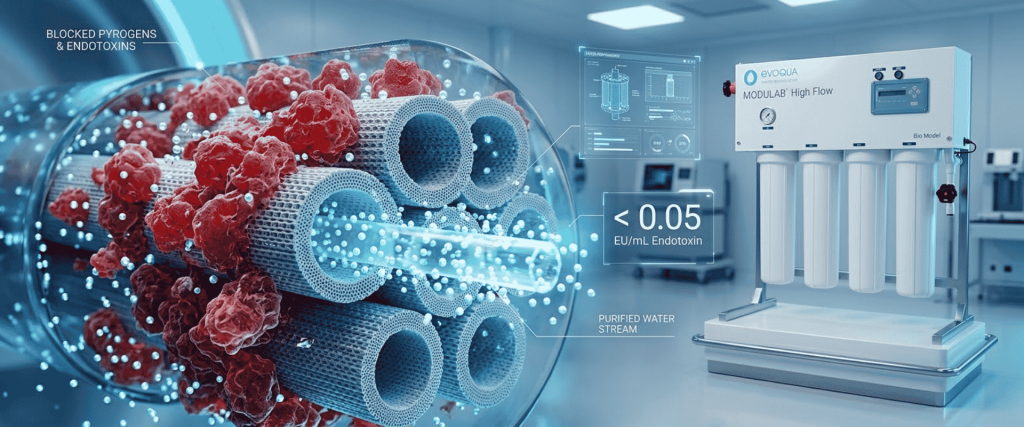
The Modulab High Flow Bio Model incorporates an integrated ultrafiltration (UF) cartridge that provides a molecular weight cut-off sufficient to guarantee endotoxin levels below 0.05 EU/mL and bacteria levels below 10 CFU/mL (or $< 1\text{ CFU/mL}$ with sub-micron filtration).
The system is configured around specific target contaminants, ensuring that high-throughput demands match process requirements.
| Configuration | Primary Filtration Stages | Max Flow Rate | Product Water Resistivity | Key Target Metric | Primary Applications |
| Standard Polishing | High-Capacity Mixed-Bed DI + Final Filter | 14 LPM (3.7 GPM) | 18.2 MΩ·cm @ 25°C | Inorganics Removal | Glassware washers, autoclave feed, environmental chambers |
| Low TOC Model | Dual Wavelength UV (185/254 nm) + Low-TOC Resin | 14 LPM (3.7 GPM) | 18.2 MΩ·cm @ 25°C | TOC < 15 ppb | HPLC, LC-MS, IC, analytical standards preparation |
| Bio / Low Pyrogen Model | Mixed-Bed DI + UV + Ultrafiltration (UF) | 14 LPM (3.7 GPM) | 18.2 MΩ·cm @ 25°C | Endotoxin < 0.05 EU/mL | Cell culture, IVF, media prep, biopharma production |
Installing a high-flow polisher is the foundation, but facility integration determines long-term stability.
The Modulab High Flow requires an incoming feed pressure between 25 psig and 60 psig. If feed pressure drops below 25 psig during simultaneous draws upstream, flow through the polisher will stall, disrupting internal distribution patterns.
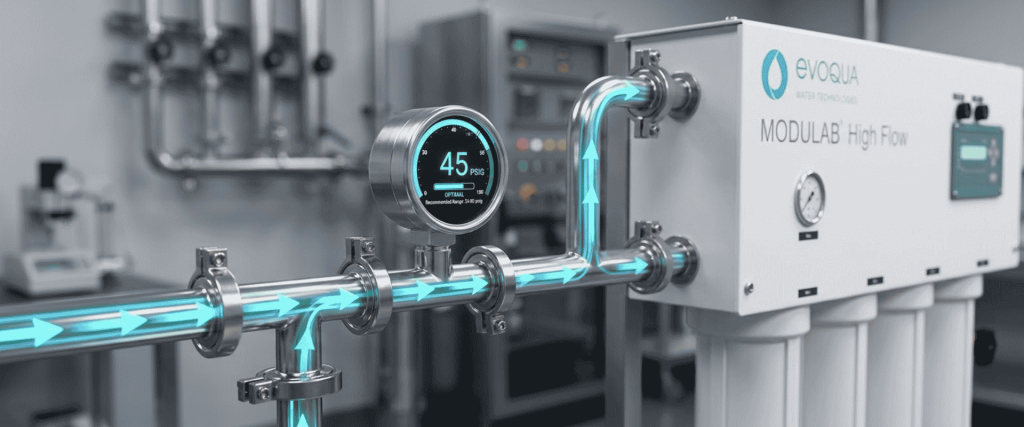
Install a dedicated booster pump or pressure-regulating station ahead of the system if supply pressure fluctuates.
The system is a polishing unit, not a raw-water filtration plant. Feedwater must always be pretreated via Reverse Osmosis (RO), Service Deionization (SDI), or Electrodeionization (EDI).
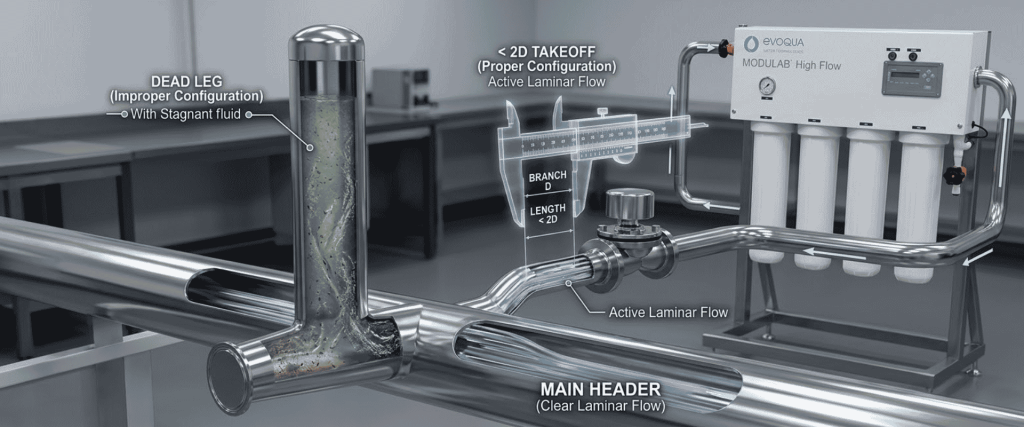
When distributing high-flow water to multiple bench drops.
High flow rates do not have to come at the expense of ionic and organic purity. By combining high-capacity resin beds, targeted UV photo-oxidation, and inline ultrafiltration, the Modulab High Flow System bridges the gap between low-volume benchtop dispensers and multi-million-dollar central distribution loops.
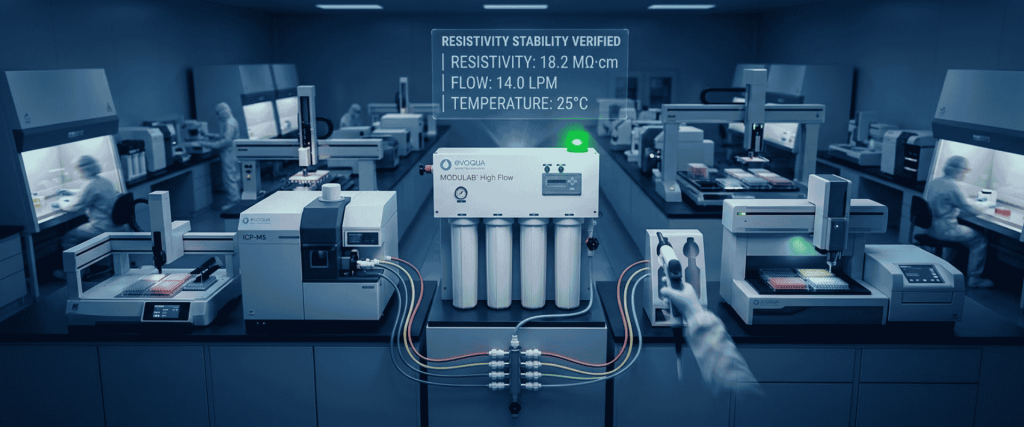
For facilities expanding their analytical throughput, medical manufacturing, or cleanroom validation workflows, matching the system configuration to process demands ensures that 18.2 MΩ·cm water remains stable, even during the busiest operating hours.
Maintaining 18.2 MΩ·cm water purity under heavy laboratory demand requires purpose-built engineering capable of handling high volumetric velocity without resin fluidization.
The Modulab High Flow System bridges the gap between low-capacity benchtop dispensers and costly central distribution loops by combining large-format polishing, UV oxidation, and ultrafiltration.
By eliminating resistivity drift during peak multi-station draws, it provides laboratories with dependable, compliant Type 1 water for their most critical workflows.
When multiple points draw water at the same time, flow velocity through the resin bed increases, reducing contact time (EBCT). If the system is not designed for high flow rates, ions pass through without binding, causing an immediate drop in resistivity.
No. The Modulab High Flow is a Type 1 polishing system designed for pretreated water (RO, DI, or EDI). Supplying raw tap water will exhaust the mixed-bed cartridges rapidly and void operating parameters.
The system delivers continuous flow rates from a minimum of 2 LPM (0.5 GPM) up to a maximum of 14 LPM (3.7 GPM), provided feed pressure is maintained between 25 and 60 psig.
The Bio Model uses an integrated ultrafiltration (UF) cartridge with a low molecular weight cut-off. This membrane physically blocks endotoxins, pyrogens, and nucleases, maintaining endotoxin levels below 0.05 EU/mL at the point of use.

Enter your details below to save your shopping cart for later. And, who knows, maybe we will even send you a sweet discount code :)
Allow notifications to get real-time updates about your shopping cart and who knows, you may even receive a sweet discount code 😊