Mandatory cleanroom smoke studies often risk contaminating critical ISO 1 and ISO 5 environments with poor-quality tracer media.
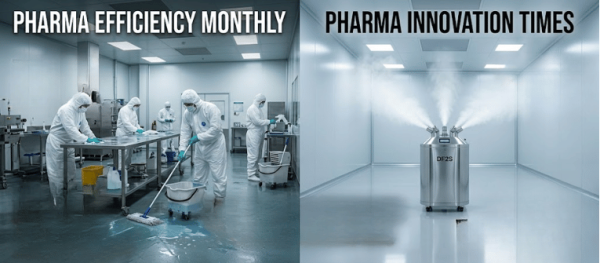
Standard glycol and chemical foggers leave oily residues, foul HEPA filters, and cause expensive production downtime.
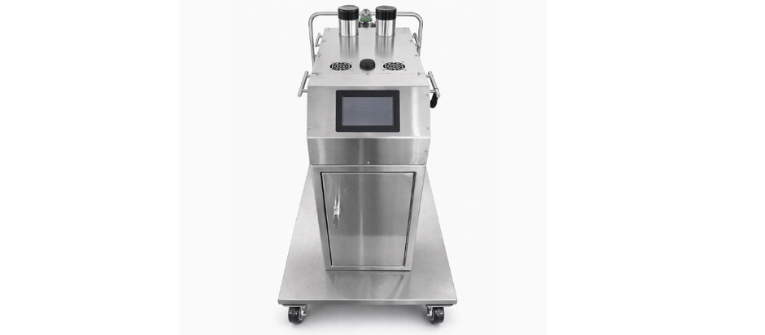
The AP100 LN₂ Ultrapure Cleanroom Fogger eliminates this risk by combining liquid nitrogen with high-purity DI or WFI water.
It delivers dense, high-contrast visualization for audit compliance and evaporates 100% residue-free with zero cleanup required.
Regulatory bodies, including the FDA, EMA (EU GMP Annex 1), and ISO inspectors, require clear video evidence of unidirectional airflow, containment integrity, and operator air disruption.
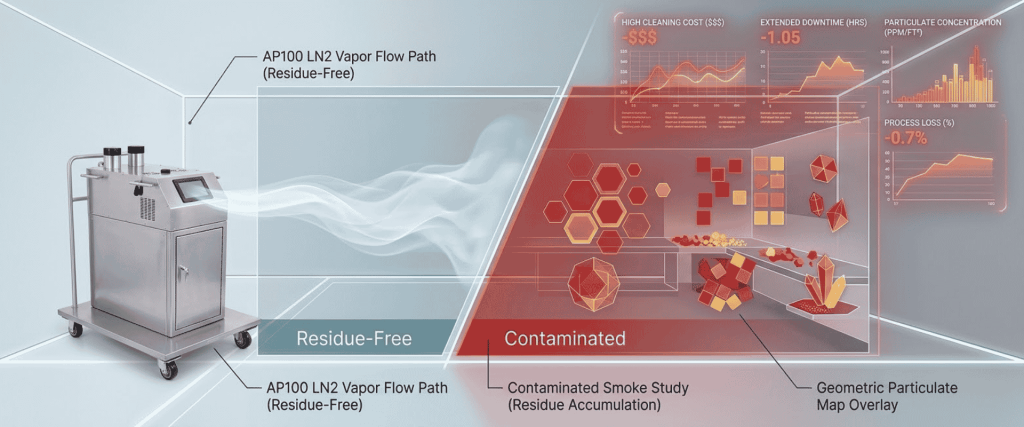
When facilities select the wrong tracer medium, they trade regulatory compliance for contamination risk.
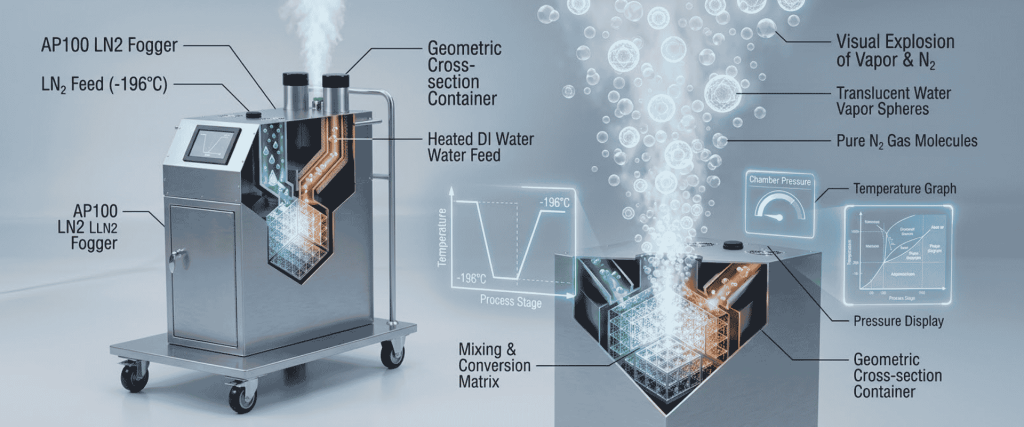
The AP100 operates on a pure thermodynamic reaction between Liquid Nitrogen (LN₂) and heated Deionized (DI) water or Water for Injection (WFI).
Liquid Nitrogen (-196°C) + Ultra-Pure Water (DI / WFI)
│
▼
High-Density Sub-Micron Fog (Pure Water Vapor + N₂ Gas)
│
▼
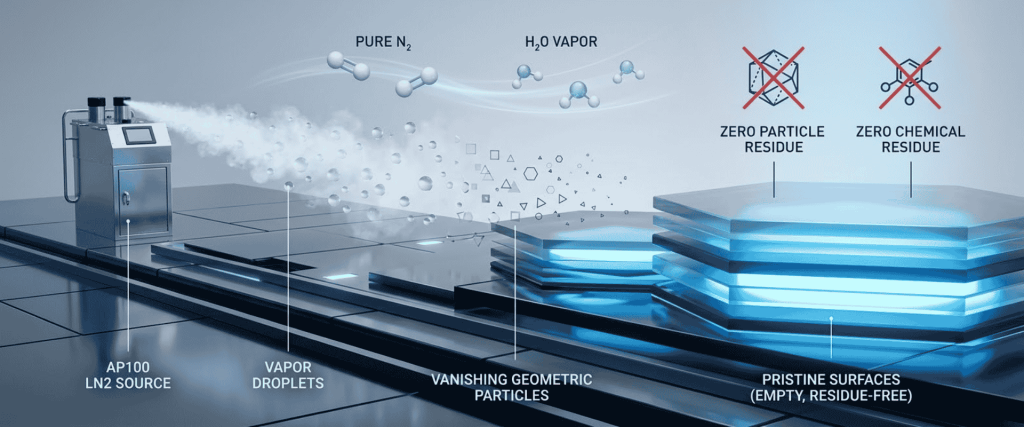
100% Evaporation (Zero Chemical Residue, Zero Particle Residue)
Liquid nitrogen vaporizes rapidly when mixed with heated high-purity water, creating millions of sub-micron water droplets suspended in pure nitrogen gas.
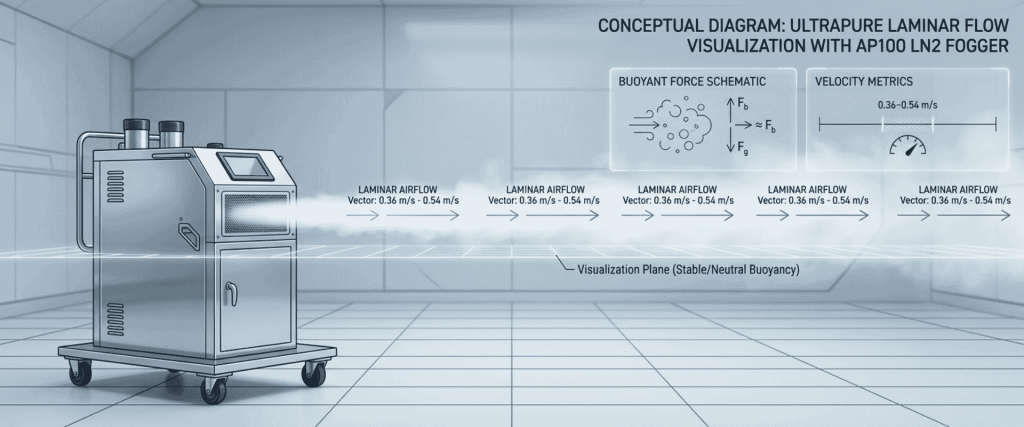
The generated fog reaches thermal equilibrium with the ambient cleanroom environment, floating naturally with laminar air currents rather than sinking quickly or rising prematurely.
When the visualization study concludes, the fog particles evaporate back into clean, breathable nitrogen gas and ambient humidity. No particulate matter, salts, or chemical binders are left on room surfaces, tooling, or product containers.
Beyond zero-residue output, the AP100 provides the volume, throw, and control required to map complex aerodynamic patterns across large manufacturing floors.
Large semiconductor fab bays and pharmaceutical fill-finish suites require massive fog volume to track airflow across full filter banks.
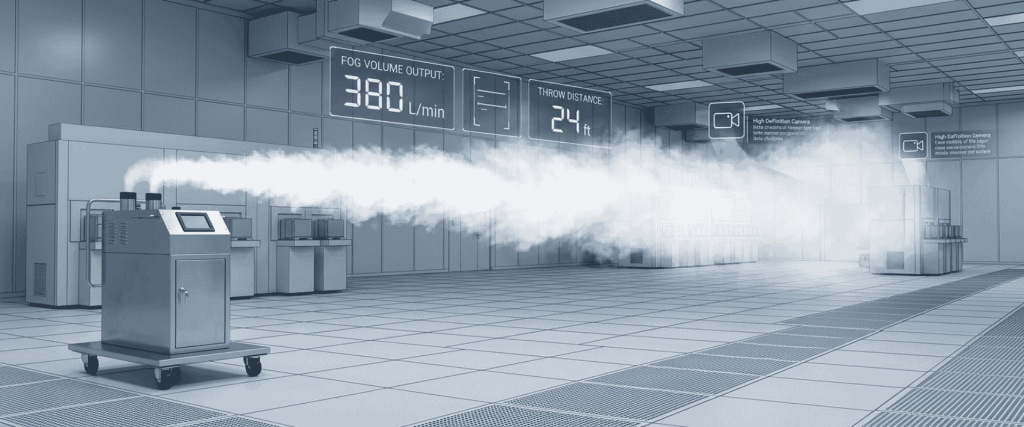
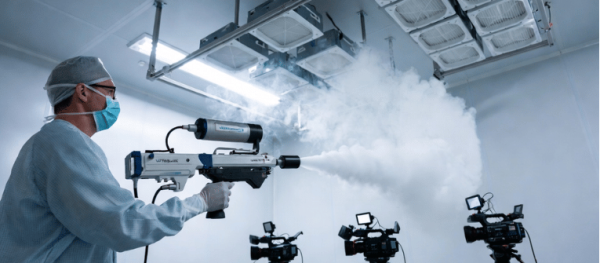
The AP100 generates dense, highly visible fog with a throw distance exceeding 20 feet, ensuring air patterns remain clear on high-definition video cameras during validation audits.
Human presence inside an aseptic zone during a smoke test disrupts natural airflow and introduces shed particles.
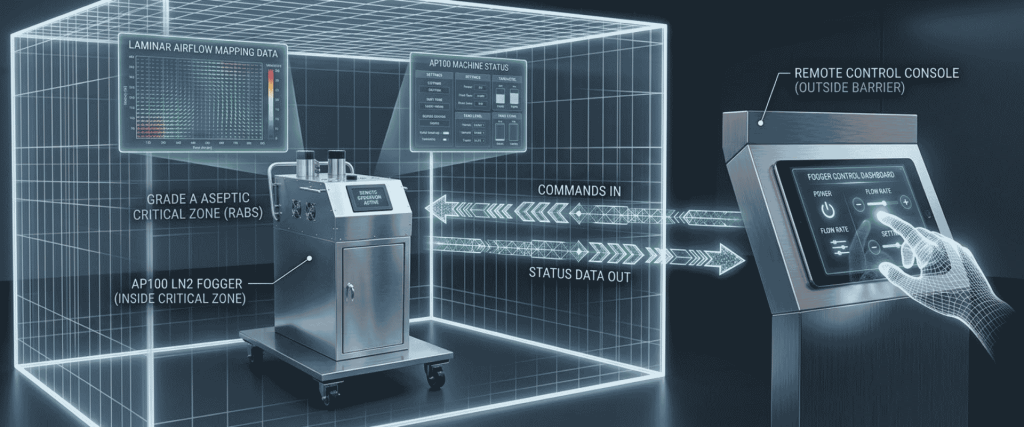
The AP100 includes remote control capabilities, enabling validation engineers to start, stop, and modulate fog velocity from outside the critical barrier or through glove ports without disturbing the laminar boundary layer.
To accurately document cleanroom aerodynamics, the fog’s exit velocity must match the room’s air velocity (typically 0.36 to 0.54 m/s in unidirectional suites).
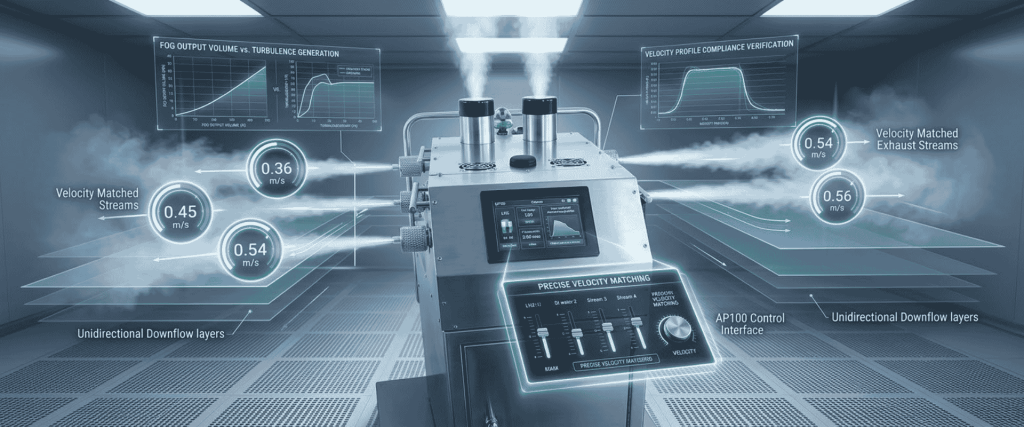
The AP100 allows operators to tune output speed, preventing the artificial turbulence created by high-pressure smoke nozzles.
| Feature / Metric | AP100 LN₂ Ultrapure Fogger | Standard Ultrasonic Fogger | Glycol / Chemical Generator |
| Media Used | LN₂ + DI / WFI Water | DI / Purified Water | Glycol / Mineral Oil Base |
| Residue / Deposition | Zero (100% Residue-Free) | Minimal to low minerals | High (Oily film/particulates) |
| Cleanroom Rating | ISO 1 – ISO 5 / Grade A–B | ISO 5 – ISO 8 / Grade C–D | Industrial / Non-classified |
| Visual Throw Distance | 20 to 30+ feet | 6 to 10 feet | 15 to 25 feet |
| Fog Density | Very High (Opaque white) | Moderate / Semi-translucent | High |
| Post-Study Cleanup | None | Light wipe-down (if pooling) | Intensive chemical wipe-down |
| Control Interface | Integrated & Remote control | Manual / Basic switch | Manual switch |
Recent updates to international cleanroom standards place heavy emphasis on dynamic smoke studies, testing airflow patterns while operators perform routine interventions and machinery is in active motion.
By providing high-contrast, sub-micron fog that leaves no trace on sterile equipment, the AP100 provides cleanrooms with defensible video documentation without risking subsequent production batch contamination.
Eliminating contamination risks during cleanroom airflow testing requires an engineering approach that prioritizes media purity.
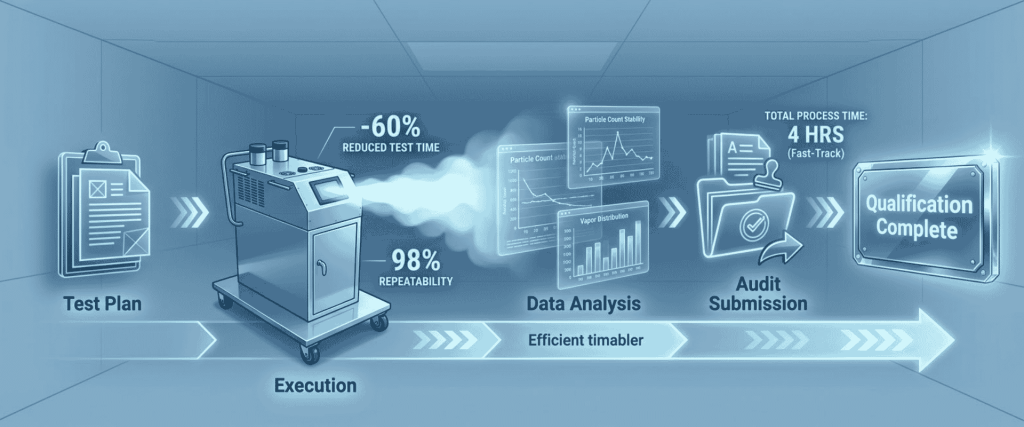
By utilizing liquid nitrogen and high-purity water, the AP100 LN₂ Ultrapure Cleanroom Fogger delivers the visual density required for strict regulatory video audits while eliminating post-test cleaning routines, surface residues, and filter contamination.
Airflow visualization should validate cleanroom integrity without introducing contamination risks to critical processing zones.
By combining liquid nitrogen with ultra-pure water, the AP100 generates dense, buoyant fog that evaporates completely residue-free.
This provides facilities with the clear video evidence required for strict ISO 14644-3 and EU GMP Annex 1 compliance audits.
Investing in the AP100 protects product batch integrity while eliminating post-test wipe-downs and costly operational downtime.
No. Because the fog droplets are sub-micron in size and suspended in nitrogen gas, the fog evaporates cleanly into the ambient air before condensation or water pooling can occur on work surfaces.
To guarantee zero residue in critical zones, the AP100 should always be operated with Deionized (DI) water (18 Meg-ohm purity) or Water for Injection (WFI).
Yes. The fog output can be routed into isolators, RABS, and biological safety cabinets via flexible, non-contaminating sanitary hoses to map barrier performance without opening cabinet doors.
The system features adjustable flow controls, allowing operators to match the fog’s exit velocity directly to the ambient laminar downflow velocity (0.36–0.54 m/s), ensuring true, undisrupted airflow path visualization.
Enter your details below to save your shopping cart for later. And, who knows, maybe we will even send you a sweet discount code :)
Allow notifications to get real-time updates about your shopping cart and who knows, you may even receive a sweet discount code 😊