In aerosol science and cleanroom monitoring, measurement precision is non-negotiable.
Laser Aerosol Spectrometers (LAS) and Optical Particle Counters (OPC) rely heavily on accurate calibration to categorize particles by size.
NIST-traceable Polystyrene Latex (PSL) spheres, ranging from 20nm to 900nm, serve as the industry gold standard for validating these instruments.
These monodisperse particles provide a consistent, known reference point, allowing researchers and technicians to ensure their data is reliable and reproducible.
The Importance of NIST Traceability in Particle Sizing
Traceability to the National Institute of Standards and Technology (NIST) means that the particle size has been verified through an unbroken chain of comparisons to international standards.
For laboratories, this provides a layer of legal and technical certainty.

Using NIST-traceable PSL spheres ensures that a 100nm measurement in one facility is identical to a 100nm measurement in another.
This is critical for regulatory compliance, particularly in pharmaceutical manufacturing, semiconductor fabrication, and atmospheric research.
How PSL Spheres Calibrate Laser Aerosol Spectrometers
Laser Aerosol Spectrometers operate by measuring the intensity of light scattered by individual particles as they pass through a laser beam.
Because different materials scatter light differently based on their refractive index, a standard material is required to create a calibration curve.
PSL spheres are ideal for this because they have a well-defined refractive index (approximately 1.59 @ 589nm) and near-perfect spherical geometry.
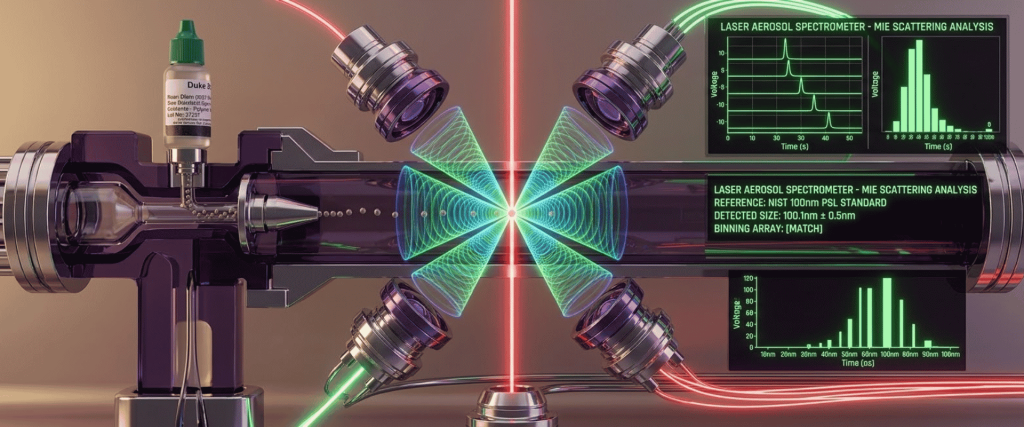
By introducing a known size of PSL spheres, for example, 100nm or 500nm, into the spectrometer, the instrument can correlate the detected light signal with a specific physical diameter.
This process eliminates guesswork and allows the instrument to accurately bin unknown ambient particles during real-world testing.
Technical Characteristics of 20nm, 900nm PSL Particles
The 20nm to 900nm range is particularly significant as it covers the accumulation mode of aerosols, where particles are large enough to scatter light effectively but small enough to remain suspended in air for long periods.
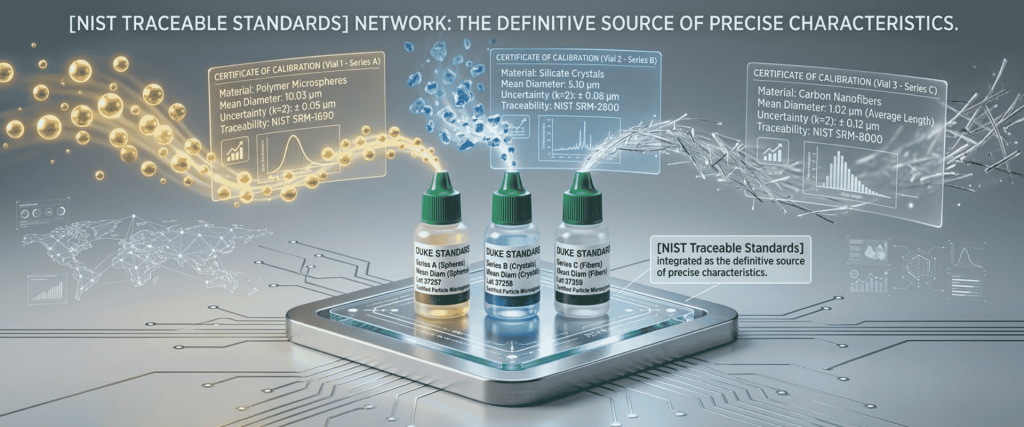
Key characteristics include:
- Monodispersity: These spheres have an extremely narrow size distribution, meaning the Coefficient of Variation (CV) is typically less than 3%.
- Surface Stability: The spheres are suspended in ultra-pure water with trace amounts of surfactant to prevent agglomeration.
- High Precision: Each bottle comes with a Certificate of Calibration documenting the mean diameter and the uncertainty of the measurement.
Technical Comparison: PSL Sphere Applications by Size
| Size Range | Primary Application | Primary Instrument Used |
| 20nm – 100nm | Nucleation studies and ultra-fine particle detection | SMPS, Nano-Aerosol Spectrometers |
| 100nm – 500nm | HEPA/ULPA filter efficiency testing | Laser Aerosol Spectrometers (LAS) |
| 500nm – 900nm | Cleanroom monitoring and atmospheric research | Optical Particle Counters (OPC) |
Best Practices for Handling and Use
To maintain the integrity of the calibration standards, proper handling is essential. Always store PSL spheres at 4°C to prevent bacterial growth and maintain suspension stability.
Before use, the solution should be gently agitated (never vigorously shaken) to ensure the particles are evenly distributed.
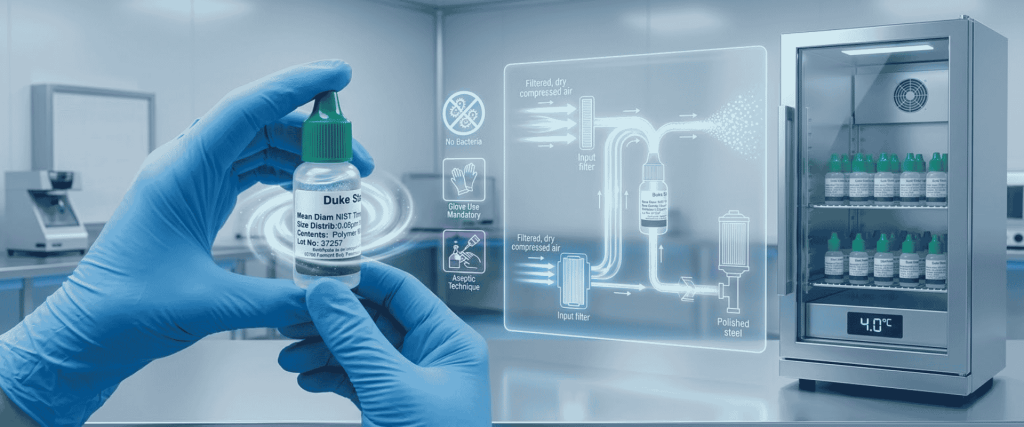
When nebulizing the spheres for aerosol applications, use filtered, dry compressed air to avoid introducing contaminants that could skew the spectrometer readings.
Conclusion
NIST-traceable PSL spheres in the 20nm to 900nm range are indispensable tools for any professional working with aerosol measurement technology.
By providing a predictable, spherical, and stable reference, these particles bridge the gap between raw light-scattering data and accurate particle size distribution.
Investing in high-quality calibration standards is the most effective way to ensure the long-term accuracy and credibility of aerosol research and industrial monitoring.
Frequently Asked Questions (FAQs)
1. What is the shelf life of PSL spheres?
Most NIST-traceable PSL spheres have a shelf life of 12 to 24 months, provided they are stored correctly at 4°C and kept free from contamination.
2. Can PSL spheres be used in liquid particle counters?
Yes, while they are widely used for aerosol spectrometers, they are also frequently used to calibrate liquid-borne particle counters in the pharmaceutical and water treatment industries.
3. Why is the refractive index of 1.59 important?
Laser Aerosol Spectrometers use Mie scattering theory to calculate size. Since scattering depends on the refractive index, knowing the exact index of the PSL (1.59) allows the instrument software to create an accurate calibration curve.
4. Are these spheres available in custom sizes?
While the 20nm to 900nm range covers most standard requirements, specific diameters can often be selected to match the exact bins or channels of a specific instrument.