
Maintaining a cleanroom environment requires more than standard cleaning protocols.
In pharmaceutical, biotech, and semiconductor industries, the presence of resilient spores and microbial contaminants can lead to catastrophic batch failures.
Cold vapor dry fogging has emerged as the industry standard for achieving a validated 6-log bioburden reduction, providing a level of sterility that manual wiping simply cannot match.
The Dry Fog 2 (DF2) system from us represents the pinnacle of this technology, utilizing ultra-fine droplets to ensure that every surface, even those in shadowed or hard-to-reach areas, is thoroughly decontaminated.
Understanding Cold Vapor Dry Fog Technology
Cold vapor dry fogging works by converting a liquid sterilant, typically a hydrogen peroxide and peracetic acid blend, into an ultra-fine aerosol.
Unlike traditional humidifiers or misters, a true dry fogger produces droplets significantly smaller than 10 microns.
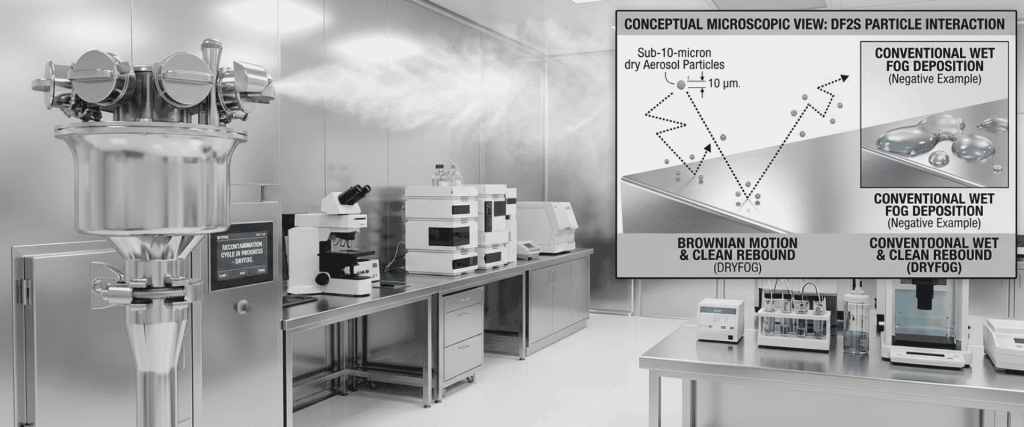
These tiny droplets behave similarly to a gas. Because of their low mass, they do not burst upon impact with surfaces. Instead, they bounce off surfaces and circulate through the air via Brownian motion.
This allows the sterilant to permeate complex equipment, under tables, and inside ventilation ducts without leaving behind wet residues or causing corrosion to sensitive electronics.
Why 6-Log Reduction Matters in Cleanroom Environments
In the context of sterilization, a log reduction refers to a mathematical scale showing the relative number of live microbes eliminated. A 6-log reduction means that the number of microorganisms is reduced by 99.9999%.
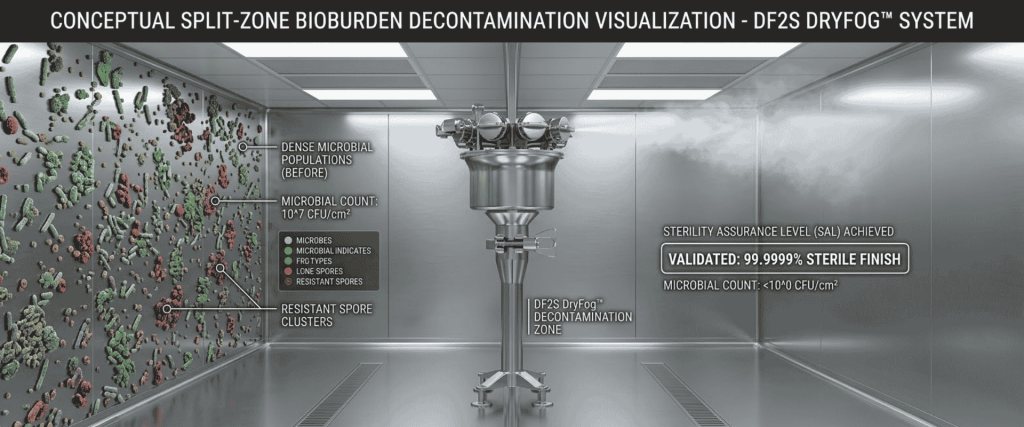
For instance, if a surface has one million colony-forming units (CFUs), a 6-log reduction leaves only one survivor.
The Role of Sporicidal Disinfectants
Bacterial spores are among the most difficult organisms to kill. They are resistant to heat, desiccation, and many standard chemical disinfectants. Achieving a 6-log reduction specifically against these spores (sporicidal activity) is the benchmark for cleanroom validation.
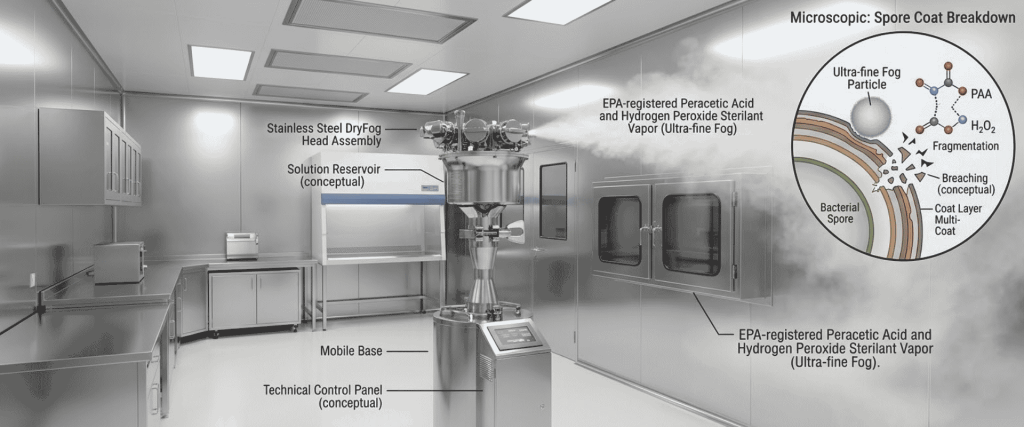
The Dry Fog 2 system, when used with the appropriate sterilant, provides the consistent contact time and concentration required to meet these stringent regulatory standards.
Key Features of the Dry Fog 2 (DF2) System
The Dry Fog 2 is engineered specifically for the rigorous demands of GMP-compliant facilities. Its design focuses on reliability, ease of use, and repeatable results:
- Stainless Steel Construction: Built to withstand harsh sterilants and ensure a long service life in pharmaceutical environments.
- Multiple Nozzle Configurations: Allows for 360-degree coverage, ensuring the fog reaches every corner of the room.
- Portable and Lightweight: Easy to move between different cleanroom suites or containment zones.
- Zero Wetness: The droplet size is so fine that it evaporates before it can pool, protecting sensitive laboratory instruments.
Technical Comparison: Dry Fogging vs. Traditional Methods
To understand why the Dry Fog 2 is the preferred choice for bioburden control, it is helpful to compare it against manual cleaning and standard wet fogging:
| Feature | Manual Wiping | Standard Wet Fogging | Dry Fog 2 (Cold Vapor) |
| Log Reduction | 2-log to 3-log | 3-log to 4-log | Validated 6-log |
| Surface Coverage | Line of sight only | Varies; prone to pooling | Total room coverage |
| Residue / Moisture | High | High | Minimal to None |
| Labor Intensity | Very High | Moderate | Low |
| Shadow Areas | Missed | Partial | Full Penetration |
Operational Benefits for GMP Facilities
Implementing the Dry Fog 2 system offers significant operational advantages beyond simple microbial control. For facilities operating under Good Manufacturing Practices (GMP), consistency is vital.
The DF2 provides a repeatable process that can be easily validated during the IQ/OQ/PQ phases of facility setup.
Furthermore, because the dry nature of the fog eliminates the need for post-decontamination wiping, the time required to return a suite to service is greatly reduced.
This translates to less downtime and higher production efficiency.
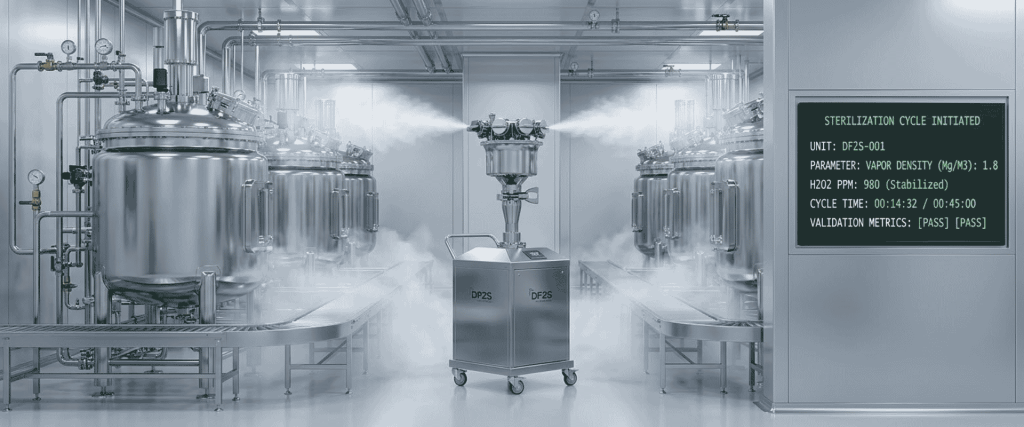
Achieving a 6-log sporicidal bioburden reduction is a critical requirement for modern cleanroom facilities.
The Dry Fog 2 system provides an efficient, reliable, and non-corrosive solution for total surface decontamination.
By utilizing cold vapor technology, facility managers can ensure they are meeting the highest standards of sterility while protecting their equipment and optimizing operational timelines.
Conclusion
Achieving a validated 6-log bioburden reduction is non-negotiable for safeguarding GMP cleanrooms against resilient microbial and spore contamination.
The Dry Fog 2 system uses sub-10-micron cold vapor technology to penetrate complex shadow areas and ductwork via Brownian motion without surface wetting.
Its non-corrosive, residue-free delivery protects sensitive electronics and analytical equipment while eliminating the labor and variability of manual wipe-downs.
For high-stakes biotech and pharmaceutical facilities, the DF2 delivers repeatable, audit-ready sterility that accelerates suite turnaround and prevents catastrophic batch loss.
Frequently Asked Questions (FAQs)
1. What is the typical droplet size of the Dry Fog 2?
The Dry Fog 2 produces droplets that are typically less than 10 microns in diameter, which ensures they behave like a gas and do not wet surfaces.
2. Can I use different disinfectants with the DF2?
While the system is designed for high-level sterilants like Minncare or hydrogen peroxide solutions, always consult the manufacturer’s guidelines to ensure chemical compatibility with the stainless steel components.
3. How long does a typical decontamination cycle take?
The duration depends on the room volume and the target log reduction. Generally, a cycle involves a fogging phase, a dwell period (usually 30–60 minutes), and an aeration phase to remove the sterilant from the air.
4. Is the Dry Fog 2 safe for electronics?
Yes. When operated correctly, the dry fog does not condense on surfaces. This makes it safe for use in areas with sensitive electronic equipment, such as computers and analytical lab instruments.