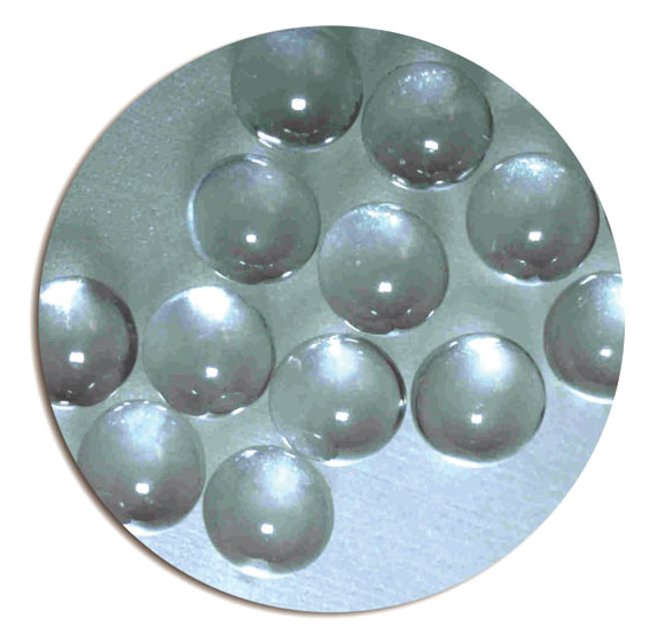
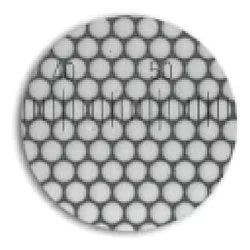
Uniform Glass Microspheres, uniform borosilicate microspheres, NIST traceable, 1 gram, dry.

Nominal = 2µm
NIST Traceable = 2.5µm ± 0.5µm
Mean & C.V. = 1.0µm (40%)
Wt./pkg = 1 g
Approximate Count Per gm = 4.8 x 10¹⁰

Small borosilicate glass microspheres have fewer spherical imperfections…

Description

Nominal = 2µm

NIST Traceable = 2.5µm ± 0.5µm

Mean & C.V. = 1.0µm (40%)

Wt./pkg = 1 g

Approximate Count Per gm = 4.8 x 10¹⁰

Small borosilicate glass microspheres have fewer spherical imperfections and inclusions than other glass microspheres. They also have better mechanical and thermal stability. This series has been calibrated with NIST traceable methods of optical microscopy. They are packaged as one gram of dry spheres (as a free-flowing dry powder). The borosilicate spheres have a density of 2.50-2.55g/cm3 and an index of refraction of 1.56 @ 589nm (23° C). For those interested in magnetic susceptibility measurements, such data does not (to our knowledge) publicly exist, but we can report that the only magnetism would come from the low level iron impurities, and which are not more than 0.2% by weight of Fe2O3. Furthermore, these borosilicate glass spheres have low levels of trace element impurities.

Applications:

In addition to the numerous applications in microscopy, these borosilicate glass spheres can also be used for applications in flow tracing, filter checking, and instrument calibration.

Additional information

Size

2 µm, dry, 5 µm, dry, 8 µm, dry, 10 µm, dry, 15 µm, dry, 20 µm, dry, 30 µm, dry, 40 µm, dry, 50 µm, dry, 60 µm, dry, 70 µm, dry, 80 µm, dry, 90 µm, dry, 100 µm, dry, 110 µm, dry, 120 µm, dry, 140 µm, dry, 170 µm, dry, 200 µm, dry, 230 µm, dry, 280 µm, dry, 330 µm, dry, 400 µm, dry, 480 µm, dry, 550 µm, dry, 650 µm, dry, 950 µm, dry, 1000 µm, dry, 2000 µm, dry

Reviews

There are no reviews yet.

Only logged in customers who have purchased this product may leave a review.