Semiconductor Metrology & Electronics Manufacturing Equipment
Semiconductor fabrication is one of the most contamination-sensitive manufacturing environments in existence.
At advanced process nodes, particles far smaller than a human hair can cause fatal defects in integrated circuits.
A single particle deposited during lithography, deposition, or packaging may render an entire die nonfunctional.
For this reason, semiconductor manufacturing depends on continuous verification of:
Surface contamination levels
Inspection system calibration
Airflow behavior in process environments
Particle detection accuracy
Process repeatability across tools and production lines
Applied Physics develops metrology standards and process equipment used to verify that these systems operate within defined tolerances.
Inspection tools are only reliable if their measurements remain calibrated and traceable.
Surface scanning inspection systems (SSIS), wafer scanners, and particle detection tools measure contamination levels in nanometer ranges.
Over time, optical systems, sensors, and calibration references drift.
Without known reference standards, engineers cannot confirm whether detected particles represent real contamination or measurement error.
Calibration standards allow process engineers to verify:
Detection sensitivity
Particle size accuracy
Inspection tool matching across production lines
Process drift over time
This verification is necessary to maintain yield stability and traceable measurement results.
Calibration wafer standards are used to verify the accuracy of wafer inspection systems.
These standards contain precisely deposited particle sizes with known distributions that allow engineers to confirm whether inspection tools are correctly detecting contamination.
Typical applications include:
Calibration of scanning surface inspection systems (SSIS)
Verification of wafer inspection tool sensitivity
Process development and research laboratories
Tool matching between semiconductor production lines
Acceptance testing of new inspection equipment
Particles are typically deposited using monodisperse microspheres, allowing precise verification of detection thresholds.
Calibration wafers provide traceable reference points that support process stability and yield optimization.
Particle standards are used to calibrate instruments that detect airborne and surface contamination in semiconductor facilities.
Typical applications include:
Laser particle counter calibration
Aerosol monitoring systems
Cleanroom contamination measurement
Process tool contamination analysis
These standards are manufactured using tightly controlled particle size distributions to ensure measurement consistency.
Without traceable particle standards, contamination monitoring systems cannot reliably confirm particle size or concentration accuracy.
Semiconductor cleanrooms rely on carefully controlled airflow to remove airborne particles from sensitive process areas.
Even small airflow disturbances can cause particles to settle on wafers during critical operations such as:
Photolithography
Etching
Deposition
Packaging and assembly
Airflow visualization allows engineers to confirm that air moves away from wafer surfaces rather than toward them.
Visualization studies are commonly used to evaluate:
Tool exhaust airflow behavior
Equipment installation impact
Maintenance recovery time
Door openings and personnel interaction
Process enclosure airflow stability
These studies help prevent contamination events that could cause yield loss.
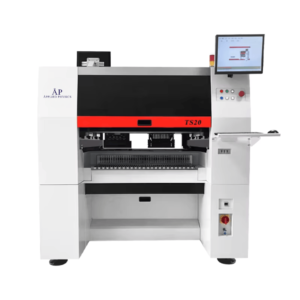
Beyond semiconductor metrology standards, Applied Physics supports electronics manufacturing with Surface Mount Technology production equipment.
SMT production lines are used to assemble printed circuit boards that support semiconductor devices across industrial, medical, aerospace, and research applications.
Typical SMT equipment includes:
Pick and place machines
Reflow ovens
Solder paste printers
Automated optical inspection (AOI) systems
PCB handling conveyors
Stencil printing systems
These systems are used in electronics manufacturing services (EMS), prototype labs, and advanced manufacturing environments.
By combining metrology verification tools with electronics production equipment, Applied Physics supports both contamination validation and electronics assembly infrastructure.
If metrology systems drift or contamination monitoring becomes unreliable, engineers may lose visibility into process stability.
Possible consequences include:
Undetected wafer contamination
Reduced production yield
Process variation between tools
False inspection results
Production line downtime
Misdiagnosed defect sources
Calibration and contamination verification provide the measurement confidence necessary to maintain stable semiconductor manufacturing processes.
Applied Physics semiconductor equipment is used in:
Semiconductor fabrication facilities (fabs)
Wafer inspection laboratories
Process development facilities
Electronics manufacturing services (EMS)
Advanced research laboratories
Semiconductor packaging and assembly operations
These environments require consistent measurement traceability and contamination control.
Typical users include:
Semiconductor process engineers
Yield engineers
Metrology specialists
Cleanroom facility engineers
Equipment installation teams
Research laboratory scientists
These teams rely on calibration standards and process verification tools to maintain measurement integrity.
A calibration wafer standard is a reference wafer containing precisely deposited particles used to verify the accuracy of wafer inspection systems.
They allow particle counters and contamination detection tools to confirm accurate size measurements and concentration readings.
Improper airflow can carry particles toward wafer surfaces during sensitive process steps, causing fatal defects.
Calibration is typically performed during installation, maintenance, and periodic process verification to ensure measurement accuracy.
SMT production lines assemble electronic systems that integrate semiconductor components into functional devices.