Cleanroom Contamination Control & Airflow Validation Equipment
Cleanrooms are engineered to control airborne contamination through filtration, airflow direction, and pressure differentials. However, design specifications alone do not guarantee that contamination control performs as expected during real operation.
Personnel movement, equipment placement, door openings, and process activity can alter airflow behavior and allow particles or microorganisms to reach critical surfaces.
Validation equipment is used to confirm that environmental controls function correctly under real working conditions.
Applied Physics cleanroom systems are used to verify airflow behavior, particle monitoring accuracy, and contamination control performance across pharmaceutical, semiconductor, healthcare, and advanced manufacturing environments.
Airflow visualization is one of the most important diagnostic tools used during cleanroom validation.
Even in environments with compliant particle counts, incorrect airflow can allow contaminants to settle on sterile product surfaces or sensitive semiconductor wafers.
Visualization studies allow engineers to observe how air actually moves around equipment, operators, and process tools.
Typical evaluations include:
Laminar airflow behavior
Turbulence near critical zones
Operator interference patterns
Equipment shadowing effects
Airflow recovery after disturbances
Contamination transport pathways
These studies are often documented using video recording to support regulatory inspections and validation reports.
Cleanroom airflow testing is required or recommended by several regulatory frameworks governing sterile and controlled manufacturing environments.
ISO 14644 defines particle concentration classifications for cleanrooms.
Airflow visualization studies are used during cleanroom qualification to demonstrate proper airflow direction and contamination removal.
Testing may occur during:
Installation qualification (IQ)
Operational qualification (OQ)
Periodic requalification
Equipment installation or relocation
Pharmaceutical compounding environments must demonstrate that sterile preparations are protected by first air during compounding activities.
Airflow visualization studies are used to verify:
Laminar airflow hood performance
Operator impact on sterile zones
Barrier isolator airflow behavior
Biological safety cabinet protection
These tests must often be performed under dynamic conditions with operators present.
In pharmaceutical manufacturing, airflow studies are used to confirm protection of product contact surfaces during aseptic filling, packaging, and sterile processing.
These studies help demonstrate compliance with FDA and EU GMP expectations.
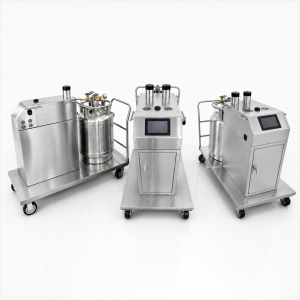
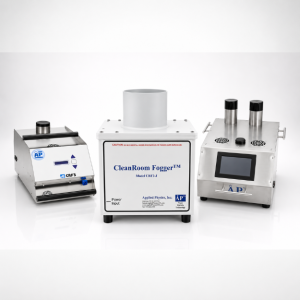
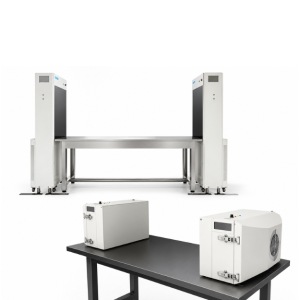
Applied Physics manufactures both ultrasonic and LN₂-based foggers designed for cleanroom airflow studies.
These systems generate visible vapor that follows airflow patterns without introducing contamination into the environment.
LN₂ foggers generate high-purity fog using liquid nitrogen and sterile water.
The resulting vapor produces highly visible airflow patterns suitable for large cleanrooms and semiconductor production areas.
Typical applications include:
Pharmaceutical aseptic filling lines
ISO 5–8 cleanrooms
Semiconductor fabs
RABS and isolator validation
Large production suites
Because the fog evaporates quickly and leaves no residue, testing can be performed without post-cleaning requirements.
Ultrasonic foggers use high-frequency transducers to generate fog from deionized or sterile water.
These portable systems are commonly used for localized airflow verification.
Applications include:
Laminar flow benches
Biosafety cabinets
Glove boxes
Cleanroom door airflow studies
Fume hood airflow verification
Ultrasonic foggers allow engineers to visualize small-scale airflow patterns and turbulence near work surfaces.
Airflow visualization confirms directional airflow, but contamination monitoring requires particle detection instruments.
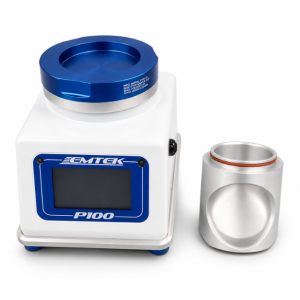
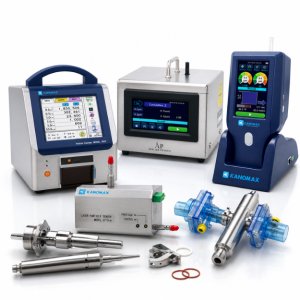
Particle monitoring systems are used to measure airborne particulate concentrations and verify compliance with cleanroom classification limits.
Typical applications include:
Cleanroom certification
Continuous environmental monitoring
Process equipment qualification
Contamination investigations
Filter performance verification
Particle counters and air sampling equipment allow facilities to track contamination trends and detect deviations before they impact production.
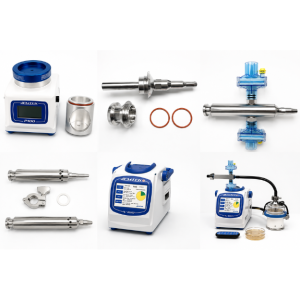
Beyond airflow visualization and particle counting, facilities often require additional environmental monitoring tools to verify contamination control systems.
Common monitoring categories include:
These tools provide additional data supporting contamination control programs and environmental monitoring plans.
If airflow behavior is not properly validated, contamination pathways may remain undetected.
Possible consequences include:
Sterile product contamination
Batch rejection in pharmaceutical manufacturing
Increased particle defects in semiconductor production
Failed environmental monitoring investigations
Regulatory observations during inspections
Expensive requalification events
Airflow visualization and contamination monitoring provide the physical evidence required to identify and correct these issues.
Applied Physics cleanroom systems are used in:
Pharmaceutical manufacturing facilities
Sterile compounding pharmacies
Biotechnology laboratories
Semiconductor fabrication plants
Medical device manufacturing
Hospital sterile environments
Research laboratories
Each environment requires documented validation of contamination control systems.
Cleanroom testing is typically conducted by:
Validation engineers
Cleanroom certification professionals
Quality assurance teams
Facility engineering
Microbiology departments
Regulatory compliance specialists
Documentation generated during testing is often required during audits and inspections.
A smoke study visualizes airflow patterns in a controlled environment to verify that air moves away from critical surfaces and contamination sources.
Airflow direction determines how particles travel through the room. Visualization confirms that contamination is carried away from sensitive processes.
Ultrasonic foggers are portable and ideal for localized airflow studies, while LN₂ foggers produce higher volumes of fog for large cleanroom environments.
They are typically performed during cleanroom certification, after equipment changes, and periodically as part of validation programs.
No. Particle counters measure concentration but cannot reveal airflow direction or contamination transport pathways.