
Last Updated: July 13, 2026
Preventing cleanroom contamination in manufacturing is critical for pharmaceutical compounding, semiconductor production, and medical device manufacturers. A single contamination event can trigger recalls, regulatory sanctions, or patient harm. This guide covers essential strategies, standards, and monitoring techniques that separate compliant facilities from those facing costly failures.
Contamination comes from two primary vectors: particulate matter and microbial organisms. Personnel behavior and workflow errors account for a larger share of contamination events than external sources like dust and air quality.
Particulate contamination consists of solid particles suspended in air or settled on surfaces. Non-controlled environments contain roughly 35 million particles per cubic foot. A properly classified ISO 5 cleanroom reduces this to fewer than 100 particles per cubic foot, a 99.9997% reduction.
Microbial contamination includes bacteria, fungi, and spores that pose direct risk to sterile compounded preparations (CSPs). Unlike particulates, microbial contaminants reproduce rapidly if conditions allow. A single viable organism can become millions within hours at room temperature.
Particulate contamination is detected through non-viable sampling (particle counts), while microbial contamination requires viable sampling (culture-based methods). High particulate counts often correlate with elevated microbial risk because particles can carry viable organisms.
Temperature, humidity, and air pressure create conditions that either suppress or promote contamination. Temperature between 68°F and 86°F accelerates bacterial reproduction. Humidity above 60% relative humidity (RH) supports mold and fungal growth. Below 30% RH, static electricity increases, which can damage components and dislodge particles.
Pressure differential is critical. A cleanroom must maintain positive pressure relative to adjacent spaces, typically 0.02 to 0.05 inches of water column. When pressure differential drops, contaminated air from hallways migrates inward, a common failure in audits.
Air changes per hour (ACH) directly impact contamination risk. ISO 5 areas require minimum 240 ACH. Lower ACH rates mean contaminants linger longer before HEPA filtration captures them. Personnel movement generates 100,000 to 1 million particles per minute depending on garbing quality. Slow, deliberate movements shed fewer particles than rapid, jerky ones.
ISO 14644 defines cleanroom classifications based on maximum allowable particle counts. The classification determines what products can be safely compounded and monitoring frequency requirements.
ISO 5 cleanrooms allow no more than 100 particles ≥0.5 microns per cubic foot. This is where primary engineering controls (PECs) like laminar flow hoods and isolators are located. USP 797 requires ISO 5 classification for all non-hazardous sterile compounding.
ISO 7 buffer rooms support ISO 5 areas and allow up to 352,000 particles ≥0.5 microns per cubic foot. Personnel don garb and perform hand hygiene here before entering the ISO 5 space. The buffer room must maintain positive pressure relative to the ante-room.
ISO 8 ante-rooms are transition spaces between uncontrolled and controlled environments, allowing up to 3.52 million particles ≥0.5 microns per cubic foot. Personnel perform initial garbing here before moving to the ISO 7 buffer room.
Pressure must increase as you move inward: ante-room < buffer room < ISO 5. If this gradient fails, contamination flows backward and the system is compromised.
HEPA filters capture 99.97% of particles ≥0.3 microns. Fan Filter Units (FFUs) combine the fan and filter in a single modular package, simplifying installation and replacement.
ISO 5 areas require minimum 240 ACH; ISO 7 requires 100 ACH; ISO 8 requires 20 ACH. Doubling ACH from 120 to 240 reduces peak contamination concentration by roughly 50% during an active contamination event.
Laminar flow (unidirectional) is preferred for ISO 5 areas because it sweeps contaminants directly out of the workspace. Turbulent flow (multi-directional) in buffer and ante-rooms is acceptable and more cost-effective. The transition between zones must be managed carefully to prevent eddy currents that trap particles.
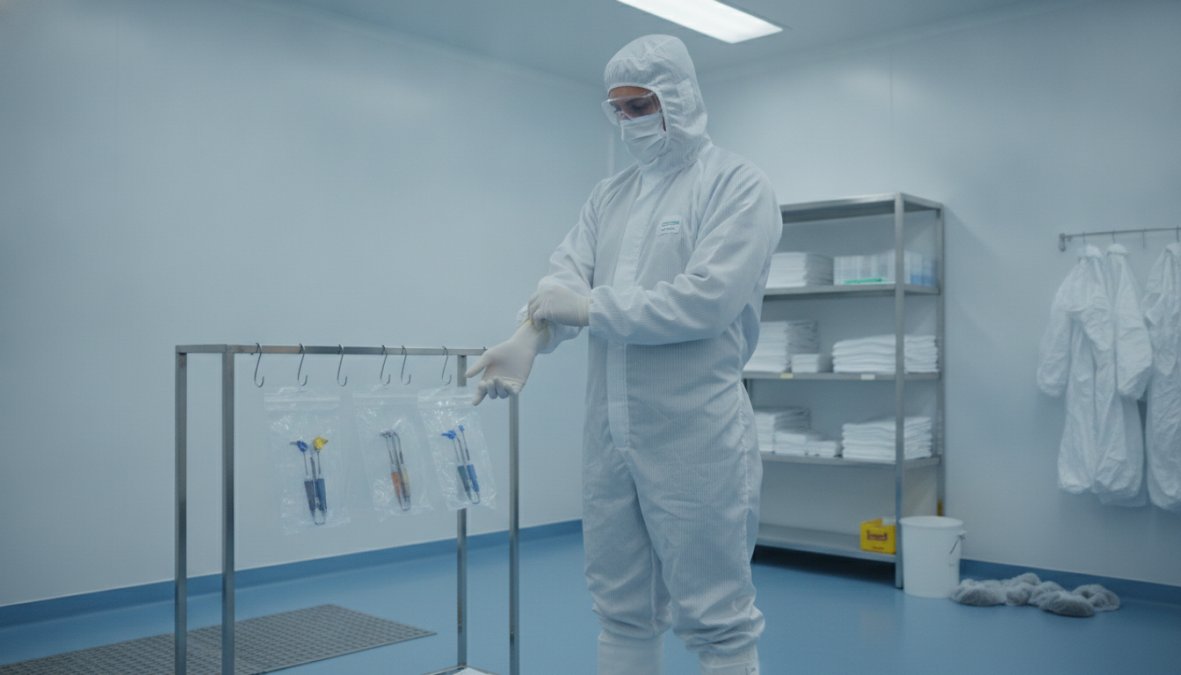
Personnel are the single largest source of contamination in most cleanrooms. A non-gowned person sheds 10,000 particles per minute. Proper gowning reduces this to under 100 particles per minute. Aseptic technique, maintaining sterile conditions during product handling, prevents remaining particles from contaminating the final product.
USP 797 requires initial competency assessment and annual retraining for all personnel handling CSPs. Competency means demonstrating the ability to execute procedures under realistic conditions, not just passing written tests.
Initial training must cover proper gowning and degowning sequences, hand hygiene protocols, aseptic technique principles, contamination sources, environmental monitoring procedures, and when to stop work.
Media-fill testing is the gold standard for aseptic technique validation. Personnel compound a sterile preparation using growth medium instead of active drug. The preparation is then incubated to detect microbial growth. If growth appears, the technician’s technique allowed contamination. Most facilities require annual media-fill testing for each compounder.
The sequence of gowning matters. Incorrect order allows contaminated items to contact clean surfaces.
Ante-room sequence (ISO 8):
Buffer room sequence (ISO 7):
5. Perform hand hygiene (alcohol-based sanitizer, 30 seconds minimum)
6. Don second pair of gloves, pulling cuff over gown sleeve
7. Don hood, ensuring complete hair and neck coverage
8. Perform final visual inspection, no exposed skin should be visible
Gloved fingertip testing validates gowning. After gowning, personnel place gloved fingertips on a nutrient agar plate, incubate, and check for growth. Colonies indicate glove contamination before entering the ISO 5 area.
Environmental monitoring provides data confirming contamination control is working or alerting you to problems before they cause product failures.
Non-viable sampling uses particle counters to measure particle concentration ≥0.5 microns. Counters use light scattering: a laser beam passes through sampled air, particles scatter light, and the counter registers each event. Results are available in minutes.
Particle counting must be done at multiple locations within each zone and at multiple heights. ISO 5 areas require sampling at least quarterly in static state and annually in dynamic state. Many facilities sample monthly for early warning of filter degradation.
Viable sampling uses settle plates, contact plates, or active air samplers to detect living microorganisms. Settle plates sit open for a specified time (usually 4 hours), then are incubated. Contact plates are pressed against surfaces. Active air samplers draw air through a collection medium at a known flow rate, making results quantitative.
Viable sampling takes 24-48 hours to incubate but directly measures contamination risk. Most facilities do viable sampling monthly in ISO 5 areas and quarterly in ISO 7 areas.
Portable particle counters are essential for troubleshooting and validation. They’re battery-powered and provide immediate results. Fixed particle counters provide continuous monitoring and trigger alarms if counts exceed setpoints.
Particle size distribution matters more than total count. A space with 50 particles ≥0.5 microns might have 5,000 particles ≥0.1 microns. Smaller particles are harder to capture and pose higher contamination risk.
Pressure differential monitoring is equally important. A dedicated gauge in each zone triggers alarms if pressure drops below minimum specification. Low pressure often signals a filter problem or HVAC malfunction.
Real-time monitoring systems integrate particle counts, pressure data, temperature, humidity, and viable sampling results into a single dashboard, allowing facility managers to spot trends and make data-driven decisions.
Cleaning removes particles and viable organisms from surfaces. Done incorrectly, it can increase contamination by dislodging particles into the air. Done correctly, it’s a critical control point.
Daily cleaning targets high-touch surfaces and visible contamination using lint-free wipes and approved disinfectants (typically 70% isopropyl alcohol for non-hazardous areas). Wipes are used with single-direction motion (top to bottom) to avoid re-depositing particles.
Weekly cleaning includes all horizontal surfaces and equipment exteriors using the same disinfectants with longer contact times (1-2 minutes).
Periodic cleaning (monthly to quarterly) includes walls, ceilings, and less frequently touched surfaces using deeper disinfection like hydrogen peroxide vapor (HPV) or sporicidal agents.
The choice of disinfectant matters. 70% isopropyl alcohol is effective against vegetative bacteria and viruses but not spores. For hazardous drug areas, USP 800 requires sporicidal agents like peracetic acid or hydrogen peroxide.
Cleaning frequency should be risk-based. High-traffic areas need more frequent cleaning. Low-traffic areas can be cleaned less frequently, balancing contamination control with operational efficiency.
After cleaning, surface sampling confirms contamination was removed. Contact plates are pressed against cleaned surfaces with standardized pressure, then incubated.
Common action levels for surface viable sampling:
If results exceed action levels, the surface is re-cleaned and resampled. If results still exceed levels, investigate the root cause. Is the disinfectant expired? Is cleaning technique inadequate? Is there biofilm requiring more aggressive treatment?
Trend analysis is powerful. Increasing surface sampling results despite consistent cleaning signal a deeper problem, perhaps a failing HEPA filter or personnel not following gowning procedures correctly.
USP 797 (Pharmaceutical Compounding, Sterile Preparations) and USP 800 (Hazardous Drugs, Handling in Healthcare Settings) define the regulatory framework for cleanroom operation in pharmacy settings. These standards are enforceable by state pharmacy boards and the FDA.
The buffer room is the ISO 7 space where personnel perform final gowning and hand hygiene immediately before entering the ISO 5 PEC. It must maintain positive pressure relative to the ante-room, preventing contaminated air from flowing backward.
The ante-room is the ISO 8 transition space between the uncontrolled environment and the buffer room. It must maintain positive pressure relative to the hallway.
USP 797 allows two configurations: separate buffer and ante-room (most common in pharmacy), or a combined buffer/ante-room (allowed if at least 100 square feet and maintaining appropriate pressure gradients).
The pressure cascade is critical: hallway < ante-room < buffer room < ISO 5 PEC. If this gradient fails, the system is compromised.
Category 1 (Low Risk): Simple preparations using only commercially available, FDA-approved sterile products. Example: reconstituting a powder with sterile diluent. Requires ISO 5 environment and basic environmental monitoring.
Category 2 (Medium Risk): Preparations involving multiple manipulations or non-sterile components. Example: compounding a topical cream from bulk ingredients. Requires more frequent environmental monitoring and media-fill testing.
Category 3 (High Risk): Preparations using non-sterile components or non-sterile equipment. Example: compounding a suspension from bulk powder. Requires intensive environmental monitoring and potentially additional sterilization steps.
The category determines the beyond-use date (BUD). Category 1 preparations can be assigned longer BUDs (up to 30 days) if environmental monitoring confirms low contamination. Category 3 preparations have shorter BUDs (typically 3-7 days) unless sterilized.
Regulatory inspections reveal consistent patterns of non-compliance. Understanding these pitfalls helps you avoid them.
Pressure differential is the most frequently cited deficiency in pharmacy cleanroom inspections. Many facilities install HVAC systems correctly but fail to maintain them. Filters clog, dampers drift, and pressure gradually declines.
Prevention requires continuous monitoring. A differential pressure gauge in each zone should be checked daily and logged. If pressure drops below minimum specification, investigate immediately. Common causes include HEPA filter approaching end of life, supply or return damper partially closed, blocked vents, or unplanned door openings.
Airflow velocity must be validated. In laminar flow hoods, velocity should be 80-120 linear feet per minute (LFM). Below 80 LFM, particles may not be swept out. Above 120 LFM, flow becomes turbulent and loses sweeping efficiency.
Velocity is validated with a handheld anemometer at multiple points across the hood face during initial certification and annually thereafter.
Personnel behavior is the hardest variable to control. Common errors include touching face or hair after donning hood, rushing through hand hygiene, adjusting hood or gown during compounding, placing non-sterile items on work surfaces, and leaning over the hood.
Prevention requires ongoing training, observation, and accountability. Supervisors should periodically observe compounding activities and provide feedback. A second control is using isolators instead of hoods, which provide a physical barrier between operator and product, eliminating many personnel-related contamination risks.
After passing regulatory inspection or internal audit, compliance is maintained through ongoing monitoring, documentation, and periodic revalidation.
Every cleanroom procedure must be documented in a standard operating procedure. SOPs should include gowning sequences with photos, cleaning protocols with specific products and contact times, environmental monitoring procedures and action levels, personnel training requirements, equipment maintenance schedules, and deviation investigation procedures.
Documentation must be current. Outdated SOPs that don’t reflect actual practice create gaps between policy and reality. Review and update SOPs annually or immediately if procedures change.
Training records must be maintained for every person working in the cleanroom, including initial competency assessment date and results, annual retraining dates, media-fill test results, and any remedial training. Regulators review these records first. Incomplete or missing training records are cited as deficiencies.
Cleanroom certification requires periodic revalidation:
Revalidation must be performed by a qualified third party for objectivity and regulatory documentation.
| Validation Element | Frequency | Standard | Action if Failed |
|---|---|---|---|
| Particle counts (static) | Annually | ISO 14644 | Investigate and correct before use |
| Particle counts (dynamic) | Every 3 years | ISO 14644 | Investigate and correct before use |
| Pressure differential | Daily | USP 797 | Stop operations, troubleshoot |
| HEPA filter integrity | Every 5-10 years | ISO 14644 | Replace filter immediately |
| Surface viable sampling | Monthly to quarterly | USP 797 | Re-clean and resample |
| Personnel competency | Annually | USP 797 | Remedial training and retest |
Cleanroom compliance requires ongoing investment. Understanding cost structure helps you plan budgets and justify expenditures.
HEPA filter replacement is often the largest single maintenance cost. A standard HEPA filter for a hood costs $500-$2,000. Budget for filter replacement every 5-10 years, or more frequently if the cleanroom operates continuously or in high-particulate environments.
Fan Filter Units (FFUs) offer cost-effective alternatives to traditional ceiling-mounted HEPA systems. FFUs are modular, allowing incremental capacity additions without major renovation. A single FFU costs $2,000-$5,000 installed.
Pressure differential monitoring systems cost $5,000-$15,000 installed. This investment pays for itself by detecting problems before they cause contamination events.
Environmental monitoring equipment is a recurring cost. Particle counters range from $15,000 for portable units to $50,000+ for fixed systems. Viable sampling supplies cost roughly $50-$100 per sample. Budget for monthly sampling in ISO 5 areas and quarterly sampling in ISO 7 areas.
Personnel training and competency assessment have indirect costs: time away from production, external consultants, and media-fill supplies. Budget $500-$1,000 per employee annually.
Building Management Systems (BMS) integration allows real-time monitoring of pressure, temperature, humidity, and particle counts. Alerts notify staff immediately if parameters drift out of specification, preventing small problems from becoming large ones.
Data logging systems automatically record all monitoring data, eliminating manual transcription errors and providing audit trails for regulatory inspections.
Automated environmental monitoring systems provide real-time particle count data without manual sampling, reducing labor costs and increasing sampling frequency for better early warning of contamination problems.
The return on investment for automation is significant. A facility that catches a single contamination event before it reaches patients saves far more than the cost of monitoring equipment. Regulatory fines, product recalls, and reputational damage can exceed $1 million for a single event.
Preventing cleanroom contamination requires a systematic approach grounded in ISO standards, USP guidance, and continuous validation. The most successful facilities treat contamination control as an ongoing discipline, not a compliance checkbox. Applied Physics has helped hundreds of manufacturers achieve and maintain compliance through expertise in airflow visualization, particle metrology, and cleanroom validation. Our team provides technical guidance and monitoring solutions that transform contamination control into a competitive advantage. Contact Applied Physics today to schedule a cleanroom assessment and discover how precision monitoring can protect your operations.
Cleanroom contamination originates from multiple sources: personnel (skin cells, hair, microbes), materials and equipment brought into the environment, airborne particles, and environmental factors like temperature and humidity fluctuations. Improper gowning procedures, inadequate hand hygiene, and workflow violations are among the most common causes. Understanding these sources is critical to implementing effective prevention strategies and maintaining ISO classification standards.
Monitoring frequency depends on ISO classification and regulatory requirements. Most facilities conduct daily particle counting and viable sampling at least weekly, with more frequent testing during critical operations. Real-time monitoring systems using aerosol photometers and portable microbial air samplers (like the P100) provide continuous surveillance. USP 797 and USP 800 standards specify minimum monitoring intervals; exceeding these requirements strengthens contamination prevention and provides better early detection of system failures.
Non-viable sampling measures total particle counts using aerosol photometers and laser particle counters, these detect all particles regardless of microbial content. Viable sampling captures and cultures airborne microorganisms to identify contamination sources and assess microbial risk. Both methods are essential: non-viable sampling detects general contamination trends, while viable sampling confirms the presence of living microorganisms that pose actual sterility risks. Combined use provides comprehensive environmental monitoring and supports compliance with cleanroom certification requirements.
Proper gowning procedures create a physical barrier between personnel and the cleanroom environment. Correct donning sequences, removing outer clothing, applying shoe covers, gowning in proper order, and performing hand hygiene, minimize skin cell and microbial shedding. Personnel training on aseptic technique, gloved fingertip testing, and media-fill testing validates competency. Consistent gowning compliance is one of the most effective contamination prevention strategies, as personnel behavior directly impacts sterile compounding success and product safety.
This article was written using GrandRanker

Enter your details below to save your shopping cart for later. And, who knows, maybe we will even send you a sweet discount code :)
Allow notifications to get real-time updates about your shopping cart and who knows, you may even receive a sweet discount code 😊