Last Updated: August 9, 2026
A portable cleanroom fogger is an essential tool for validating laminar flow patterns, detecting leaks, and ensuring GMP compliance in controlled environments. According to ISO 14644-3 cleanroom testing standards, airflow visualization is a mandatory validation technique for ISO-classified cleanrooms. The difference between a mediocre fogger and a precision instrument comes down to fog media choice, output consistency, and compliance certifications. Applied Physics has spent over three decades refining airflow visualization technology specifically for pharmaceutical manufacturing, semiconductor fabrication, and biotech research environments where contamination control is a regulatory requirement.
Below, we’ve evaluated the leading portable cleanroom foggers available today, focusing on models that deliver reliable, repeatable results for validation studies, leak detection, and airflow pattern documentation.
The CRF4 sets the standard for ultrapure fog generation in GMP-regulated environments. This unit generates 1.25 cubic meters of pure fog per minute using deionized water, sterile water, or water for injection, eliminating contamination risk from glycol-based alternatives. The 10-15 feet visible fog distance provides clear visualization of laminar flow patterns without overwhelming your cleanroom’s air handling capacity.
What separates the CRF4 from generic fog machines is its wireless remote control operation, allowing you to trigger fog generation from outside the critical area while maintaining aseptic conditions. The stainless steel AISI 316L construction resists corrosion and meets pharmaceutical manufacturing durability standards. The CRF4 satisfies ISO 14644-3 and USP 797 requirements for sterile compounding pharmacies, making it the logical choice for facilities undergoing regulatory audits.
Pro Tip Setup takes roughly 15 minutes. Fill the water reservoir, connect power, and run a 2-minute purge cycle. The unit reaches stable fog density immediately, with no warm-up lag.
For rapid leak detection and localized airflow studies, the handheld glycol fogger excels. This battery-operated unit emits 1 ml/minute of fog and runs for 45-60 minutes per charge, ideal for technicians validating small-footprint containment systems like biosafety cabinets, isolators, and fume hoods.
The glycol-based fog produces denser, more visible patterns than water-based alternatives in some lighting conditions, making it valuable for documenting airflow turbulence and identifying dead zones. The tradeoff is operational time, a single charge covers one validation session, requiring a second unit or extended battery inventory for back-to-back testing. Glycol fluid also requires proper disposal, adding a compliance step that ultrapure water doesn’t.
This unit generates non-contaminating fog using liquid nitrogen combined with ultra-pure water, producing zero residue, critical for semiconductor fabs and pharmaceutical manufacturing where any particulate addition could invalidate validation studies. The M2001 eliminates the need to shut down operations for validation, revealing how your system performs under actual working conditions.
The LN2 approach adds complexity. You’ll need liquid nitrogen supply logistics and on-site storage, with setup time exceeding water-based systems. But for facilities that cannot shut down operations, the M2001 solves that constraint.
The CFG 291 brings European precision engineering to cleanroom validation. This mobile unit generates highly visible fog using TopFog fluid, a proprietary aqueous mixture optimized for low-impulse fog input. The hermetically sealed fluid tank allows operation in multiple orientations, crucial for technicians working around equipment or accessing difficult angles.
The CFG 291 meets ISO 14644 and VDI 2083-3 standards, making it acceptable for European pharmaceutical facilities and semiconductor manufacturers. The proprietary fluid requirement creates a supply-chain dependency, and fog output is optimized for initial acceptance testing rather than high-frequency leak detection.
The FlowMarker prioritizes simplicity and portability. This lightweight unit generates continuous fog for over 20 minutes on a full tank, with adjustable fog flow rate and optional Hydra Tube System for accessing confined spaces. The fog fluid is clean, safe, and bacteria-free, important for facilities concerned about biological contamination.
Operational time remains the limiting factor, twenty minutes per charge requires battery management for larger validation programs. The fog output is lower than industrial-scale foggers, making it better suited for visual verification than detailed documentation.
Key Takeaway For small labs, contract research organizations, and facilities validating glove boxes or biosafety cabinets, the FlowMarker delivers adequate performance at significantly lower cost than industrial-grade equipment.
The choice between ultrapure water and glycol fog media determines your validation approach, compliance posture, and operational workflow. Ultrapure water foggers generate fog from deionized, sterile, or water-for-injection sources, producing residue-free vapor with zero contamination risk. Glycol foggers use proprietary fluid blends optimized for visibility and persistence, producing denser fog that lingers longer.
Ultrapure water wins for GMP-regulated environments. Pharmaceutical manufacturing, sterile compounding, and semiconductor fabrication all require validation data that cannot be challenged by contamination questions. If a regulatory auditor asks whether your fog media introduced particulate matter, ultrapure water eliminates the argument entirely.
Glycol excels for rapid diagnostics and leak detection. The denser fog creates higher contrast in photography, making airflow patterns visually obvious. Technicians identify dead zones faster with glycol-based fog, which matters when troubleshooting failing airflow patterns.
Cost differs significantly. Ultrapure water is inexpensive; glycol fluids are proprietary formulations that cost more per unit volume and require proper disposal. For facilities running validation studies monthly or quarterly, cumulative glycol costs become substantial.
USP 797 sterile compounding standards explicitly address contamination control in pharmaceutical preparation areas. Ultrapure water foggers align directly with these requirements. Glycol-based alternatives require additional justification and documentation to satisfy auditors.
Airflow visualization testing reveals what your cleanroom’s design specifications promise versus what actually happens when air moves through your space. Smoke studies using portable foggers generate visible fog that traces air movement, identifies stagnant zones, and documents laminar flow patterns for validation records.
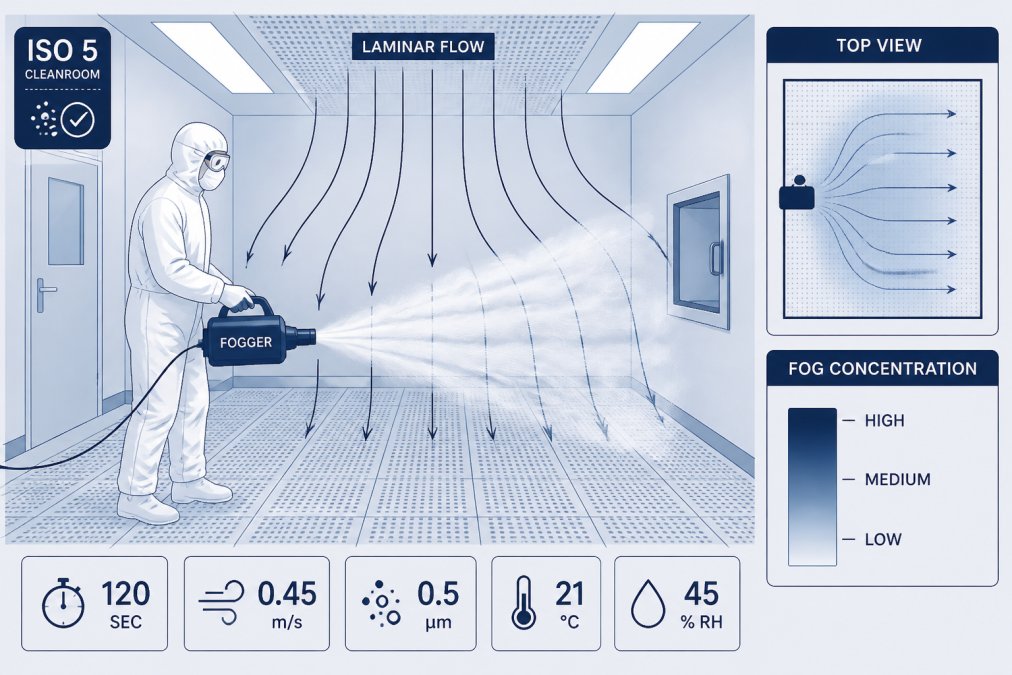
Professional technician in full cleanroom attire (white gown, gloves, hood) operating a portable cleanroom fogger inside an ISO-classified cleanroom environment, with visible fog flowing through laminar flow patterns under bright overhead lighting
Effective airflow visualization requires methodical observation. Start at the cleanroom entrance and move systematically through the space, releasing small amounts of fog at different heights and positions. Document how fog moves toward exhaust points, whether it reaches all work surfaces, and where it stalls or reverses direction. Video recording captures dynamic patterns that still photography misses.
Timing matters. Conduct visualization studies when the cleanroom is unoccupied and in its normal operational state. Temperature stability affects fog behavior, conduct studies when your cleanroom has been at steady-state temperature for at least one hour. Repeat studies at different times to account for HVAC cycling and pressure variations.
Pro Tip Record fog behavior from multiple angles. Use video from at least three perpendicular angles for comprehensive documentation.
ISO 14644-3 establishes testing protocols for cleanroom airflow visualization and documentation. This standard defines how to conduct smoke studies, what constitutes acceptable airflow patterns, and what documentation must be maintained for regulatory compliance.
The standard specifies fog media requirements. Smoke or fog used for visualization must not introduce contamination that could compromise your cleanroom’s classified status. Ultrapure water foggers meet this requirement inherently. Glycol-based alternatives require additional justification and testing to demonstrate they don’t introduce particulate matter.
ISO 14644-3 defines acceptable airflow patterns for different cleanroom classifications. ISO Class 5 environments (used in pharmaceutical manufacturing) require laminar flow with minimal turbulence. Your airflow visualization study must document that your space meets its classified standard.
Documentation requirements are rigorous. You must maintain records showing:
Contact Us →
Recertification frequency depends on your facility’s risk profile. Most pharmaceutical manufacturers conduct airflow visualization studies annually or when equipment changes occur. USP 797 facilities often validate quarterly to satisfy compounding pharmacy audits.
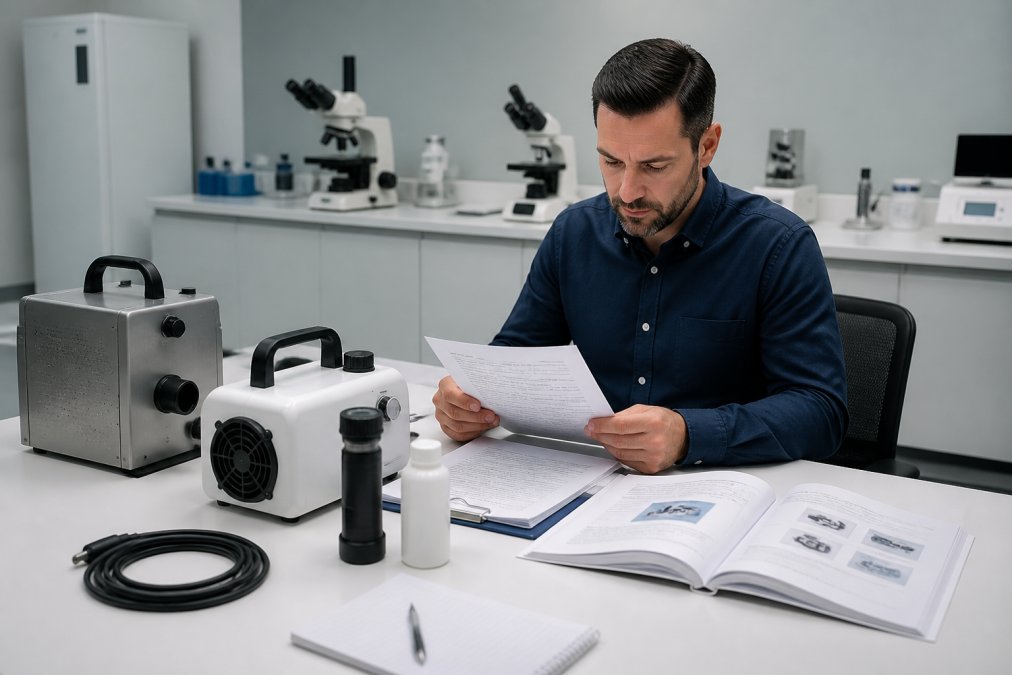
Quality assurance manager reviewing cleanroom equipment specifications and validation documentation at desk, with various portable fogger units and technical manuals visible in professional laboratory setting
Choosing the right fogger starts with understanding your validation frequency and cleanroom size. Facilities conducting monthly airflow studies in large spaces need industrial-scale equipment with high fog output and extended runtime. Small labs validating glove boxes can succeed with handheld, battery-operated units.
Define your fog media requirements next. If your facility operates under GMP, USP 797, or similar regulations, ultrapure water foggers eliminate compliance questions. Consider operational workflow, can your cleanroom tolerate shutdown time for validation studies, or do you need equipment that visualizes airflow during normal operations?
Evaluate portability requirements. Technicians validating multiple rooms need lightweight equipment that fits in a vehicle and sets up quickly. Budget constraints matter but shouldn’t override compliance needs. Compare total cost of ownership, including equipment cost, media expenses, maintenance, and compliance documentation burden.
Review certifications carefully. ISO 14644-3 compliance, CE marking, and validation protocol support matter more than marketing claims. Test drive equipment before committing to large purchases, many suppliers offer rental programs or demonstration units.
The rental versus purchase decision hinges on validation frequency, budget constraints, and equipment use rates. Renting makes sense for facilities conducting airflow studies annually or less frequently. Purchasing becomes economical when validation happens quarterly or more often.
Calculate your total validation costs. Equipment purchase price is only the starting point. Add media costs, maintenance, calibration, storage, and eventual replacement. A fogger used twice yearly for ten years costs per study plus media and maintenance. A rental for two studies costs per year but eliminates storage and maintenance burden.
Rental programs offer flexibility. If your cleanroom undergoes major renovation, you need temporary equipment without capital commitment. Rental equipment comes pre-calibrated and maintained by the supplier, reducing your administrative workload.
Purchase economics improve with scale. Multi-site pharmaceutical operations validating cleanrooms across several locations benefit from owning equipment. Owning equipment also means your team becomes proficient with specific models, improving documentation quality.
Key Takeaway For most facilities, a hybrid approach works best: own [one primary fogger for routine validation](/products/portable-cleanroom-fogger/) and rent specialized equipment for infrequent, specialized studies.
Fog output inconsistency indicates water quality problems or nozzle blockage. If your fogger produces weak fog, check that your water source meets specification, deionized water must have resistivity above 1 megohm-cm. Mineral-laden tap water clogs nozzles within hours. Flush the system with distilled water and replace cartridges if available.
Temperature sensitivity affects fog density. Cold fog is denser and more visible; warm fog disperses quickly. Conduct studies during cooler hours or allow extra time for fog to reach steady-state visibility. Fog that doesn’t reach expected distance suggests HVAC problems, not equipment failure, strong laminar flow can push fog toward exhaust points faster than expected.
Residue or staining on cleanroom surfaces indicates glycol fluid incompatibility. Ultrapure water foggers eliminate this issue. Battery failures mid-study are preventable with proper maintenance, charge batteries fully before studies and keep spares available. Battery runtime decreases in cold environments; expect 20-30% shorter runtime than specifications indicate below 68°F.
Fog that pools in corners instead of flowing toward exhaust reveals dead zones in your cleanroom design. This is valuable diagnostic information. Equipment won’t power on after storage suggests battery degradation, store foggers with batteries at 50% charge in cool, dry conditions and charge fully one week before planned use.
Pre-Validation Planning
Equipment Preparation
During Visualization Study
Post-Study Documentation
Compliance Filing
Selecting the right portable cleanroom fogger requires matching equipment capabilities to your validation requirements and regulatory environment. Applied Physics foggers, particularly the CRF4 for ultrapure applications and the Portable Glycol Fogger for rapid diagnostics, deliver the precision and compliance documentation that regulated facilities demand. Whether you’re validating pharmaceutical manufacturing cleanrooms, semiconductor fabrication spaces, or sterile compounding pharmacies, having equipment designed specifically for GMP environments eliminates the ambiguity that generic fog machines introduce. Contact Applied Physics to discuss your specific airflow visualization requirements and explore how our precision contamination control equipment supports your validation protocols.
A portable cleanroom fogger visualizes airflow patterns inside cleanrooms, biosafety cabinets, and laminar flow hoods by generating visible fog that traces air movement. This helps validate that airflow meets ISO 14644 standards, detect leaks in HEPA filters, identify turbulence zones, and verify containment in critical environments. For GMP-regulated facilities, fogger studies document cleanroom performance and support compliance audits.
Ultrapure water foggers use deionized water or liquid nitrogen to create non-contaminating fog safe for active cleanroom operations and sterile compounding pharmacies. Glycol foggers use propylene or polyethylene glycol fluid for higher fog density and longer visibility, making them ideal for leak detection and training. Ultrapure options avoid residue that could contaminate products; glycol models cost less and require less infrastructure but leave trace particles.
Start with the cleanroom at operating conditions (temperature, humidity, airflow stable). Position the fogger at the air inlet or work surface. Activate the fogger and observe fog movement patterns throughout the space, documenting flow direction, velocity, and any stagnant zones. Record observations with photos or video. For ISO 14644 compliance, tests must follow VDI 2083-3 or equivalent protocols, with results retained for audit trails.
Yes, but only ultrapure water foggers approved for USP 797 and USP 800 environments. These foggers use sterile water, water for injection (WFI), or liquid nitrogen to eliminate contamination risk. Glycol-based foggers should not be used in active compounding areas due to residue that could contaminate sterile preparations. Always verify equipment certification and perform validation studies during non-compounding hours.
ISO 14644-3 requires foggers to produce visible, non-disruptive fog that accurately traces airflow without introducing particles above the cleanroom classification. Foggers must have low-velocity output to avoid artificially disrupting laminar flow patterns. Equipment must be calibrated, documented, and validated before use. For pharmaceutical and semiconductor facilities, fogger studies must follow GMP protocols, with records maintained for regulatory inspections and audits.
APPLIED PHYSICS TECHNICAL RESOURCE
Airflow visualization, smoke studies, tracer delivery, particle monitoring and controlled-environment validation. Product and standards references should be interpreted for the actual instrument, facility, protocol and configuration.
Enter your details below to save your shopping cart for later. And, who knows, maybe we will even send you a sweet discount code :)
Allow notifications to get real-time updates about your shopping cart and who knows, you may even receive a sweet discount code 😊