Comparing Fog Density Retention: Nitrogen-Based vs. Ultrasonic Foggers
In industries ranging from semiconductor manufacturing to high-end theatrical production, the quality of fog is rarely about just making smoke; it is about density, control, and retention.
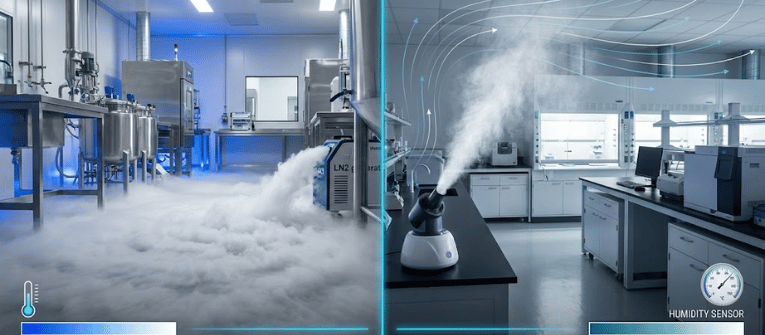
Choosing between a Liquid Nitrogen (LN2) Fogger and an Ultrasonic Fogger often comes down to physics.
This article investigates the mechanisms behind these technologies, specifically analyzing how they generate fog and, crucially, how well they retain that fog density over time and distance.
The Physics of Fog Generation
To understand density retention, we must first understand the thermodynamic origin of the fog in each system.
Nitrogen-Based Foggers (Cryogenic)
LN2 foggers operate on the principle of extreme temperature differentials.
Liquid nitrogen is stored at approximately -196°C (-320°F). When this cryogenic liquid meets water (or ambient air), it causes rapid condensation of water vapor.
Mechanism: The phase change of nitrogen from liquid to gas absorbs immense heat, chilling the surrounding air instantly. This creates a dense cloud of microscopic water droplets and cold nitrogen gas.
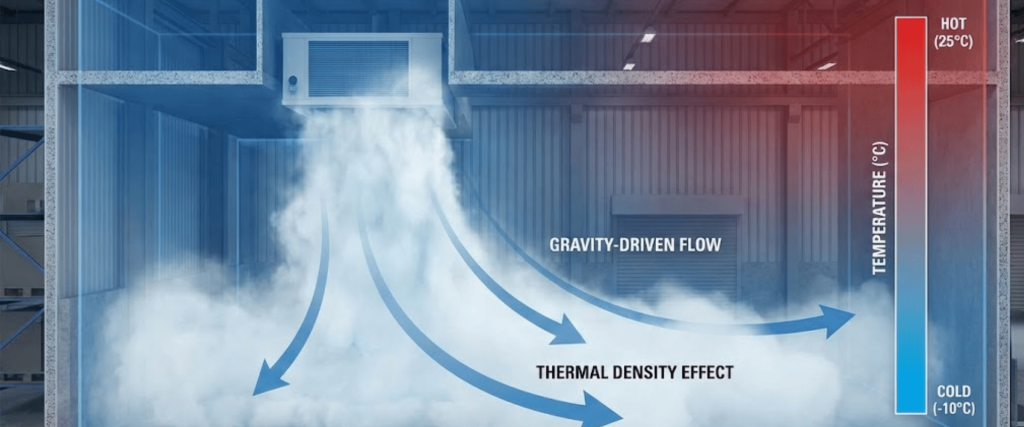
Density Factor: Because the gas mixture is significantly colder than the ambient room temperature, it is physically heavier (denser). According to the Ideal Gas Law ($PV=nRT$), as temperature ($T$) drops, density increases (assuming constant pressure).
Ultrasonic Foggers (Piezoelectric)
Ultrasonic foggers do not rely on heat or cold. Instead, they use high-frequency mechanical vibrations.
Mechanism: A piezoelectric transducer vibrates at ultrasonic frequencies (typically 1.7 MHz or 2.4 MHz) beneath a reservoir of pure water (DI water). These vibrations create cavitation bubbles that implode, ejecting water droplets $\approx$ 1–5 microns in size into the air.
Density Factor: The resulting mist is at ambient temperature. It does not have the thermal weight of LN2 fog.
Comparative Analysis: Fog Density Retention
Retention refers to two characteristics. Opacity (how thick the white cloud remains) and Spatial Structure (how well the fog holds its shape against airflow or diffusion).
A. Thermal Density & Ground Effect
This is the primary differentiator.
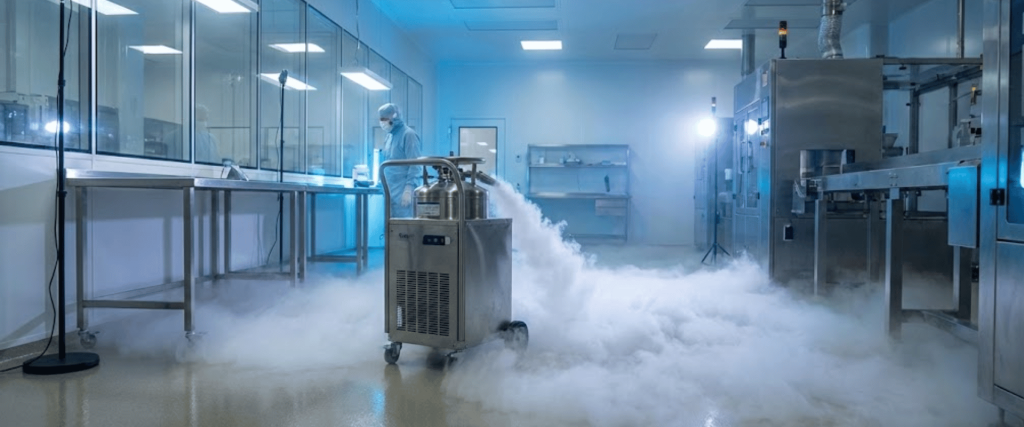
Nitrogen (High Retention): Because the fog is cold, it has a higher density ($\rho$) than the surrounding air ($\rho_{fog} > \rho_{air}$). Gravity pulls it down, creating a blanket effect. It retains its density at the floor level remarkably well, refusing to rise or dissipate upwards until it warms up.
Ultrasonic (Low Retention): The fog is roughly the same density as the ambient air ($\rho_{fog} \approx \rho_{air}$). It is highly susceptible to even minor air currents. Without containment, ultrasonic fog diffuses outward in all directions, losing density retention rapidly as it mixes with room air.
B. Droplet Lifespan & Evaporation
Nitrogen: The droplets are formed via condensation. In high-humidity environments created by the fogger, these droplets are stable. However, as the nitrogen gas warms and expands, the fog eventually disappears completely, leaving no residue.
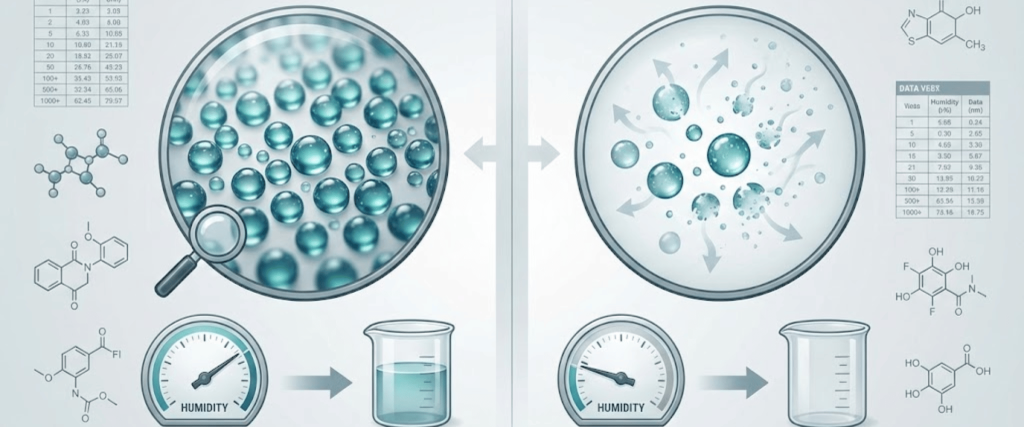
Ultrasonic: The droplets are essentially mechanical sprays of water. Their retention depends entirely on the Relative Humidity (RH) of the room. In dry air, ultrasonic fog flashes off (evaporates) very quickly, causing poor density retention over distance.
Data Comparison: Performance Metrics
The following table contrasts the behavior of the two systems in a controlled environment (20°C, 50% RH).
Feature
Nitrogen-Based (LN₂) Fogger
Ultrasonic (DI Water) Fogger
Fog Density
Extremely high; looks like a solid, opaque white wall
Medium to high; can be translucent to opaque depending on number of transducers
Retention Profile
Stays close to the floor; keeps density while flowing over surfaces
Stays airborne; moves with airflow and thins out as it spreads
Dissipation
Evaporates cleanly with no residue
Evaporates; may leave water residue if air becomes saturated
Travel Distance
Can move 20–30 feet while staying visibly dense
Usually spreads or fades within 3–6 feet without fan support
Fluid Consumption
High (liquid nitrogen plus water)
Low (deionized water only)
Use Cases Based on Retention Needs
When to Choose Nitrogen (LN2)
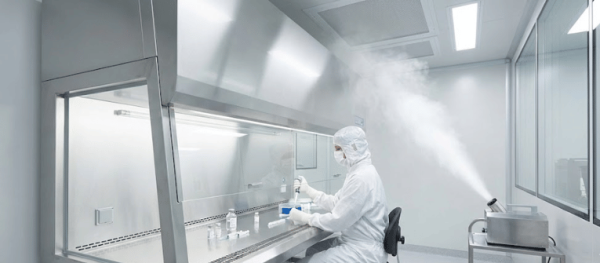
Cleanroom Airflow Visualization (AFV): This is the gold standard for ISO 1-5 cleanrooms. You need a fog that is dense enough to visualize laminar flow patterns but purely volatile so it leaves zero contamination. LN2 fog retains density long enough to trace air from the HEPA filter to the return grille.
Theatrical Low-Lying Fog: When a director wants fog that stays strictly on the floor (e.g., a walking on clouds effect) and does not obscure the actors’ faces or camera lenses.
When to Choose Ultrasonic
Humidity Control: Because ultrasonic fog integrates easily with the air, it is excellent for increasing room humidity rather than creating visual effects.
Small Scale Airflow Tests: For visualizing airflow in small glove boxes or containment hoods, where the heavy, sinking nature of LN2 fog would obscure the turbulence being tested.
Aeroponics: The fog density is retained well enough to deliver nutrients to plant roots in enclosed containers.
Conclusion
While both technologies create visible mist, they serve opposite physics.
If your goal is maximum density retention over distance and a strictly controlled, low-lying visual profile, Nitrogen-Based Foggers are the superior choice.
Their high thermal density prevents the fog from diffusing into the ambient air, keeping the visual effect tight and opaque.
If your goal is cost-effective misting, local humidity control, or short-range visualization where heavy sinking is undesirable, Ultrasonic Foggers provide a continuous, ambient-temperature solution.
Frequently Asked Questions (FAQs)
1. Which fogger creates a denser cloud?
Liquid Nitrogen (LN2) foggers create a significantly denser and whiter cloud. Because the fog is extremely cold, the droplets are packed tightly together, creating an opaque wall of white fog that is much thicker than the mist from ultrasonic units.
2. Do ultrasonic foggers leave a wet residue?
Yes, they can. Since ultrasonic foggers spray microscopic water droplets at room temperature, these droplets can settle on surfaces and create dampness. In contrast, nitrogen fog evaporates completely and leaves no residue, making it safer for electronics and cleanrooms.
3. Why does nitrogen fog stay on the floor?
It comes down to physics. The nitrogen gas is colder than the room’s air, making it heavier. This extra weight pulls the fog down to the floor (the blanket effect), whereas ultrasonic fog is the same temperature as the air and floats away easily.
Since 1992, Applied Physics Corporation has been a leading global provider of precision contamination control and metrology standards. We specialize in airflow visualization, particle size standards, and cleanroom decontamination solutions for critical environments.