
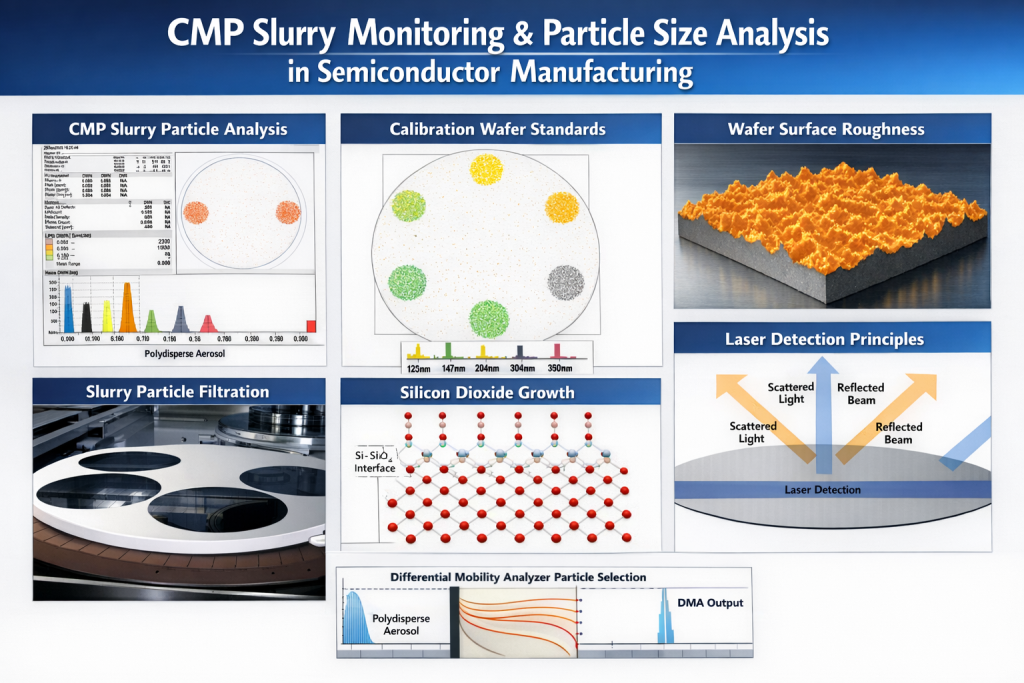
Effective CMP slurry monitoring and particle size analysis are essential for controlling wafer surface quality, maximizing yield, and minimizing defects in semiconductor IC manufacturing. Chemical-Mechanical Planarization (CMP) is a critical process used to planarize wafer topography, but it also introduces the risk of abrasive particle contamination that can lead to scratches, embedments, and yield loss if not properly monitored and controlled.
In this article, we explain why CMP slurry particle analysis is foundational to contamination control, how slurry particles interact with wafer surfaces, and why proper metrology practices are necessary to maintain high-performance manufacturing.
CMP combines chemical action and mechanical abrasion to smooth wafer surfaces, remove excess material, and create a flat and uniform surface prior to lithography and multi-level interconnect formation.
Slurry used in CMP contains abrasive particles, typically silica or alumina, suspended in a chemical solution. These particles physically wear down high points on the wafer surface while the chemical component alters surface chemistry. Although CMP is designed to improve planarity, improper slurry formulation or contamination can cause:
Because CMP occurs at a point where wafers are fragile and surfaces are not yet protected by films, any particle contamination introduced during CMP can propagate through later process steps and result in yield loss.
The size, concentration, and shape of slurry particles directly impact how CMP affects a wafer. Too many large particles can increase scratch rates. Too many fine particles can lead to haze, localized non-uniformity, and unpredictable surface texture.
Key particle attributes that fabs monitor include:
Modern CMP processes target ultra-tight particle size distributions to improve uniform abrasion and reduce the risks of surface defects.
Accurate particle size analysis enables fabs to:
Tools used in particle size analysis range from laser diffraction analyzers to dynamic light scattering and high-resolution microscopy. Each method offers distinct advantages depending on the particle range of interest.
For example:
Periodic sampling of CMP slurry for laboratory analysis provides a snapshot of particle quality, but it does not guarantee that the slurry feeding the tool at any given moment remains within specification.
Continuous or real-time monitoring systems provide:
Real-time CMP slurry particle monitoring helps fabs reduce unplanned stops, improve first-pass yield, and avoid defect escapes.
Slurry can become contaminated through multiple channels:
Because CMP slurry is circulated and reused within delivery loops, contamination events can propagate quickly if not detected early.
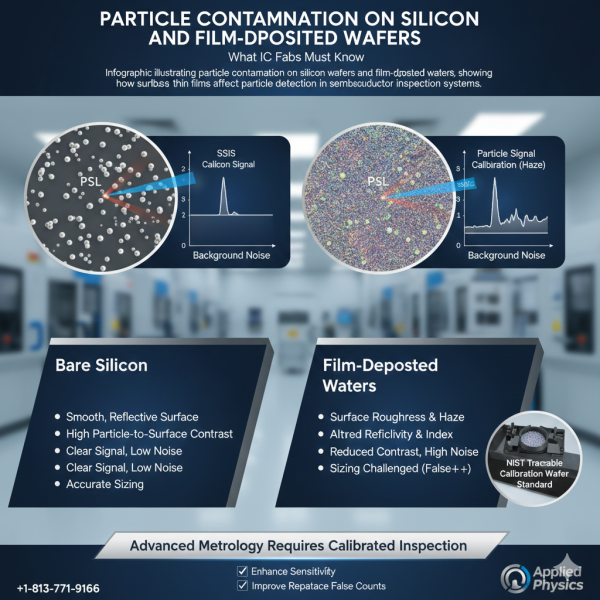
CMP slurry monitoring should not exist in isolation. It should be linked with downstream metrology and inspection data, such as wafer surface scans from Surface Scanning Inspection Systems (SSIS) or optical inspection tools.
Common practices include:
Cross-referencing slurry particle analytics with wafer inspection helps fabs root-cause defect excursions more quickly.
Effective CMP slurry control reduces the likelihood of:
By reducing these risks, fabs improve process stability, increase device yields, and reduce overall manufacturing cost.
To extract the most value from particle size analysis, fabs often adopt layered strategies:
These approaches help align CMP performance with broader contamination control programs.
CMP slurry particle size analysis is not a nice-to-have—it is a process foundation. Without accurate particle control:
By integrating CMP slurry monitoring with inspection metrology and contamination control programs, fabs can maintain tighter process control and improve overall manufacturing performance.
CMP slurry is the abrasive chemical solution used in chemical-mechanical planarization. It removes material and planarizes surfaces, but its particle characteristics must be controlled to avoid scratches and defects.
Particle size distribution influences abrasive action. Larger particles increase scratch risk; smaller particles may fail to planarize effectively and can cause haze or embedded defects.
Laser diffraction, dynamic light scattering, and electron microscopy are common particle size analysis tools. Each has strengths at different size ranges.
Real-time monitoring detects particle deviations while the slurry is in use, enabling corrective action before wafers are impacted, unlike periodic sampling which provides only snapshots.
Increased particle counts in slurry often correspond to higher defect rates on wafer surfaces, particularly scratches and embedded particles observed in inspection metrology.
Since 1992, Applied Physics Corporation has been a leading global provider of precision contamination control and metrology standards. We specialize in airflow visualization, particle size standards, and cleanroom decontamination solutions for critical environments.