Last Updated: July 24, 2026
According to regulatory compliance data from the pharmaceutical and semiconductor industries, cleanroom airflow testing equipment cost represents between 8-15% of total cleanroom validation budgets, yet many facilities underestimate the true total cost of ownership. Understanding cleanroom airflow testing equipment cost encompasses calibration, maintenance, regulatory compliance, and operational efficiency factors that directly impact your facility’s ability to maintain certification and avoid costly downtime.
At Applied Physics, we’ve analyzed cleanroom validation spending across hundreds of facilities since 1992. This guide breaks down exactly what cleanroom airflow testing equipment cost includes, how to compare options across different equipment categories, and how to calculate the financial impact of your investment decisions.
Improper airflow directly causes product contamination, regulatory failures, and production shutdowns. The cost of a single failed batch in pharmaceutical manufacturing or semiconductor production can exceed $500,000, making precision airflow validation one of your most critical operational expenses.
Cleanroom airflow testing equipment cost varies dramatically based on equipment type, measurement precision, and intended application. A basic handheld anemometer for simple velocity checks might cost under $800, while a comprehensive airflow validation system combining multiple instruments can exceed $15,000. The real challenge isn’t finding cheap equipment, it’s identifying which tools actually deliver the measurement accuracy your regulatory requirements demand.
Most cleanroom managers face a fundamental decision early: invest in portable testing equipment that your team operates themselves, or establish a contract with specialized commissioning firms who bring calibrated instruments to your facility. Each approach carries different cost implications across equipment purchase, staff training, calibration maintenance, and regulatory documentation.
Cost drivers extend beyond the equipment itself. Differential pressure monitoring instruments require regular calibration against certified standards. Particle counters need aerosol generators for validation testing. HEPA filter integrity testing demands both smoke test kits and photometers. Your actual cleanroom airflow testing equipment cost includes all these complementary tools working together as a system.
Anemometer types and velocity measurement tools form the foundation of airflow testing. These handheld instruments measure air velocity at specific points in your cleanroom, typically expressed in feet per minute (FPM). The TSI VelociCalc 9565, a multi-function ventilation meter widely used in cleanroom environments, carries a starting price around $2,655 and includes optional probes for velocity, temperature, and humidity measurements.
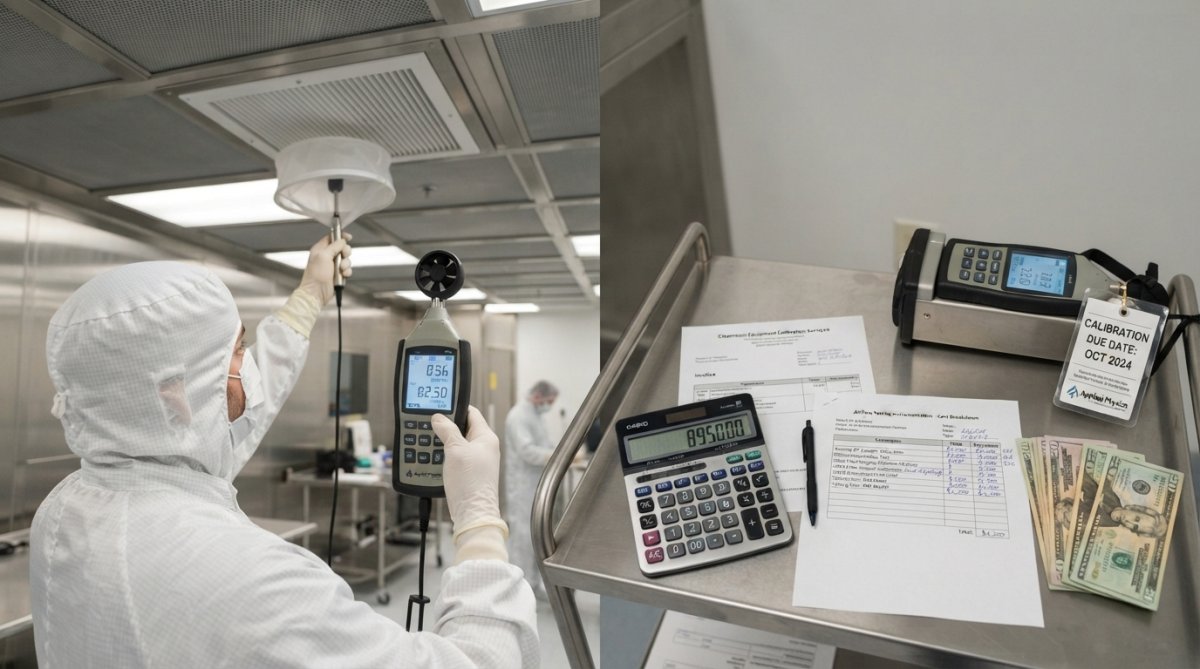
Lower-cost alternatives include the Dwyer 471B-1 Digital Thermo-Anemometer at approximately $709, which measures air velocity and temperature simultaneously. The Fluke 922 Airflow Meter combines differential pressure, static pressure, and velocity measurements into one device, starting around $1,036. For facilities needing pressure monitoring alongside velocity data, this combination approach eliminates purchasing separate instruments.
Differential pressure monitoring instruments measure the pressure difference between cleanroom spaces and adjacent areas, a critical compliance metric under ISO 14644 standards. The Testo 400 Universal Airflow/IAQ Instrument represents the high-end option, starting at $1,577 for the meter alone, with additional probes sold separately.
Particle counters and aerosol photometers measure contamination levels in your cleanroom air. The Applied Physics Aerosol Photometer BAP-350 provides HEPA validation and cleanroom classification verification at a lower cost than full-size particle counters exceeding $20,000.
Smoke test kits and leak detection systems represent essential tools for HEPA filter integrity validation. A basic smoke test kit costs between $400-800 and includes a smoke generator, hoses, and detection equipment. However, regulatory compliance increasingly requires quantitative aerosol testing rather than visual smoke observation.
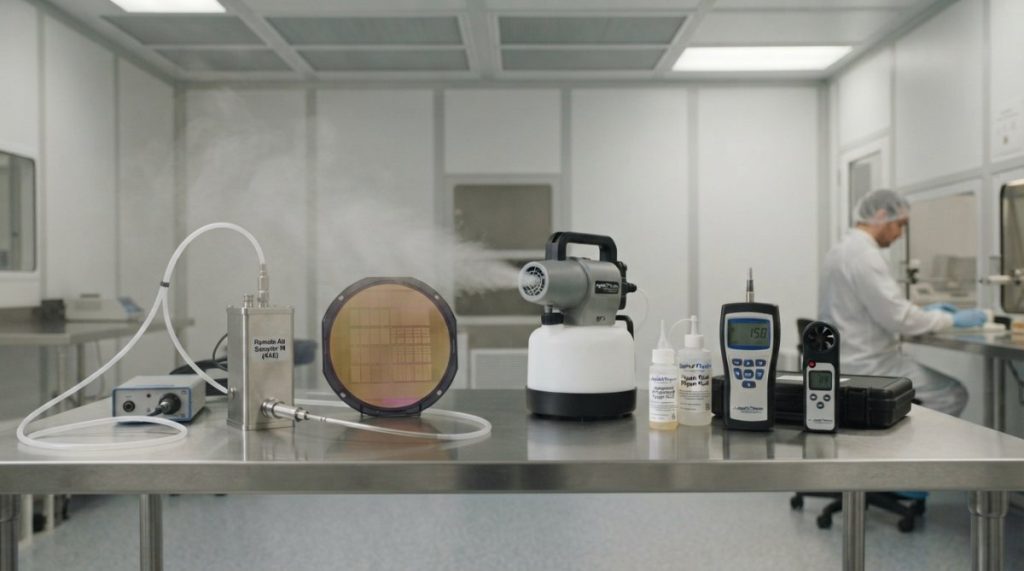
Aerosol generators for filter integrity validation come in two main types: cold aerosol generators that produce particles without heating, and heated generators that create aerosol through thermal processes. The Applied Physics Aerosol Generator-Cold Type BAG-4B features a Laskin Nozzle design suitable for cleanrooms, clean benches, biosafety cabinets, and glovebox testing. Cold generators avoid heat-related concerns but require more operator skill to maintain consistent aerosol output.
The Applied Physics Aerosol Generator-Cold Type BAG-6D serves pharmaceutical industry filter leak detection. Cold aerosol systems typically cost between $3,000-6,000 depending on output capacity. Heated aerosol generators cost more, often $8,000-12,000, but produce more consistent particle distributions.
| Equipment Type | Price Range | Best For | Maintenance Cost |
|---|---|---|---|
| Handheld Anemometer (basic) | $700-1,200 | Initial airflow surveys | $200-300/year |
| Multi-function Ventilation Meter | $1,600-2,700 | Comprehensive airflow analysis | $300-500/year |
| Differential Pressure Meter | $800-1,600 | Pressure monitoring | $300-400/year |
| Cold Aerosol Generator | $3,000-6,000 | HEPA validation | $500-800/year |
| Aerosol Photometer | $2,500-4,500 | Particle counting | $400-600/year |
The choice between smoke test kits and quantitative aerosol testing often comes down to regulatory requirements. Pharmaceutical facilities under USP 797 or FDA inspection typically need quantitative data showing filter integrity percentages.
Airflow capture hoods and balancing tools measure volumetric flow rates across supply and return vents. A basic capture hood setup costs $2,000-4,000, while advanced hoods with multiple measurement points and data logging capabilities reach $8,000-12,000.
Micromanometers and advanced pressure sensors provide precise differential pressure measurements required for ISO 14644 classification. Advanced micromanometers with data logging and wireless connectivity cost between $3,500-6,000, compared to $800-1,500 for basic analog models.
The Applied Physics Air Volume Meter BK-AVM-1 and BK-AVM-1S offer LCD display options for straightforward air volume measurement. Both models include nylon windproof fabric for outdoor applications and represent the practical middle ground between basic handheld tools and sophisticated data-logging systems.
Real-time monitoring versus portable systems presents another critical cost decision. Permanent installations of continuous airflow and pressure monitoring systems cost $15,000-30,000 for equipment plus installation, but eliminate the need for periodic manual testing. Portable systems cost less upfront but require regular technician visits, typically monthly or quarterly depending on regulatory requirements.
Selecting the right airflow balancing hood depends on your cleanroom size, ductwork configuration, and measurement precision requirements. Small cleanrooms with simple layouts may function adequately with basic capture hood systems costing $2,500-4,000. Large facilities with complex ductwork and multiple zones require advanced systems costing $10,000-15,000.
The decision to purchase versus rent airflow balancing equipment often hinges on frequency of use. If your facility requires airflow validation only during initial qualification and annual revalidation, renting specialized equipment for $1,500-3,000 per engagement makes financial sense. If you perform monthly or quarterly monitoring, equipment ownership becomes more economical.
Most airflow balancing hood systems include software for data analysis and report generation. This software component adds $1,500-3,000 to the total system cost but is essential for generating the compliance documentation that regulators require.
Real-time monitoring versus portable systems represents one of the most significant cost decisions in cleanroom validation. Portable particle counters cost $8,000-15,000 per unit. Real-time monitoring systems installed in ductwork or cleanroom spaces cost $20,000-40,000 per location but provide continuous data streams that catch contamination events immediately.
The Applied Physics Aerosol Photometer BAP-350 bridges this gap by offering a portable system with real-time measurement capability. At a lower price point than full particle counters, photometers provide rapid assessment of air quality without the capital investment of permanent monitoring systems.
Data logging capabilities transform a simple measurement device into a compliance documentation system. Basic portable instruments provide instantaneous readings that operators must manually record. Data-logging versions automatically timestamp measurements and store them in formats compatible with your facility’s quality management system.
Calculating total cost of ownership for cleanroom airflow testing equipment requires looking five years ahead. A $2,000 anemometer purchased today will require calibration every 12 months at approximately $400 per calibration. Over five years, that equipment accumulates $2,000 in calibration costs alone, bringing true ownership cost to $4,000, double the initial purchase price.
Calibration, maintenance, and certification costs often exceed the equipment purchase itself. Most regulatory environments require annual calibration against traceable standards. Many facilities discover that their preferred service provider has six-week turnaround times, forcing them to purchase backup equipment to maintain continuous monitoring capability.
Regulatory compliance ROI and downtime savings represent the financial flip side of validation costs. A facility that skips rigorous airflow validation and experiences a contamination event faces costs that dwarf equipment investments: product loss, batch reprocessing, regulatory investigation, and potential FDA warning letters.
Staff training and certification represent another often-overlooked cost component. Operators need training on proper measurement techniques, data interpretation, and regulatory documentation. Many facilities budget $1,500-3,000 per technician for initial training and $500-1,000 annually for refresher training.
When renting makes financial sense becomes clear when you analyze your testing frequency and total cost of ownership across a five-year horizon. If your facility requires comprehensive airflow validation only during initial qualification and annual revalidation, perhaps four to six testing days per year, renting specialized equipment for $1,500-3,000 per engagement costs significantly less than ownership.
Rental Cost Scenario (Low-Frequency Testing):
A facility conducting airflow validation 4 times annually at $2,000 per engagement accumulates $8,000 in annual rental costs. Over five years, total rental expense reaches $40,000. This rental model includes calibrated equipment, trained operators, and compliance documentation.
Equipment Ownership Scenario (Same Facility):
Purchasing a multi-function ventilation meter ($2,500), differential pressure instrument ($1,200), and basic aerosol photometer ($3,500) requires $7,200 in initial capital. Annual calibration costs total $1,200. Staff training for two technicians costs $3,000 initially, then $1,000 annually. Over five years: $7,200 (equipment) + $6,000 (calibration) + $3,000 (initial training) + $4,000 (ongoing training) = $20,200 total cost. Equipment ownership delivers 50% cost savings for this low-frequency testing scenario.
Equipment Ownership Scenario (High-Frequency Testing):
A facility conducting monthly airflow monitoring across three cleanroom zones requires 36 testing events annually. Renting equipment 36 times at $2,000 per engagement costs $72,000 annually, or $360,000 over five years. The same equipment investment ($7,200) with annual calibration ($1,200) and training costs ($1,000 annually) totals $20,200 over five years. Equipment ownership delivers 94% cost savings for high-frequency testing.
Breakeven Analysis:
The crossover point where equipment ownership becomes more economical than rental occurs at approximately 8-10 testing engagements annually. Below this threshold, rental delivers better economics. Above it, equipment ownership provides superior ROI.
Rental Equipment Advantages Beyond Cost:
Rental equipment comes with built-in obsolescence protection. As measurement technology advances and regulatory requirements change, rental providers upgrade their equipment inventories. Your facility always uses current-generation instruments that meet latest standards without the burden of managing aging equipment or expensive upgrades.
Rental agreements typically include operator expertise and compliance documentation. The rental provider’s technicians understand current regulatory expectations and generate reports formatted for FDA inspection or ISO 14644 audit.
Equipment Ownership Advantages:
Ownership provides control over testing schedules and eliminates dependency on external service providers. Your team can conduct validation testing whenever needed without waiting for rental equipment availability. This becomes critical during troubleshooting situations when you need rapid airflow assessment to diagnose HVAC problems or investigate potential contamination sources.
Owned equipment enables predictive maintenance and continuous monitoring. Rather than testing quarterly or annually, you can implement monthly or weekly monitoring to detect equipment degradation early.
Hybrid Approach: Equipment Ownership Plus Rental Backup:
Many mid-sized facilities adopt a hybrid strategy: own basic equipment for routine monthly monitoring and rent specialized equipment for annual comprehensive validation. This approach costs approximately $10,000-15,000 annually but provides both operational control and access to advanced measurement capabilities without the capital investment of purchasing a complete instrument suite.
Data logging, real-time monitoring, and automation capabilities transform standalone testing instruments into integrated facility management tools that directly impact regulatory compliance outcomes and audit success rates. Modern cleanroom validation equipment that connects to building management systems enables automated alerts when pressure drops below specified thresholds or airflow velocity falls outside acceptable ranges.
Cost Premium for BMS Integration:
Equipment with BMS integration capabilities typically costs 30-50% more than standalone instruments. A basic differential pressure meter costs $1,200 standalone; the BMS-integrated version costs $1,800-1,900. A multi-function ventilation meter costs $2,500 standalone; the BMS-integrated version costs $3,500-3,750.
Regulatory ROI: How BMS Integration Impacts Audit Outcomes:
Facilities with integrated BMS monitoring consistently demonstrate faster ISO 14644 certification audits and fewer compliance findings. During FDA inspections or ISO audits, regulators expect to see continuous pressure and airflow data demonstrating that your cleanroom maintained specified conditions throughout the audit period. A facility with BMS-integrated monitoring provides continuous data streams showing 1,440+ daily measurements, creating an audit trail that is difficult to dispute.
The FDA’s 2023 guidance on data integrity emphasizes that electronic records with automatic timestamps and system-generated audit trails are preferred over manually recorded data. Facilities using BMS-integrated equipment report 40-60% faster audit completion times because regulators spend less time questioning data reliability.
Operational Cost Savings from Automated Monitoring:
A facility with manual monthly airflow testing requires approximately 8-12 hours of technician time per month. At a fully-loaded technician cost of $65-85/hour, this represents $520-1,020 in monthly labor. Over five years, manual monitoring costs $31,200-61,200 in labor alone.
BMS-integrated equipment eliminates most manual monitoring labor. Automated alerts notify facility managers when conditions drift outside acceptable ranges, but routine data collection, timestamping, and documentation occur automatically. A facility with BMS integration typically requires 2-4 hours of technician time monthly, reducing monthly labor to $130-340. Over five years, this represents $7,800-20,400 in labor costs, saving $23,400-40,800 compared to manual monitoring.
These labor savings often justify the 30-50% equipment premium within 18-24 months.
Data Integration Platforms and Compatibility Considerations:
Equipment that integrates with BMS must be compatible with your facility’s existing management platform. Before selecting BMS-integrated equipment, verify compatibility with your existing facility management system to avoid expensive integration work or forced equipment replacement.
Wireless connectivity in modern instruments enables data transmission directly to facility management systems without manual data entry. This eliminates transcription errors and ensures that compliance documentation reflects actual measurements. For facilities managing multiple cleanrooms or complex HVAC systems, wireless data integration becomes nearly essential for practical compliance management.
Predictive Maintenance and Equipment Lifecycle Cost Reduction:
BMS-integrated monitoring enables predictive maintenance by tracking equipment performance trends over time. Rather than replacing HEPA filters on a fixed schedule, BMS data shows actual filter degradation rates. A facility might discover that filters degrade 40% slower than the manufacturer’s recommended replacement interval, enabling 6-month extensions that save $3,000-5,000 annually.
Differential pressure trending is particularly valuable for predictive maintenance. BMS systems can alert facility managers when pressure loss rate exceeds normal degradation patterns, indicating potential seal leaks or filter bypass conditions.
Compliance Documentation and Audit Trail Requirements:
Regulators increasingly expect electronic records with system-generated audit trails showing when data was collected, by whom, and whether any modifications occurred. BMS-integrated equipment creates these audit trails automatically. Facilities using BMS-integrated monitoring can generate compliance reports directly from the system, ensuring consistency between raw data and reported results.
ISO 14644 compliance and validation requirements define the technical standards your equipment must meet and the documentation you must maintain. ISO 14644 Part 3 specifies testing methods for cleanroom classification, requiring measurements of particle concentrations, air changes per hour, and differential pressure. Your equipment must deliver measurement precision sufficient to demonstrate compliance with your cleanroom’s specified classification level.
Laminar flow versus turbulent flow testing requires different measurement approaches and equipment configurations. Laminar flow cleanrooms (typically ISO Class 5 or better) require airflow velocity measurements at multiple points across the work surface to verify uniform downward flow. Turbulent flow cleanrooms rely more heavily on air change rate calculations and particle concentration measurements.
The cost difference between validating laminar flow versus turbulent flow cleanrooms is substantial. Laminar flow validation requires comprehensive airflow mapping across the entire work surface, typically 20-30 measurement points. Turbulent flow validation focuses on fewer measurement points but requires more sophisticated particle counting equipment.
ISO 14644 cleanroom classification standards
Many facilities discover that their existing equipment cannot adequately validate their cleanroom design. Understanding your cleanroom design and selecting equipment that matches your specific validation requirements prevents costly equipment mismatches.
Cleanroom airflow testing equipment cost extends far beyond the initial purchase price, encompassing calibration, maintenance, staff training, and regulatory compliance throughout the equipment’s operational life. The decision between equipment types, rental versus purchase, and integration with facility management systems requires analyzing your specific testing frequency, regulatory requirements, and operational priorities.
Applied Physics has supported cleanroom validation across pharmaceutical, semiconductor, and healthcare manufacturing since 1992, providing precision instruments including aerosol generators, photometers, and air volume meters specifically designed for cleanroom environments. Our equipment integrates advanced measurement capabilities with practical field operation, enabling your team to achieve regulatory compliance while minimizing total validation costs. Contact Applied Physics to discuss your cleanroom validation requirements and identify the equipment combination that delivers both compliance assurance and operational efficiency.
Cleanroom airflow testing requires multiple instruments: anemometers for velocity measurement, differential pressure monitors (micromanometers) for pressure differential readings, particle counters or aerosol photometers for contamination validation, and smoke test kits for HEPA filter integrity checks. For ISO 14644 compliance, you'll also need airflow capture hoods and data logging capability. Applied Physics offers aerosol generators (BAG-4B, BAG-6D) and aerosol photometers (BAP-350) for comprehensive testing.
Individual instruments range from $700-$2,655 depending on capability and brand. A basic setup (anemometer + differential pressure meter) costs $1,500-$2,500, while comprehensive validation systems with particle counters, aerosol generators, and data logging can exceed $5,000-$8,000. Total cost of ownership over 5 years typically includes calibration ($200-$500 annually), maintenance, and potential downtime. Renting equipment for one-time validations may cost $500-$1,500 per project, making it cost-effective for infrequent testing.
HEPA filter testing costs depend on equipment type: smoke test kits ($300-$800), aerosol generators ($1,500-$3,000), and photometers ($2,000-$4,000). Applied Physics aerosol generators like the BAG-4B and BAG-6D support pharmaceutical and cleanroom applications with precise particle generation. Additional factors affecting price include sensor accuracy, data logging capability, compliance certifications, and whether equipment meets GMP or USP 797 standards. Higher-precision instruments for sub-10nm particle detection cost significantly more.
Rent if: testing occurs less than twice yearly, you need specialized equipment for one-time validation, or you're avoiding capital expenditure. Purchase if: testing is required quarterly or more frequently, you need consistent calibration and control, or you're validating multiple cleanrooms. Rental costs $500-$1,500 per project; ownership costs $3,000-$8,000 upfront plus $200-$500 annual calibration. For facilities requiring ongoing ISO 14644 compliance, ownership typically delivers better ROI within 2-3 years.
BMS integration adds $1,000-$3,000 to equipment costs but eliminates manual data collection and enables real-time monitoring of differential pressure, airflow velocity, and particle counts. Systems with data logging and automated alerts reduce labor costs and validation downtime. Applied Physics equipment supports environmental monitoring and can integrate with facility management systems for continuous compliance tracking. This integration is particularly valuable for pharmaceutical and semiconductor facilities requiring continuous validation documentation.
This article was written using GrandRanker

Enter your details below to save your shopping cart for later. And, who knows, maybe we will even send you a sweet discount code :)
Allow notifications to get real-time updates about your shopping cart and who knows, you may even receive a sweet discount code 😊