
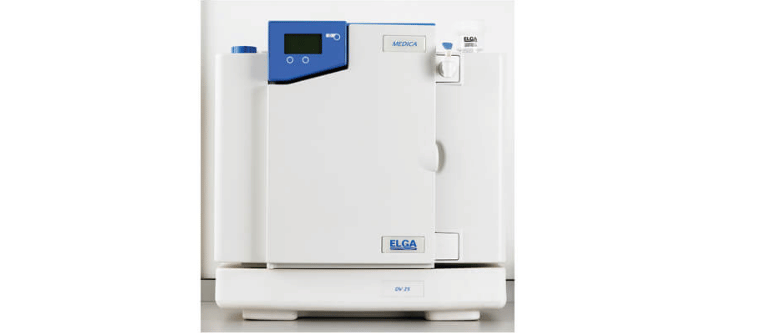
Automated clinical chemistry and immunoassay analyzers depend on a continuous supply of Clinical Laboratory Reagent Water (CLRW).
Sub-optimal feed water compromises photometric baselines, causes ion-selective electrode (ISE) drift, and introduces particulate fouling into precision pipetting manifolds.
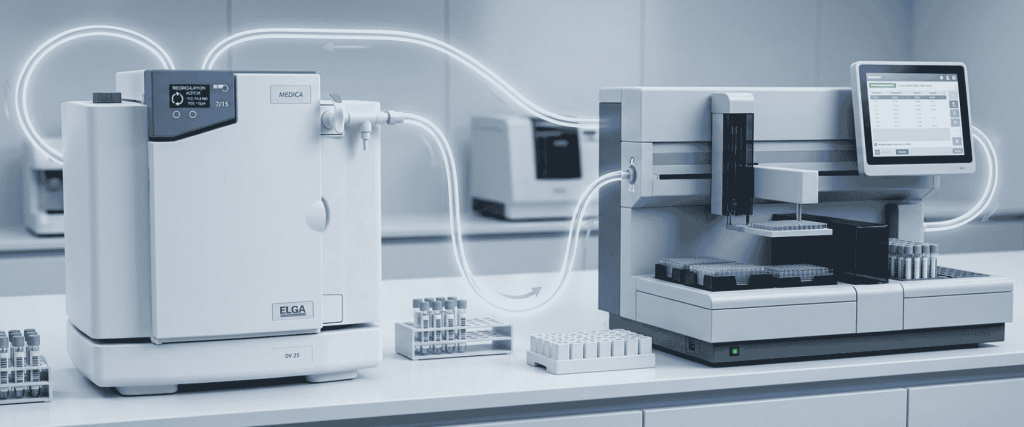
The ELGA MEDICA-R 7/15 and MEDICA-D 7/15 water purification systems provide dedicated, point-of-use CLRW water to single clinical diagnostic analyzers.
While both systems share the same foundational purification loop, footprint, and make-up capacities, they serve distinct analytical requirements.
The right configuration depends directly on your analyzer’s sensitivity to dissolved gases and optical interference.
The Clinical and Laboratory Standards Institute (CLSI) defines strict baseline parameters for Clinical Laboratory Reagent Water. Feed water entering clinical analyzers must meet the following criteria.
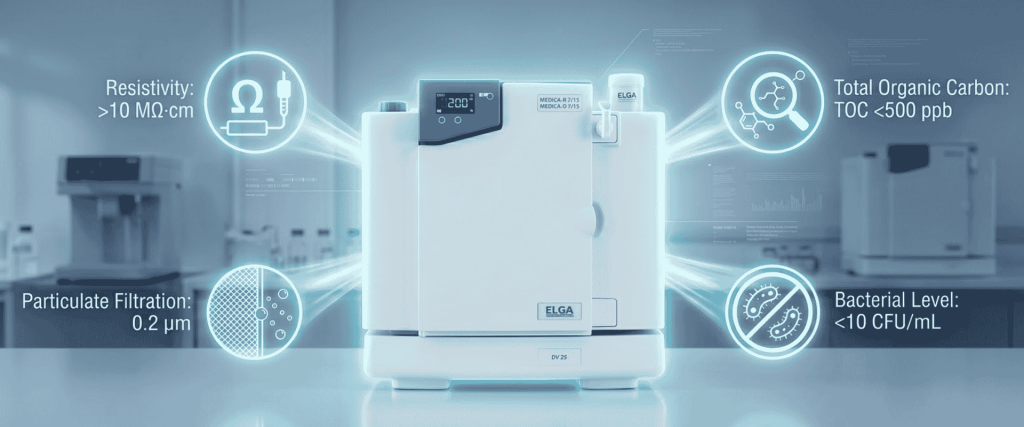
Both the MEDICA-R and MEDICA-D systems consistently exceed these baseline thresholds, delivering water with TOC levels typically below $30\text{ ppb}$ and bacterial counts under $1\text{ CFU/mL}$.
Both the MEDICA-R and MEDICA-D operate on potable tap water feed and utilize a multi-stage purification sequence designed to maintain water purity through continuous recirculation.
Tap water enters through a composite pre-treatment pack that removes free chlorine, chloramines, and coarse sediment.
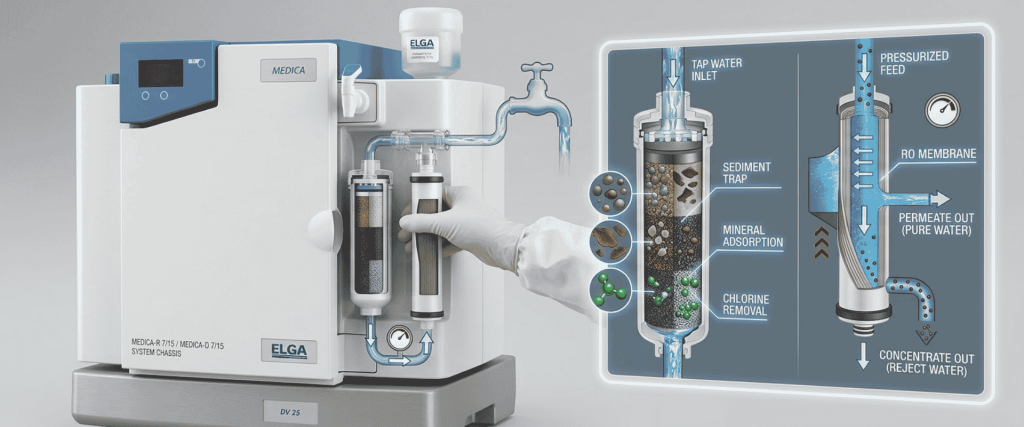
The water is then pressurized across an RO membrane, which removes greater than 95% of dissolved minerals, silica, and colloidal particles, sending ionic reject to the drain.
Water stored in the internal reservoir is continually recirculated through high-capacity ion-exchange resin packs.
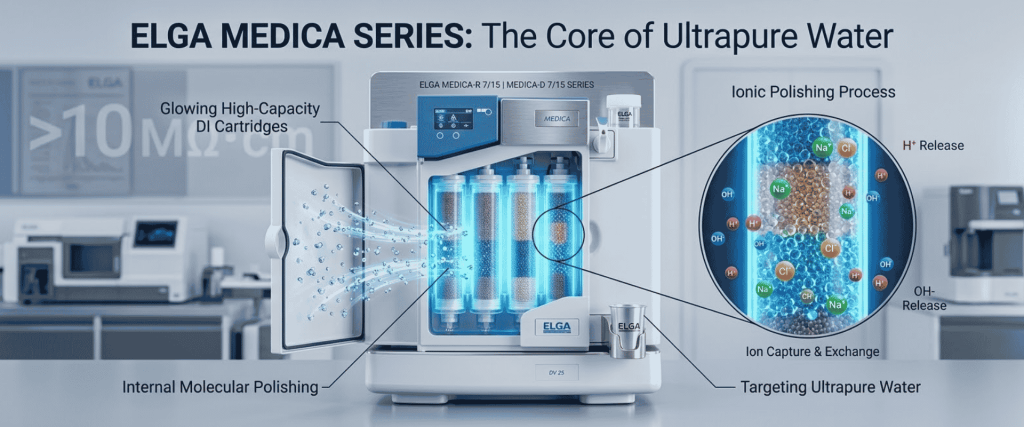
This ensures that even during idle periods, water does not stagnate or leach atmospheric contaminants, preserving a stable resistivity above $10\text{ M}\Omega\cdot\text{cm}$.
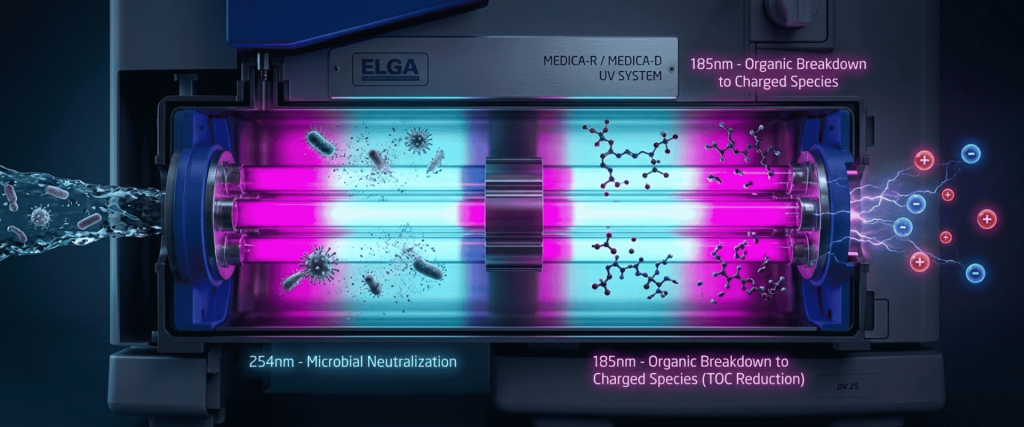
A built-in $185\text{ nm} / 254\text{ nm}$ UV lamp serves a dual role: $254\text{ nm}$ light destroys microbial DNA to arrest bacterial proliferation, while $185\text{ nm}$ radiation cleaves trace organic compounds into charged species captured by downstream polishing resin.
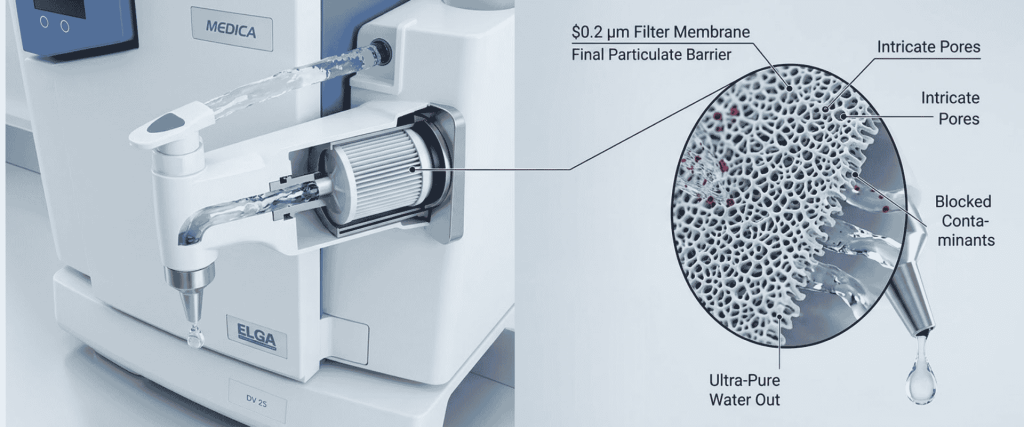
Before exiting the dispense port to the analyzer, the water passes through an integrated $0.2\text{ }\mu\text{m}$ filter membrane. This acts as a physical barrier against any shed resin fines or cell fragments.
The single technical difference between the two systems is the inclusion of an in-line deaeration membrane in the MEDICA-D.
The MEDICA-R is engineered for standard clinical chemistry and immunoassay analyzers that do not require low dissolved oxygen thresholds. It provides pressurized recirculation to maintain CLRW purity, with a direct dispense rate of up to $1.8\text{ L/min}$ at $2\text{ bar}$.
The MEDICA-D includes all the purification stages of the MEDICA-R, plus an advanced gas-permeable degassing membrane module. This module strips dissolved oxygen and nitrogen from the purified water stream before delivery.
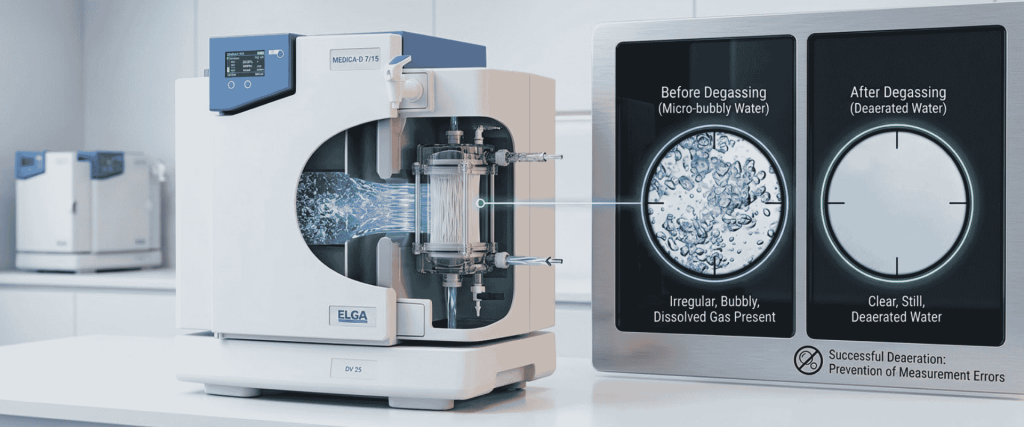
Dissolved air in water lines can spontaneously nucleate into microbubbles when subjected to temperature shifts or pressure drops inside an analyzer.
If your analyzer manufacturer explicitly specifies a dissolved oxygen limit or if your instrument lacks an internal degasser, the MEDICA-D 7/15 is mandatory.
Both the R and D configurations are available in two production capacities.
Both models support an instantaneous dispense flow of up to $1.8\text{ L/min}$, utilizing their integrated reservoir to buffer peak demand regardless of the underlying hourly RO production rate.
| Specification / Feature | MEDICA-R 7 | MEDICA-R 15 | MEDICA-D 7 | MEDICA-D 15 |
| Make-Up Production Rate | $7\text{ L/hr}$ | $15\text{ L/hr}$ | $7\text{ L/hr}$ | $15\text{ L/hr}$ |
| Instantaneous Dispense Rate | Up to $1.8\text{ L/min}$ | Up to $1.8\text{ L/min}$ | Up to $1.8\text{ L/min}$ | Up to $1.8\text{ L/min}$ |
| Water Quality Standard | CLSI CLRW | CLSI CLRW | CLSI CLRW | CLSI CLRW |
| Resistivity at 25°C | $>10\text{ M}\Omega\cdot\text{cm}$ | $>10\text{ M}\Omega\cdot\text{cm}$ | $>10\text{ M}\Omega\cdot\text{cm}$ | $>10\text{ M}\Omega\cdot\text{cm}$ |
| Total Organic Carbon (TOC) | $<30\text{ ppb}$ | $<30\text{ ppb}$ | $<30\text{ ppb}$ | $<30\text{ ppb}$ |
| Bacterial Specification | $<1\text{ CFU/mL}$ | $<1\text{ CFU/mL}$ | $<1\text{ CFU/mL}$ | $<1\text{ CFU/mL}$ |
| Deaeration / Degassing Module | Not Included | Not Included | Included | Included |
| Dissolved Oxygen Reduction | None | None | Active removal | Active removal |
| Mounting Configuration | Bench / Wall / Under-bench | Bench / Wall / Under-bench | Bench / Wall / Under-bench | Bench / Wall / Under-bench |
| Primary Target Application | Standard single analyzers | Higher-demand single analyzers | Analyzers requiring deaerated feed | High-volume deaerated feed |
Selecting between the MEDICA-R and MEDICA-D comes down to two clear technical parameters.
Maintaining continuous CLRW compliance requires routine consumable replacement and periodic loop sanitization.
Reliable diagnostic performance depends on feed water that consistently meets CLRW standards while protecting analyzer fluidics from optical drift and volumetric errors.
Select the MEDICA-D if your assays require active dissolved gas removal to eliminate microbubbles, or deploy the MEDICA-R for standard, robust clinical chemistry workflows.
Aligning this choice with the appropriate 7 or 15 L/hr make-up rate ensures seamless operation during peak morning workloads.
Investing in the right purification pathway safeguards analyzer uptime, reduces consumable waste, and ensures absolute precision in patient reporting.
R stands for Recirculating, indicating continuous water movement through the purification loop to maintain purity. D stands for Deaeration, indicating that the unit includes an integrated gas-transfer membrane to remove dissolved gases.
The MEDICA-R and D 7/15 are engineered specifically as point-of-use units for a single low-to-medium throughput clinical analyzer. Connecting multiple instruments can exceed the make-up capacity and reservoir volume, risking feed starvation.
Without deaeration, dissolved gases in the feed water can form microbubbles in the analyzer’s fluidic lines and measurement cuvettes. This frequently leads to optical scatter in photometric tests, inaccurate sample pipetting, and unstable electrolyte readings.
Upgrading requires installing the internal deaeration module, associated vacuum routing, and control adjustments. Because of the compact chassis layout, it is standard practice to specify the MEDICA-D at the time of purchase if deaeration is required.

Enter your details below to save your shopping cart for later. And, who knows, maybe we will even send you a sweet discount code :)
Allow notifications to get real-time updates about your shopping cart and who knows, you may even receive a sweet discount code 😊
