
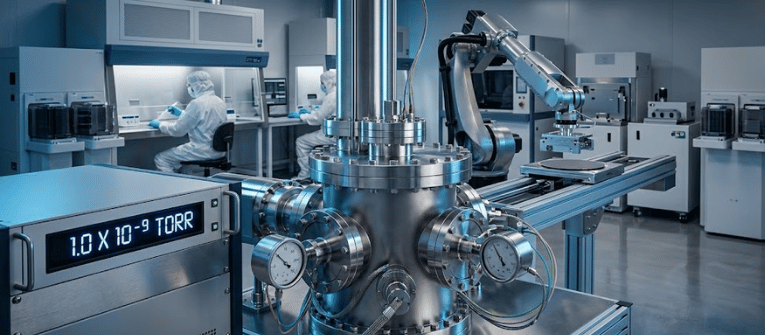
Cleanroom lab with technicians in protective suits operating high‑vacuum equipment and a robotic arm handling semiconductor wafers

Precision Calibration for Ultra-High Vacuum Pressure Monitoring Tools

In the demanding world of thin-film deposition, semiconductor fabrication, and high-energy physics, the difference between a successful batch and a total system failure often lies in the vacuum.

Ultra-High Vacuum (UHV) environments defined by pressures lower than $10^{-7}$ Pascal or $10^{-9}$ Torr require more than just high-end sensors; they require absolute measurement certainty.

Precision calibration is the only way to ensure that your UHV pressure monitoring tools are providing a true reflection of the environment, rather than a drifted estimate.

Why Calibration is Critical in UHV Environments

In a standard vacuum, a small margin of error might be negligible. In UHV, even a minor drift in an Ionization Gauge.
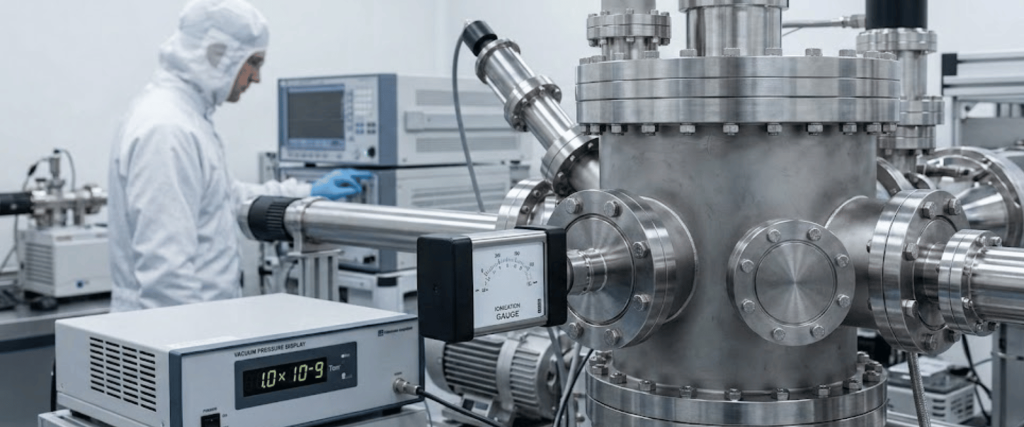
Technician in cleanroom suit operating vacuum instrumentation beside large stainless-steel scientific vacuum chamber and gauges
  • Sensor Longevity: Regular calibration schedules help identify filament degradation in Bayard-Alpert gauges before they fail mid-process.
  • Contamination Risks: Improper pressure readings can lead to outgassing or backstreaming that ruins sensitive substrates.
  • Process Inconsistency: For SEO-driven industries like semiconductor manufacturing, repeatability is king. Calibration ensures every run is identical.

Common UHV Pressure Monitoring Instruments

Before diving into the calibration process, it is essential to understand the tools typically used in these extreme low-pressure ranges.

1) Bayard-Alpert (Hot Cathode) Ion Gauges

The workhorse of UHV monitoring. These gauges use a heated filament to ionize gas molecules. Over time, the filament’s sensitivity changes, making calibration vital.
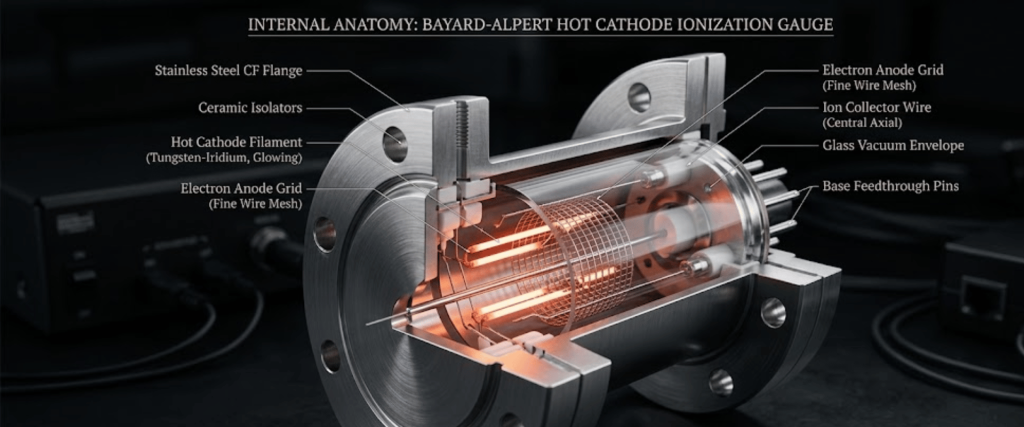
Cutaway view of a glowing Bayard-Alpert hot cathode ionization gauge with labeled parts and stainless steel flange

2) Extractor Gauges

Designed to minimize the X-ray limit that plagues standard ion gauges, these are used for the deepest UHV measurements. Their complex geometry makes precise calibration more difficult but more necessary.
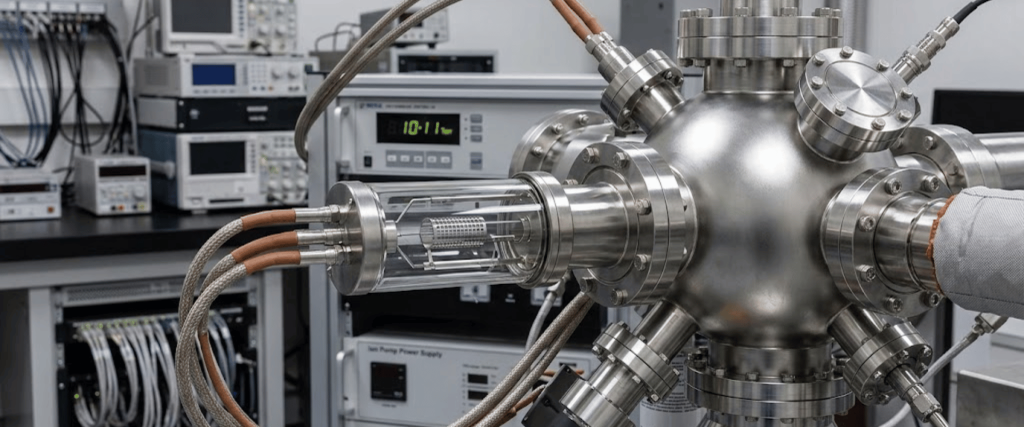
Stainless-steel vacuum chamber with multiple ports, cables, and a glass feedthrough connected to lab instruments and power supplies

3) Cold Cathode (Inverted Magnetron) Gauges

Valued for their durability and lack of a hot filament, these gauges are prone to starting delays and non-linearities at the lower end of the UHV scale.
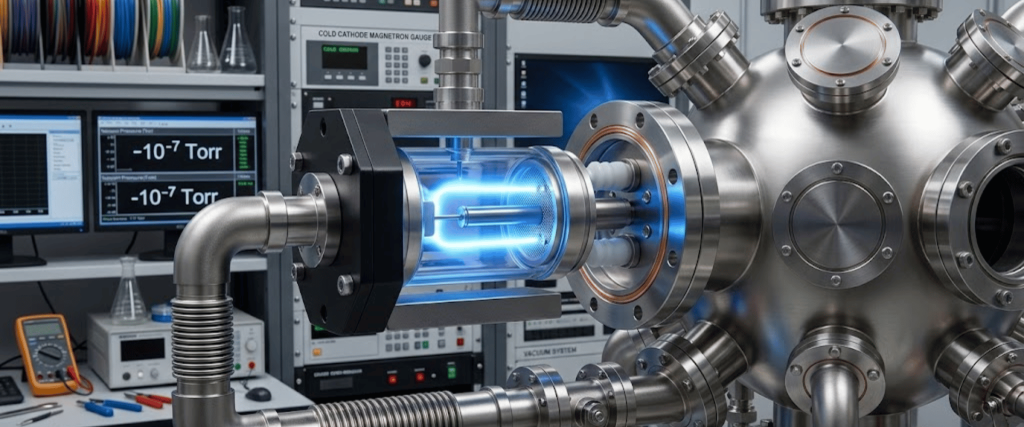
Stainless-steel vacuum chamber with connected pipes and glowing blue plasma tube module in a high-tech lab

Comparison of UHV Gauge Calibration Requirements

Gauge TypePressure Range (Torr)Typical Drift RateRecommended Calibration
Hot Cathode (B‑A)103 to 1011Moderate (Filament aging)Every 6–12 months
Extractor Gauge104 to 1012Low to ModerateEvery 12 months
Cold Cathode102 to 1010High (Electrode fouling)Every 6 months / After vent
Spinning Rotor102 to 107Very LowEvery 24 months

The Precision Calibration Process

Calibration for UHV tools is significantly more complex than standard pressure checks. It usually involves a Comparison Method or a Primary Standard Method.
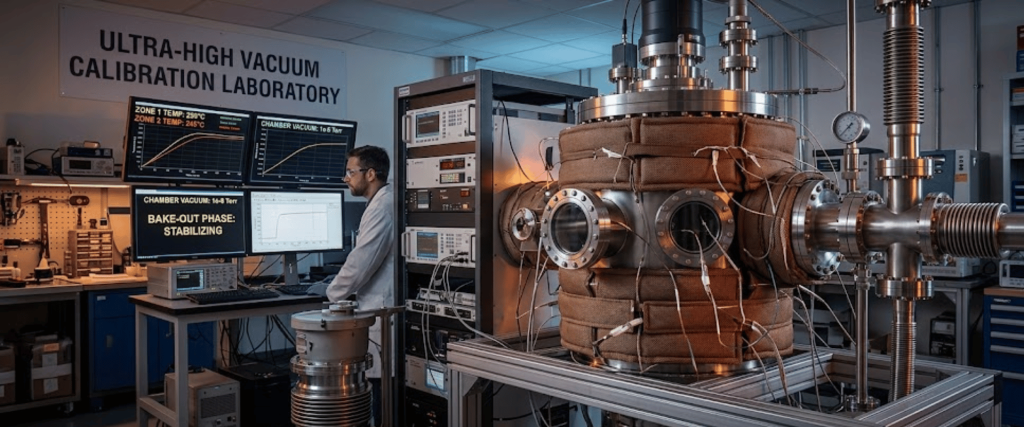
Technician monitoring vacuum calibration equipment with multiple screens, cables, and a large insulated stainless steel vacuum chamber.
  1. System Bake-out: To calibrate at UHV levels, the calibration chamber itself must be baked to remove water vapor and hydrocarbons.
  2. Reference Comparison: The tool under test (TUT) is compared against a Transfer Standard, typically a high-stability spinning rotor gauge or a specially calibrated ion gauge with a known history.
  3. Linearity Checks: Measurements are taken at multiple points across the vacuum decade (e.g., from $10^{-6}$ down to $10^{-10}$ Torr) to ensure the gauge response is linear.
  4. Gas Sensitivity Adjustments: Since UHV gauges are gas-species dependent, calibration is usually performed with Nitrogen ($N_2$) or Argon ($Ar$), and correction factors are applied.

Benefits of NIST-Traceable Calibration

Choosing a calibration service that adheres to NIST-traceable standards (or equivalent international standards like ISO/IEC 17025) provides a paper trail for quality compliance.
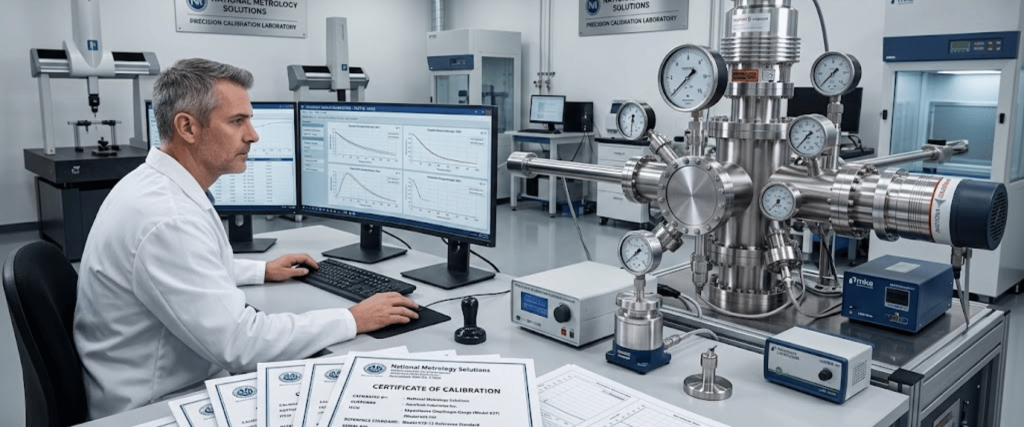
Lab technician in white coat analyzing calibration data on dual monitors beside precision vacuum instrumentation and certification reports
  • Aerospace Applications: Where components must survive the vacuum of space.
  • Pharmaceutical Freeze-Drying: Ensuring vacuum integrity for sterile processing.
  • Quantum Research: Where even a few stray molecules can decohere a quantum state.

Best Practices for Maintaining Vacuum Integrity

  • Avoid Over-Exposure: Don’t power on UHV gauges at high pressures (above $10^{-3}$ Torr) as this accelerates filament oxidation and sensor drift.
  • Monitor Emission Current: A sudden change in the emission current required to maintain a reading is a primary indicator that your gauge needs recalibration.
  • Handle with Care: UHV sensors are precision instruments. Touching the vacuum-side flange with bare hands can introduce skin oils that make reaching UHV pressures impossible.

Conclusion

In the realm of Ultra-High Vacuum (UHV) technology, there is no room for approximation. Precision calibration is the bridge between a theoretical measurement and an empirical fact.

By implementing a rigorous calibration schedule for your monitoring tools, you protect your equipment from premature failure, ensure the repeatability of complex processes, and maintain the high standards required for cutting-edge scientific research.

Ultimately, investing in professional, NIST-traceable calibration is an investment in the reliability of your data.

Whether you are working in semiconductor fabrication or aerospace testing, accurate vacuum monitoring is the foundation of your success.

Frequently Asked Questions (FAQs)

1. How often should UHV pressure monitoring tools be calibrated?

Most industry standards recommend calibrating UHV gauges every 6 to 12 months. However, if the vacuum system is frequently vented to atmosphere or used in dirty processes that cause electrode fouling, more frequent calibration may be necessary to maintain accuracy.

2. Can I calibrate Ultra-High Vacuum gauges in-house?

While basic zero-point checks can be performed, true precision calibration requires a specialized primary standard system or a comparison chamber capable of reaching $10^{-10}$ Torr. Because UHV environments are extremely sensitive to outgassing, professional laboratory calibration is highly recommended.

3. What are the main signs that a UHV sensor is drifting?

Common indicators include inconsistent base pressure readings after a standard bake-out, sudden fluctuations in emission current, or a lack of response when the vacuum environment changes. If your gauge shows a false vacuum (reading lower than physically possible for your pumps), it is a clear sign that recalibration is overdue.

Leave a Reply

Your email address will not be published. Required fields are marked *

Related Posts

About Applied Physics USA

Since 1992, Applied Physics Corporation has been a leading global provider of precision contamination control and metrology standards. We specialize in airflow visualization, particle size standards, and cleanroom decontamination solutions for critical environments.

Trending Articles