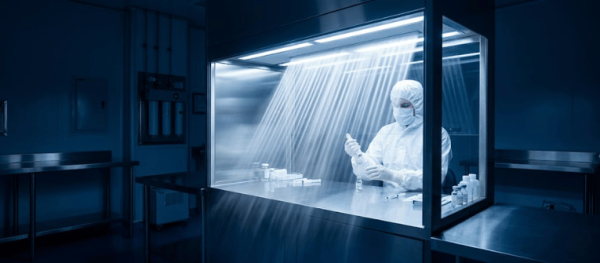
The best alternatives to Concept Smoke for high-precision,
neutral-output cleanroom fogging are DI/WFI water ultrasonic cleanroom
foggers and LN₂ ultrapure foggers that produce visible airflow without
glycol, oil, or unnecessary residue. For Applied Physics customers, that
typically means the CRF Series for portable DI/WFI water fogging and the
AP Series for high-volume LN₂ ultrapure fogging.
Concept Smoke is a known manufacturer in industrial and cleanroom
smoke generation, including water-based and LN₂ options. But buyers
should not evaluate cleanroom foggers by brand recognition alone. The
correct question is: which fogging method produces the visibility,
output control, purity, runtime, and documentation quality needed for
the facility’s airflow study?
Neutral-output cleanroom fogging means the fog should make the
airflow visible without materially changing the airflow pattern. That
requires control over:
A fogger can produce clean fog and still be a poor fit if the output
blasts into the test area. A fogger can produce a beautiful plume and
still be wrong if it leaves residue or coats filters. Precision
cleanroom fogging is not just about fog purity. It is about fog
behavior.
Ultrasonic cleanroom foggers use high-frequency transducers to
convert DI water, sterile water, or WFI water into visible fog. They are
often practical for pharmaceutical cleanrooms, compounding pharmacies,
glove boxes, BSCs, barrier isolators, RABS, fume hoods, and
semiconductor cleanrooms where chemical smoke fluids are not
desired.
Applied Physics CRF Series foggers are designed for this category.
The CRF3
Cleanroom Fogger is well suited for small to medium controlled
airflow studies. The CRF6
Cleanroom Fogger provides higher output, dual 80 mm fog outlets,
adjustable fog control, and remote operation for larger or more
demanding studies.
DI/WFI ultrasonic foggers are often the right answer when the
customer wants:
The tradeoff is that ultrasonic foggers generally do not produce the
same dense, long-distance fog volume as large LN₂ systems. For
room-scale validation, long visual travel, or large cleanroom airflow
mapping, LN₂ may be stronger.
LN₂ ultrapure foggers use liquid nitrogen and DI/WFI water to
generate dense, highly visible fog. This is usually the stronger
category when the facility needs high fog volume, long visual distance,
low residue concern, and clear video documentation in larger areas.
Applied Physics AP Series foggers are designed for this category. The
AP30
Ultrapure Cleanroom Fogger is a portable LN₂ option for
high-precision airflow visualization. The AP100
Ultrapure Fogger and AP200
Ultrapure Fogger support larger cleanroom areas where high fog
volume and longer runtime are needed.
LN₂ foggers are often the right answer when the customer wants:
The tradeoff is operational complexity. LN₂ requires safe handling,
planning, supply availability, and trained users. For small glove boxes
or simple hood studies, LN₂ may be more than the job requires.
Other suppliers offer water-based cleanroom foggers, and some may be
appropriate depending on the application. The buyer should compare them
on measurable performance, not brochure language.
Ask:
If a supplier cannot give performance numbers, be careful. Airflow
visualization is an engineering task. “It makes smoke” is not
enough.
Aerosol smoke generators can be useful in some industrial
applications, HEPA leak testing, duct visualization, or non-sterile
environments. But they are not automatically appropriate for sterile or
ultra-clean areas. If a smoke source uses oil, glycol, mineral oil, or
other chemical smoke fluids, the facility must evaluate residue, filter
loading, material compatibility, cleaning burden, and compliance
risk.
Aerosol smoke is not “bad.” It is just not the same category as
DI/WFI water fog or LN₂ ultrapure fog. The tool has to match the
cleanroom risk.
Concept Smoke offers recognized smoke and fog systems, including
cleanroom-related products. Applied Physics should not position itself
as a generic copy. The stronger positioning is:
This is a stronger argument than simply saying “we are better.”
Critical manufacturing buyers do not want hype. They want measurable
suitability.
| Use case | Best-fit fogging direction |
|---|---|
| Small hood or glove box | CRF2 or CRF3 DI/WFI ultrasonic fogger |
| Medium isolator, RABS, BSC, or room study | CRF6 adjustable dual-output fogger |
| Large cleanroom airflow mapping | AP100 or AP200 LN₂ ultrapure fogger |
| High-purity smoke study with strong visibility | AP30 or larger AP Series LN₂ fogger |
| No LN₂ available | CRF Series ultrasonic fogger |
| Strong video documentation required | Higher-density fog plus contrast lighting |
| Chemical smoke not acceptable | DI/WFI water or LN₂ ultrapure fog |
The best alternative to Concept Smoke depends on the job. If the
facility needs portable, controlled, residue-conscious fogging without
LN₂, Applied Physics CRF Series foggers are strong candidates. If the
facility needs high-volume ultrapure fog for larger cleanrooms, AP
Series LN₂ foggers are the stronger direction.
The buyer should not choose based on brand alone. Choose based on fog
purity, output control, runtime, accessories, documentation quality, and
whether the fogger reveals airflow without contaminating or disturbing
the cleanroom.
Compare the CRF6
Cleanroom Fogger, AP30
Ultrapure Cleanroom Fogger, AP100
Ultrapure Fogger, and AP200
Ultrapure Fogger to select the right Concept Smoke alternative for
your cleanroom validation program.
Since 1992, Applied Physics Corporation has been a leading global provider of precision contamination control and metrology standards. We specialize in airflow visualization, particle size standards, and cleanroom decontamination solutions for critical environments.