As the global race for quantum supremacy intensifies, the focus has shifted from theoretical algorithms to the physical reality of the laboratory.
Quantum computers are among the most sensitive instruments ever engineered. Unlike traditional silicon-based processors, quantum processors operate on the edge of physical stability.
In these environments, even a microscopic particle or a slight turbulence in airflow can lead to catastrophic system failure.
This makes advanced contamination control the silent backbone of successful quantum research.
Why Quantum Computing Demands Absolute Purity
To understand the need for contamination control, one must understand decoherence. Quantum bits, or qubits, exist in a state of superposition. This state is incredibly fragile.
Environmental noise, including physical particulates, electromagnetic interference, and thermal fluctuations, can cause a qubit to lose its quantum state, leading to calculation errors.
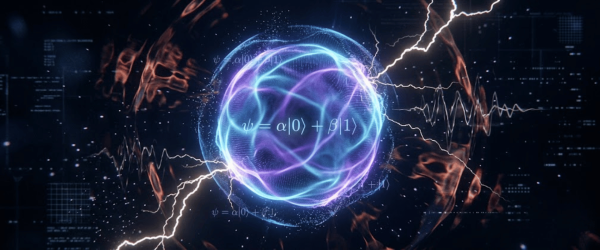
While much of the focus in quantum computing is on cryogenic cooling, the environment surrounding the dilution refrigerators is equally critical.
Particulate Interference in Superconducting Circuits
Many quantum computers utilize superconducting circuits fabricated via lithography. Much like traditional semiconductor manufacturing, a single sub-micron particle during the fabrication or assembly phase can create a killer defect.
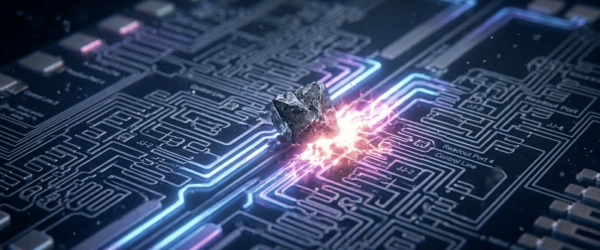
In quantum systems, these defects don’t just break a circuit; they introduce localized heat and magnetic noise that disrupts the entire processor’s performance.
Airborne Molecular Contamination (AMC)
Beyond visible dust, Airborne Molecular Contamination (AMC) poses a significant threat. Trace organic vapors or moisture can adsorb onto the surfaces of quantum components.
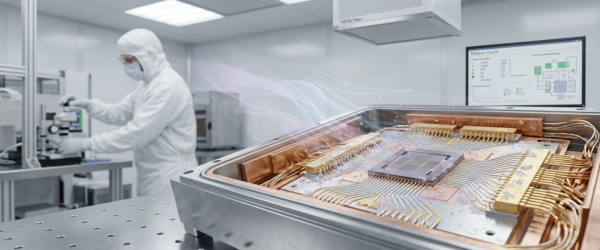
For labs working with trapped-ion or neutral-atom qubits, these molecules can interfere with vacuum integrity or laser cooling paths, directly impacting the fidelity of quantum gates.
Airflow Visualization: Ensuring a Stable Environment
In a quantum research lab, maintaining a steady, laminar airflow is vital for temperature regulation and particle removal.
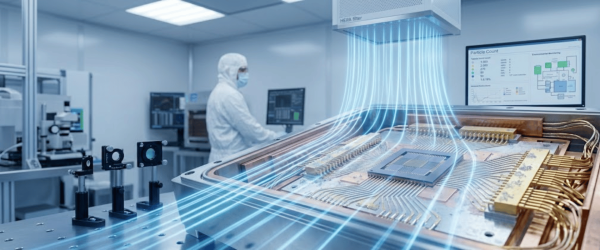
However, traditional HVAC systems often create dead zones or turbulent eddies where contaminants can settle.
The Importance of Smoke Studies in Quantum Labs
To validate that a cleanroom is performing as designed, engineers must conduct airflow visualization, commonly known as smoke studies.
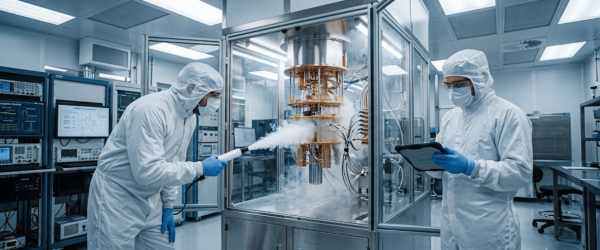
By using ultrapure cleanroom foggers, technicians.
- Identify Turbulence: See exactly where air is swirling around sensitive equipment.
- Verify Laminar Flow: Ensure that the first air reaching the quantum hardware is free of contaminants.
- Validate Pressure Differentials: Confirm that the lab remains a pressurized sanctuary against the outside environment.
Using high-purity foggers (utilizing LN2 and DI water) is essential here, as lower-quality foggers can introduce their own contaminants into the very environment they are meant to test.
ISO Standards and Regulatory Compliance
Quantum computing labs typically operate under ISO 14644-1 standards, often requiring Class 10 (ISO 4) or Class 100 (ISO 5) environments.
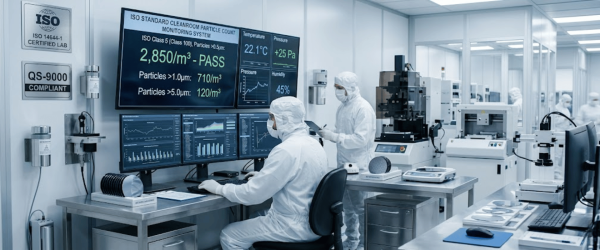
Meeting these standards is not a set it and forget it process.
Compliance involves
- Continuous Particle Monitoring: Using high-sensitivity particle counters to detect spikes in real-time.
- Regular Validation (ISO 14644-3): Periodic testing of airflow velocity and filter integrity.
- Decontamination Protocols: Implementing dry fogging sterilization to eliminate microbial and molecular threats without leaving residues that could damage sensitive optics or cryogenics.
The Synergy Between Metrology and Quantum Reliability
The tools used to monitor cleanrooms are the same tools that ensure quantum hardware reliability. Calibration standards, such as PSL (Polystyrene Latex) spheres and silica wafer standards, allow labs to calibrate their inspection tools to the highest level of NIST-traceable accuracy.
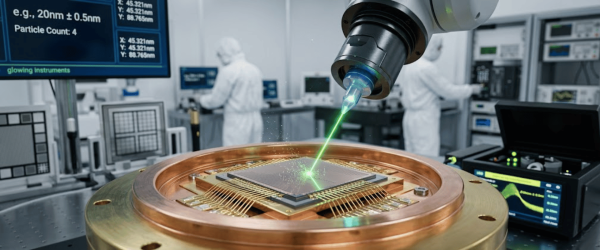
In a field where good enough results in 0% computational success, the ability to measure and control particles at the nanometer scale is the difference between a breakthrough and a failed experiment.
Conclusion
The transition from experimental quantum labs to scalable quantum data centers will depend heavily on our ability to control the environment. Advanced contamination control is no longer a peripheral concern; it is a fundamental requirement for quantum hardware.
By implementing rigorous airflow visualization, adhering to strict ISO standards, and utilizing the latest in metrology and fogging technology, research institutions can minimize decoherence and accelerate the path toward the first fault-tolerant quantum computer.
Frequently Asked Questions (FAQs)
1. Why is contamination control critical for quantum qubits?
Quantum bits (qubits) are incredibly fragile. Even a microscopic dust particle or trace molecular vapor can cause decoherence, leading to calculation errors. Advanced contamination control minimizes these environmental interferences to maintain system stability and data integrity.
2. What ISO standards apply to quantum computing labs?
Quantum research facilities typically adhere to ISO 14644-1 standards, often maintaining Class 10 (ISO 4) or Class 100 (ISO 5) environments. This ensures that the concentration of airborne particles is strictly controlled to protect sensitive superconducting circuits from defects.
3. How do smoke studies benefit quantum research environments?
Smoke studies, or airflow visualization, allow engineers to see exactly how air flows around delicate quantum hardware. By identifying turbulent zones or dead air using ultrapure foggers, labs can optimize their ventilation to prevent both heat buildup and particle accumulation.
4. Why are ultrapure foggers preferred over standard ones?
Standard foggers can leave behind chemical residues that damage sensitive quantum optics or cryogenics. Ultrapure foggers, which use liquid nitrogen (LN2) and deionized water, provide a high-density fog that is completely residue-free, ensuring the lab remains sterile during and after testing.