
In pharmaceutical manufacturing, biotechnology, and semiconductor fabrication, the integrity of high-purity water (HPW) and water-for-injection (WFI) is paramount.
One of the most persistent threats to these systems is biofilm formation.
Unlike planktonic (free-floating) bacteria, biofilms are complex, sessile communities of microorganisms that adhere to surfaces, creating a self-protecting matrix that is notoriously difficult to eradicate.
The Biofilm Challenge in Pure Water Environments
It is a common misconception that ultrapure water systems, which are devoid of most nutrients, cannot support microbial life. In reality, many microorganisms are oligotrophs, capable of surviving and even thriving in low-nutrient environments.
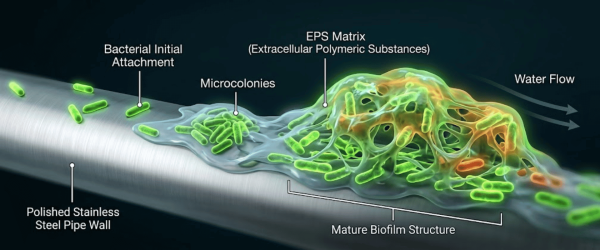
Once a single cell adheres to the internal surface of a pipe or storage tank, it begins to produce extracellular polymeric substances (EPS). This slime layer protects the colony from chemical sanitants and shear forces, leading to a resilient contamination source within the water loop.
Key Risks of Biofilm Accumulation
The presence of biofilm in a pure water system is not merely a biological issue; it poses significant operational and regulatory risks.
- Product Contamination: Biofilms can periodically shed bacteria and endotoxins into the water stream, leading to batch failures and compromised product safety.
- Endotoxin Proliferation: Even if bacteria are killed during sanitization, their remains (lipopolysaccharides) can linger as pyrogens, which are critical to exclude from injectable grade water.
- Flow Resistance and Corrosion: Thick biofilms can increase friction within piping, reducing flow rates. In metal systems, they can facilitate microbiologically influenced corrosion (MIC), leading to pinhole leaks.
- Inaccurate Monitoring: Biofilms often hide in dead-end areas of stagnant water where sensors and sampling ports may not accurately reflect the level of contamination.
Preventative Design and Maintenance Strategies
Preventing biofilm requires a multi-faceted approach involving system design, material selection, and rigorous maintenance protocols.
1) Optimal System Design
The physical layout of the water loop is the first line of defense.
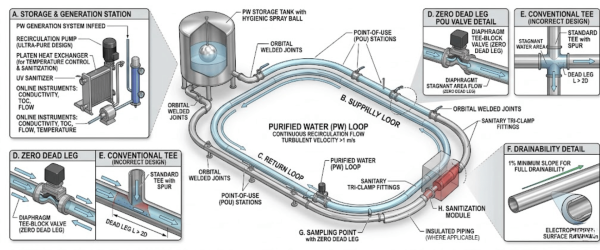
- Eliminate Dead Legs: According to the 316L Rule, any branch or T-junction should have a length no greater than two times the pipe diameter to ensure constant water movement.
- Surface Finish: Utilizing high-grade materials like 316L stainless steel with electropolished finishes (often measured at Ra < 0.5 µm) reduces the microscopic pits where bacteria can anchor.
2) Hydraulic Shear and Turbulence
Maintaining a constant velocity is essential. Turbulent flow (typically defined by a Reynolds number > 4,000) creates shear forces that discourage bacterial attachment.
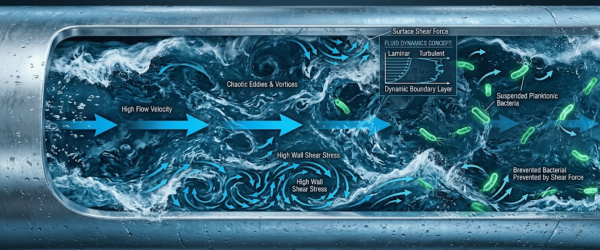
Systems should be designed to run continuously rather than using start-stop cycles, which allow for stagnation.
3) Thermal and Chemical Sanitization
Regular sanitization cycles are necessary to prevent the transition from initial attachment to a mature biofilm matrix.
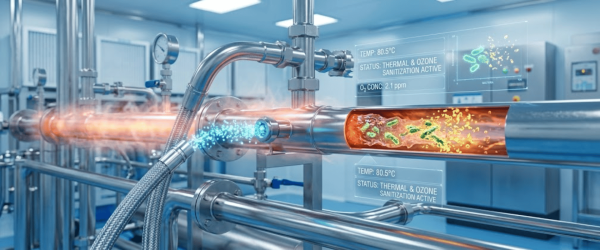
- Hot Water Sanitization: Maintaining loops at temperatures above 80°C is a highly effective method for controlling microbial growth in WFI systems.
- Ozonation: Ozone is a powerful oxidant that can be injected into the loop to kill microorganisms and break down organic matter. It must be destroyed via UV radiation before the water reaches the point of use.
Comparison of Biofilm Control and Sanitization Methods
| Method | Primary Mechanism | Best Application | Key Advantage |
|---|---|---|---|
| Thermal Sanitization | High heat (> 80 °C) denatures microbial proteins | WFI (Water for Injection) loops | No chemical residues; highly reliable |
| Ozonation | Strong oxidation breaks down cell walls and EPS | Storage tanks and distribution loops | Very powerful oxidant; reduces TOC |
| UV Radiation | DNA/RNA disruption prevents microbial replication | Point of use and ozone destruction | Continuous operation; no taste or odor impact |
| Hydraulic Shear | High‑velocity turbulent flow (Re > 4000) | Continuous loop distribution | Prevents initial bacterial attachment |
| Chemical Cleaning | Acid/alkali washing removes organic and inorganic scale | Periodic deep system cleaning | Effective against mature, stubborn biofilms |
Verification is the final component of a robust contamination control strategy.
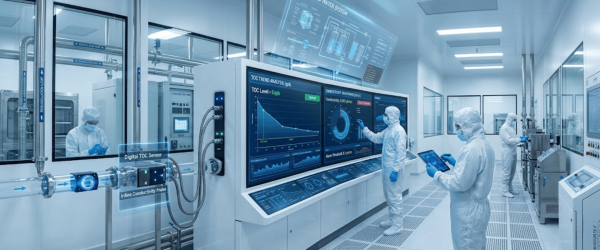
Traditional plate counts are often insufficient because they only detect planktonic bacteria that have already broken off from a biofilm.
- Total Organic Carbon (TOC) Monitoring: A sudden spike in TOC levels can indicate the breakdown or shedding of a biofilm matrix.
- Conductivity Testing: While primarily used to measure ionic purity, conductivity monitoring can provide early warnings of system degradation.
- Microbial Air Samplers and Cleanroom Validation: In the environments where these water loops operate, maintaining the surrounding air quality via ultrapure foggers and airflow visualization ensures that the points of use are not contaminated by the external environment.
Conclusion
Preventing biofilm in pure water systems is an ongoing process of vigilance.
By combining hygienic by design engineering with rigorous sanitization and advanced monitoring, facilities can ensure the consistent delivery of high-purity water that meets the stringent requirements of modern industry.
Addressing biofilm risks is not just a maintenance task; it is a fundamental requirement for process stability and consumer safety.
Frequently Asked Questions (FAQs)
1. Why do biofilms form in nutrient-poor ultrapure water systems?
Biofilms are formed by oligotrophic bacteria that are specifically adapted to survive in low-nutrient environments. Even a single microbe can adhere to a pipe surface and secrete a protective slime layer (EPS), allowing it to thrive and multiply despite the lack of traditional nutrients.
2. What is the 316L Rule in pure water system design?
The 316L Rule (or the 2-diameter rule) is a design standard used to eliminate dead legs in piping. It states that any branch or T-junction in a water loop should have a length no greater than two times its pipe diameter to ensure constant water movement and prevent stagnation.
3. Can standard UV radiation eliminate existing biofilms?
No. While UV radiation is excellent at disrupting the DNA of free-floating (planktonic) bacteria to prevent replication, it cannot penetrate the thick, protective matrix of an established biofilm attached to a surface. UV is a preventative tool, not a removal method for mature contamination.