The semiconductor industry is rapidly advancing into sub-3nm nodes and the Angstrom era. As transistor sizes shrink, the margin for error in silicon wafer manufacturing has practically vanished.
In this high-stakes fabrication environment, a particle as small as 15 nanometers (nm) can disrupt an entire circuit, causing catastrophic yield loss.
To detect these microscopic threats, Scanning Surface Inspection Systems (SSIS) must operate with absolute precision. This precision is entirely dependent on sub-20nm calibration standards.
The Escalating Threat of Killer Defects at the Sub-20nm Scale
In traditional semiconductor nodes, particles under 20nm were considered negligible background noise. Today, they are classified as killer defects. When structural features on a chip are only a few nanometers wide, a 15nm particle acts like a boulder blocking a highway, causing short circuits or open circuits.
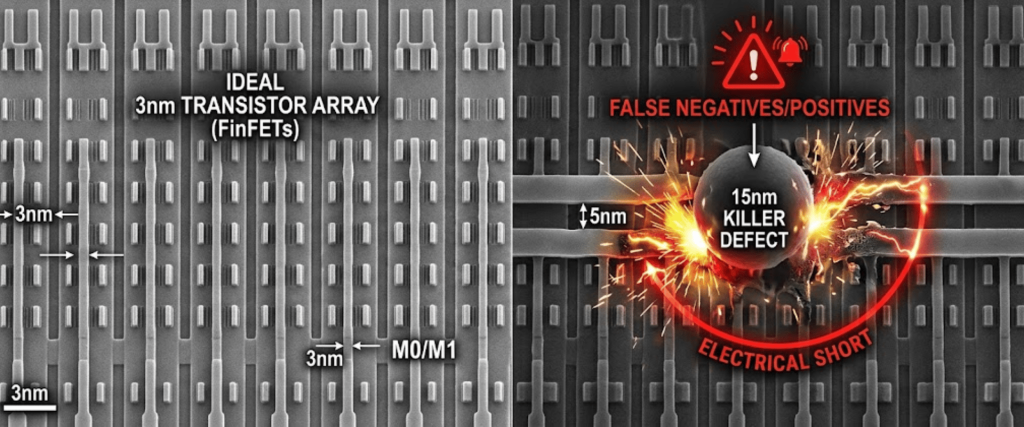
Standard inspection tools cannot reliably identify or size these micro-contaminants without exact calibration. If an SSIS tool is miscalibrated by even 1–2 nanometers, it will either miss critical defects entirely (false negatives) or flag harmless variations as threats (false positives), crippling factory throughput.
Laser Metrology Challenges in Advanced Wafer Inspection
Most high-throughput wafer inspection tools rely on light-scattering technology. When a laser hits a particle on a wafer surface, the light scatters. The inspection tool measures this scattered light to determine the particle’s size and location.
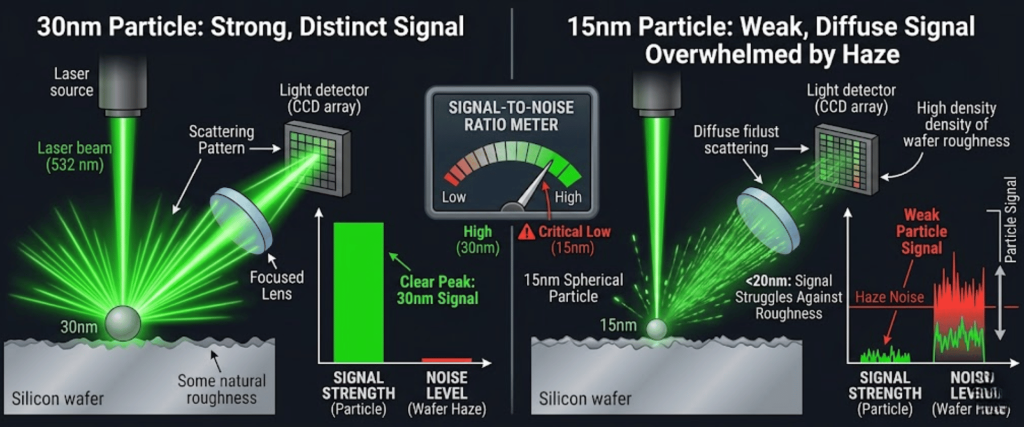
However, as particle sizes drop below 20nm, the physics changes drastically.
- The Rayleigh Scattering Phenomenon: The intensity of scattered light drops exponentially as particle size decreases. A 15nm particle scatters significantly less light than a 30nm particle, making the signal-to-noise ratio incredibly weak.
- Distinguishing Substrate Noise: At this extreme scale, the laser scanners struggle to separate the light scattered by a tiny particle from the natural surface roughness (haze) of the silicon wafer itself.
Without exact calibration using precise nanoparticles, inspection lasers cannot distinguish a true sub-20nm defect from background noise.
Polystyrene Latex (PSL) Spheres vs. Silica Microspheres
Achieving accurate calibration requires deposition standards with highly uniform particle sizes. Manufacturers primarily rely on two materials, each serving a specific role in high-precision metrology.
| Feature | Polystyrene Latex (PSL) Spheres | Silica Microspheres |
|---|---|---|
| Size Uniformity | Extremely high; monodisperse | High |
| Refractive Index | High, around 1.59; provides strong laser signals | Low, around 1.45; closely mimics real-world process particles |
| Material Stability | Vulnerable to degradation under high-intensity lasers | Highly stable under intense UV/DUV lasers |
| Primary Use Case | Baseline calibration of SSIS sizing accuracy | Real-world material simulation and laser tuning |
The Business Impact: Safeguarding Semiconductor Yields
Investing in sub-20nm calibration isn’t just about laboratory precision; it is a critical business strategy that directly impacts profitability.
- Maximizing Wafer Yield: Accurate calibration ensures that inspection tools catch defects early in the lithography cycle, preventing the processing of flawed wafers and saving millions in lost materials.
- Accelerating Process Development: When engineering next-generation nodes, accurate metrology data helps R&D teams identify the exact source of contamination, shortening the time-to-market for new chip architectures.
- Optimizing Equipment Efficiency: Properly calibrated tools reduce false alarms, ensuring production lines run continuously without unnecessary downtime for manual inspections.
As the industry pushes the boundaries of physics, sub-20nm calibration standards remain the foundation of reliable, profitable, and flawless wafer inspection.
Conclusion
As the semiconductor industry pushes past traditional physical limits into the sub-3nm and Angstrom eras, managing microscopic contamination is no longer optional; it is a survival requirement for fabrication yields.
Sub-20nm calibration standards provide the foundational accuracy that Scanning Surface Inspection Systems (SSIS) need to isolate killer defects from background substrate noise.
By implementing a strict, monodisperse aerosol deposition protocol, manufacturers can confidently tune their laser metrology tools, eliminate costly false alarms, and safeguard their production profitability.
Frequently Asked Questions (FAQs)
1. Why are sub-20nm particles called killer defects?
At advanced manufacturing nodes, transistor features are incredibly tiny. A particle as small as 15nm is large enough to bridge gaps between circuits, causing immediate short circuits or electrical failures that ruin the entire wafer yield.
2. What is the main challenge when inspecting sub-20nm particles?
The primary challenge is physics. Due to Rayleigh scattering, particles under 20nm scatter very little light. Laser scanners struggle to distinguish this weak signal from the natural surface roughness (haze) of the silicon wafer.
3. Why must the PSL stock solution be highly diluted?
If the solution is too concentrated, multiple nanospheres will escape the atomizer nozzle inside a single water droplet. As the water evaporates, these spheres clump together, forming large doublets or triplets rather than a clean single-particle calibration standard.
4. Should I use PSL spheres or Silica microspheres for calibration?
Use PSL spheres for baseline sizing calibration because they offer extreme size uniformity and strong light scattering. Use Silica microspheres if you are using high-intensity UV/DUV lasers, as silica resists laser degradation better than plastic PSL.