
Unlike standard laboratory supplies, unboxing a NIST-traceable particle standard is a high-stakes procedure where a single speck of ambient dust can instantly ruin a critical calibration baseline.
The moment you break the shipping seal, sensitive PSL spheres face immediate risks from static aggregation, thermal shock, and cleanroom cross-contamination.
Safeguarding your data accuracy requires a strict, controlled transition protocol from the shipping box directly to your laminar flow hood.
This guide provides the exact tactical steps to execute a flawless, zero-contamination unboxing process.
Pre-Unboxing Environment and Preparation
Before opening the shipping container, you must prepare the environment to prevent particulate contamination from interfering with the standard.
Cleanroom Standards
Unbox and handle particle standards in an ISO Class 5 (Class 100) cleanroom environment or under a laminar flow hood.
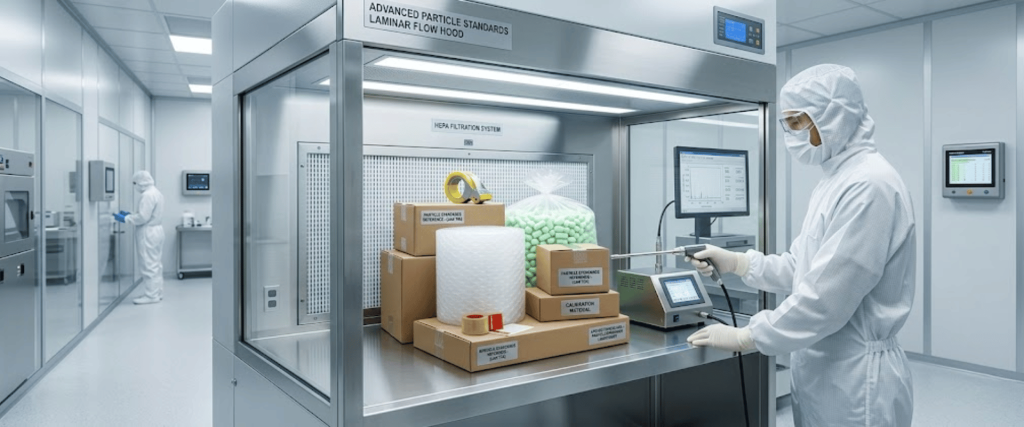
Personnel Protection Equipment (PPE)
Operators must wear powder-free nitrile gloves, cleanroom garments, and face masks. Particulate shedding from human skin or standard clothing will immediately contaminate the suspension.
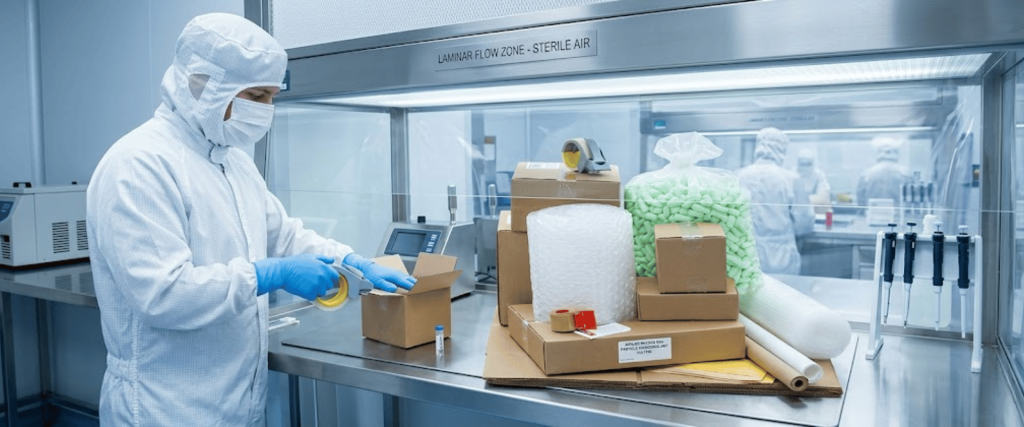
Thermal Acclimation
Particle standards are shipped with temperature controls. Before opening the insulated shipping box, allow the package to sit in the cleanroom for 2 to 4 hours to reach ambient room temperature.
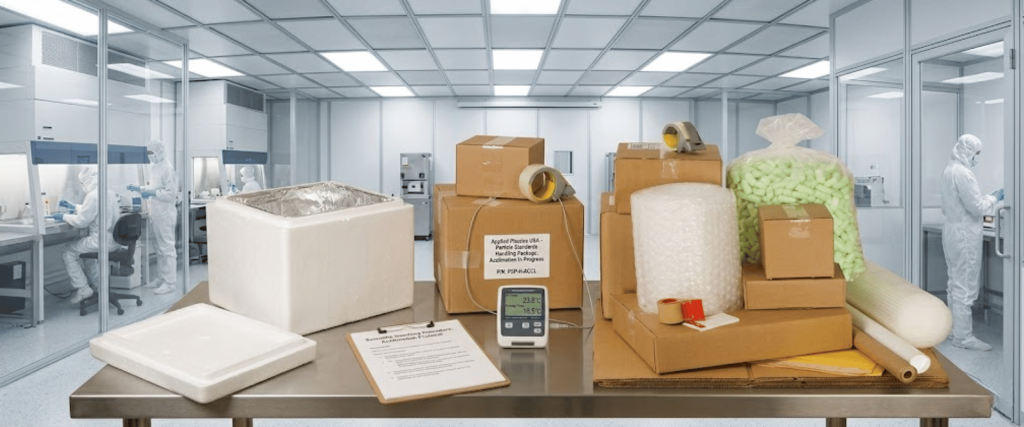
This prevents condensation from forming on the interior of the bottle, which can alter the suspension concentration.
Step-by-Step Unboxing Protocol
Exterior Disinfection
Transfer the shipping box into the gowning room or transfer hatch. Wipe down the exterior of the inner packaging with a 70% Isopropyl Alcohol (IPA) cleanroom wipe.
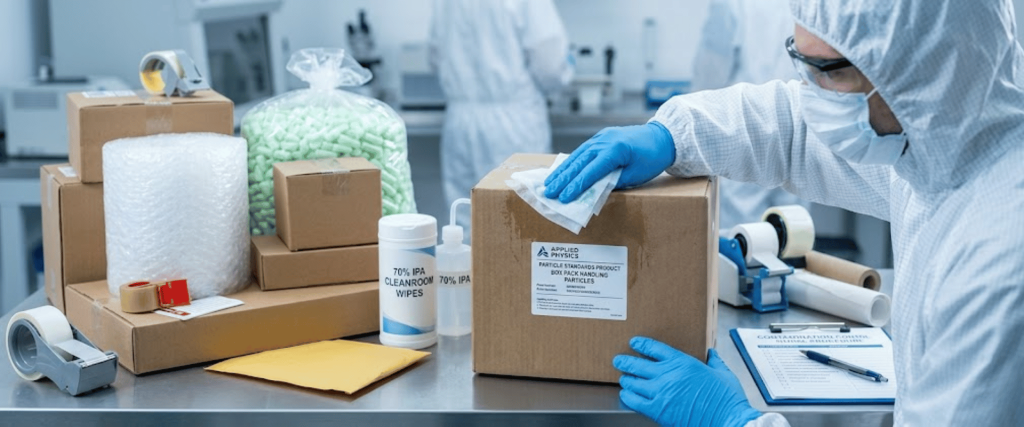
Visual Inspection
Open the inner packaging and inspect the primary bottle. Check the tamper-evident seal.
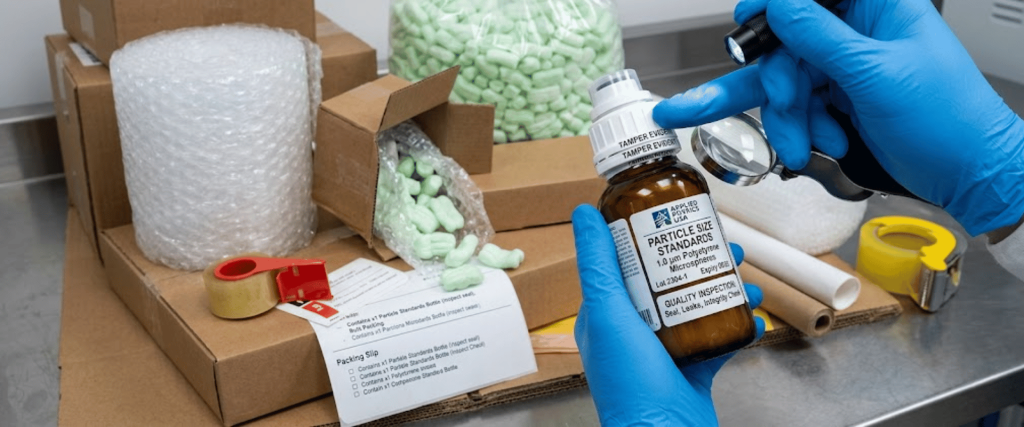
If the seal is broken or if there is visible liquid leaking around the cap, quarantine the product and contact the supplier.
Document the Certificate
Locate the NIST-traceable Certificate of Calibration included in the box.
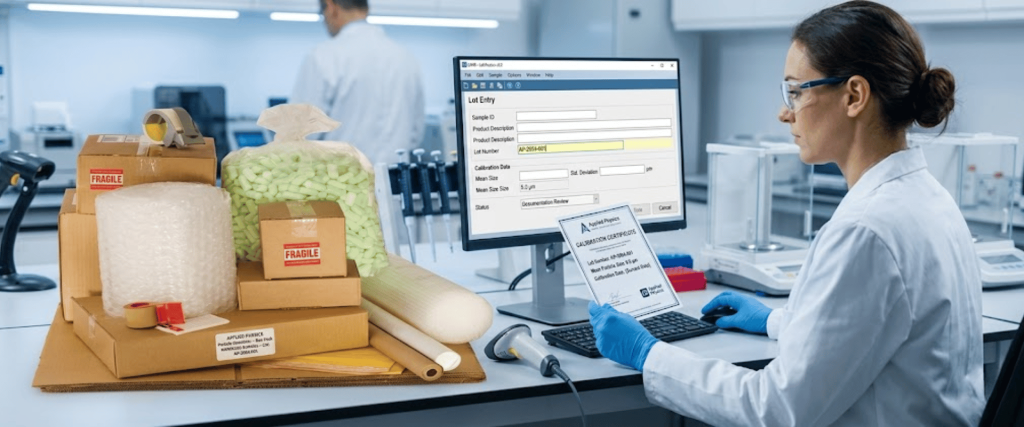
Log the lot number, mean diameter, and expiration date into your laboratory information management system (LIMS). Keep the physical certificate filed away from wet areas.
Storage Conditions and Shelf Life Management
Improper storage is the leading cause of calibration failure. Particle standards must be protected from extreme temperatures and light degradation.
| Standard Type | Optimal Storage Temperature | Light Exposure | Typical Shelf Life | Handling Restriction |
|---|---|---|---|---|
| PSL Spheres | 4°C to 15°C (Refrigerated) | Keep away from direct UV/Sunlight | 12 to 24 months | Do not freeze |
| Silica Nanoparticles | 15°C to 25°C (Room Temperature) | Store in dark cabinets | 24 months | Avoid high humidity |
| Wafer Standards | 15°C to 25°C (Room Temperature) | Store in the original wafer carrier | 12 months | Handle only by edges |
Safe Handling and Dispersion Best Practices
During storage and transit, PSL spheres and silica nanoparticles will naturally settle at the bottom of the bottle due to gravity. You must redisperse the particles evenly before extracting a sample.
The Dispersion Process
- Manual Inversion: Gently invert the bottle 5 to 10 times. Do not shake the bottle aggressively. Vigorous shaking introduces micro-bubbles into the liquid, which laser particle counters will incorrectly register as particles.
- Ultrasonic Bath (If Required): If the particles have agglomerated (clumped), place the bottle in a low-power ultrasonic bath for 10 to 30 seconds. Do not exceed 30 seconds. Prolonged exposure to ultrasonic waves will degrade the polymer structure of PSL spheres, permanently altering their certified size.
Sample Extraction
- Never insert pipettes, syringes, or any foreign object directly into the primary stock bottle. Doing so risks bacterial or particulate contamination of the entire batch.
- Instead, pour the required volume into a sterile, pre-cleaned secondary beaker or sample vial.
- Immediately recap the primary stock bottle tightly to prevent solvent evaporation.
Conclusion
Maintaining the accuracy of particle standards requires strict adherence to environmental controls and handling protocols.
By acclimating the product to room temperature, avoiding aggressive agitation, and preventing cross-contamination during extraction, technicians can ensure that their calibration data remains precise and NIST-traceable.
Always return the stock bottles to their designated temperature-controlled storage immediately after use to maximize the product’s functional shelf life.
Frequently Asked Questions (FAQs)
1. What happens if I accidentally freeze my PSL particle standards?
Freezing causes the water in the suspension to form ice crystals, which mechanically crush and rupture the polystyrene latex spheres. The standard will lose its calibrated size distribution and must be replaced immediately.
2. Why is my particle counter registering sizes larger than the standard?
This usually indicates agglomeration, where two or more spheres have stuck together due to static charge or inadequate dispersion. Gently invert the bottle or use a short 10-second ultrasonic bath to separate the particles before re-testing.
3. Can I use standard tap water or distilled water to dilute the suspension?
No. You must only use ultra-pure Deionized (DI) water or Water for Injection (WFI). Standard distilled water contains trace minerals and background particulates that will interfere with the baseline readings of your metrology equipment.
4. How often should I replace my particle standards?
Liquid suspension standards should be replaced when they reach the expiration date listed on the Certificate of Calibration (typically 12 to 24 months from the date of manufacture), or immediately if the primary bottle becomes contaminated.